
Lihat juga


 06.10.2026 08:41 AM
The dollar eased slightly after yesterday's US data but remained strong, which did little for the euro or the pound. The euro enters Tuesday after Monday's fall to the lowest level since May 2025, while the pound holds up more evenly but without much enthusiasm. Buyers of both pairs remain cautious, and initiative still sits with those who trade the dollar's safe-haven properties.
Yesterday Europe got a helpful PMI detail by sector. In September output rose in 16 of 19 sectors — the broadest rise since spring 2023 — and new orders rose in 15 sectors, a breadth not seen since April 2022. That slice is useful because it shows whether weakness is hidden in specific links; right now the links look more resilient. Tech-equipment manufacturing is growing fastest, and ten sectors added jobs, meaning demand is real. That hardly helped the euro. The indicator covers more than one eurozone country, so you can't count it as entirely euro-positive. Moreover, costs rose across all sectors and faster than average. For companies, that is a burden, and for European Central Bank hawks it's another argument to tighten; the market still expects more tightening. But politics drowns out any economics. While Paris and Madrid worry investors and French yields trade with a large spread over German bunds, good figures serve as background rather than a buying trigger.
For the pound the final UK services PMI was revised up to 52.1 from 51.7 (short of August's 52.5). That is a decent result for the sector that makes up most of GDP. The internals are weaker: new orders barely grow, external demand has fallen for seven months, and employment has been declining for two years. Prices, however, accelerated sharply. Company input costs rose fastest since June and output prices fastest since May, driven by expensive fuel and the Middle East conflict. For the Bank of England, this is an unwelcome reminder of inflation, especially since three MPC members (Pill, Green and Mann) pressed for immediate tightening in July. The pound gets some support, but it is fragile. Chancellor Hunt won't rule out measures ahead of the autumn budget, which keeps markets on edge.
The main surprise came last night from the US. The ISM services index — the principal gauge of the largest US sector — eased to 54.9, but the headline is not the key: the prices-paid component jumped to 74, the highest since summer 2022, driven by expensive fuel and freight. New orders remain high, and the employment index rose above 50 for the first time since June, signaling renewed hiring. In short, demand in US services holds while prices accelerate — an uncomfortable mix for the Federal Reserve because it gives hawks a fresh argument. For EUR and GBP pairs, this means one thing: the dollar regained some of the support it briefly lost after Friday's weak payrolls.
Interestingly, the common pain in the US, Europe and the UK is price growth, not demand weakness. Dollar holders win; households and firms paying for costly energy and logistics lose. I expect any dollar pullbacks in the coming sessions to be short-lived while Paris, Madrid and London remain sources of concern. Some skeptics doubt the Fed will tighten as much as markets price in and worry the dollar's rally is overdone. If they're right, the euro and the pound will have room for a more noticeable recovery.
Today the euro's calendar is surprisingly modest. In the first half of the day, German factory orders, French industrial production and eurozone retail sales for August will be released. Forecasts are mixed, so it's hard to rely on them to trigger confident upside. Orders show how much work factories have ahead, and for export-dependent Germany this is a look at tomorrow—retail answers whether people are cutting back on purchases. In July German industrial output fell, eurozone retail declined — especially sharply in Germany — and France has long run a trade deficit. A small improvement will be greeted with relief, while a notable disappointment will give extra ammunition to those who link euro weakness to the region's economic fragility. In my view, these figures matter not by themselves but in connection with policy. While French yields trade with a wide spread to German bunds, a single German or French print is unlikely to overturn sentiment, and the euro remains a dependent currency.
The pound's calendar livens up even before noon. The construction PMI will be released, and a modest rebound to 45 from August's 44.3 is expected. The 50 mark separates expansion from contraction, so this is not about a boom but whether the decline slows. Construction remains the weakest link in the UK economy: July data showed a noticeable industry drop, and social housing construction fell sharply over three months. The indicator's direct impact on GBP is limited, but a small surprise can move prices. If the PMI prints above 45, the market will see the sector stabilizing rather than collapsing, and the pound could tick up; disappointment would reinforce concerns that domestic demand is weakening faster than expected.
More interesting is the speech by BoE MPC member Catherine Mann. In July she voted with Pill and Green for immediate tightening, so her words are read as signals from the hawkish wing. A hint of readiness to raise rates would support the pound, while a dovish tone would cool demand. I expect the pair to be cautious until her remarks, and any real move — if it happens — will come after Mann speaks.
For the euro, above 1.1233 the pair has a path to 1.1259 and then to 1.1284, while below 1.1200 targets 1.1165 and 1.1133 open up. The range between those points is only 33 pips, and the euro can walk back and forth inside it in minutes, so I would skip the first touches. The upside scenario requires good German and French data and calm around Paris — I'm not very confident of that today. The downside fits better with the dollar remaining strong after ISM and politics weighing on the euro, so I'm prioritizing short positions, provided price closes below 1.1200.
For the pound, I consider long positions above 1.3227 with targets 1.3254 and 1.3279, and sells below 1.3191 with targets 1.3161 and 1.3128. The range is 36 pips. Mann's speech and rising UK service-sector prices give the pound more reasons to rise than the euro, so the upside scenario is more realistic here. But I do not expect a decisive move above 1.3254 because the budget issue persists and dollar strength will cool any rally. The downside scenario will kick in if Mann sounds dovish or the dollar resumes its attack — in that case the pound will likely follow the euro.
Today two reference levels sit almost on top of the breakout points, and that is where mistakes are easiest.
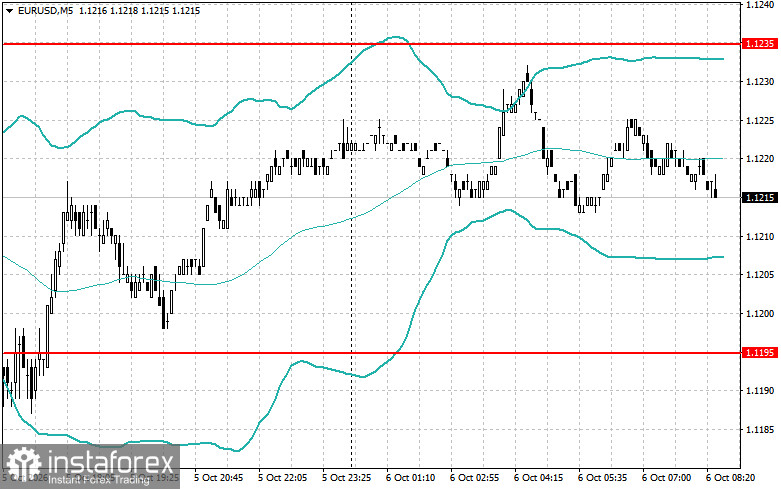
For the euro the upper reference 1.1235 is only 2 pips above the breakout point 1.1233, so they are essentially the same zone. You cannot reliably tell a real breakout from a false one on a single touch, so novices must be extra cautious. If price breaks and holds above this zone, a move to 1.1259 is underway, and selling is forbidden. If price spikes above 1.1235, fails to hold, and returns below 1.1233, I consider selling with a stop above the failed-attempt high. The lower reference, 1.1195, sits 5 pips below the breakout at 1.1200. Here I wait for a poke below 1.1195, failure to continue lower, and a return above 1.1200 — only then do I consider buy positions with a stop under the poke low. If price instead holds below 1.1195 and pushes to 1.1165, the return idea is canceled, and the downside breakout is in play. Such pulls often occur when data print close to expectations and the market retraces the initial reaction.
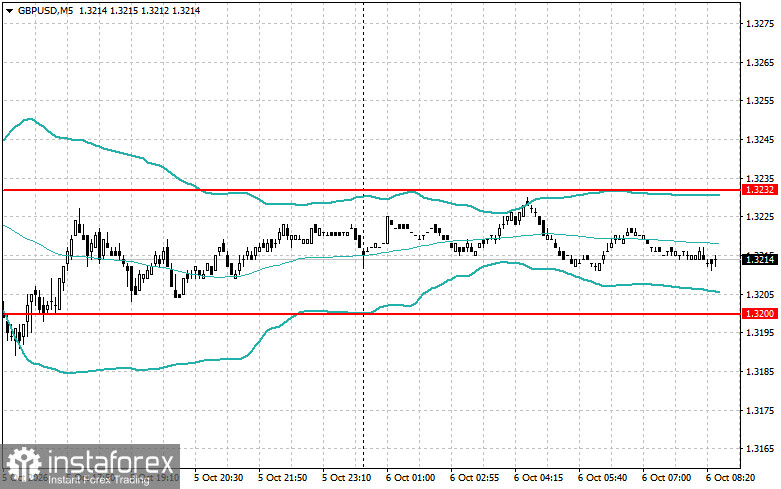
For the pound, the upper reference 1.3232 is 5 pips above the breakout 1.3227 and lies on the way to the first target 1.3254. If the pair holds convincingly above 1.3227, then 1.3232 is just a stopover and selling there is premature. If price spikes above 1.3232, fails to hold, and falls back below 1.3227, the mean-reversion sell works with a stop above the local high. The lower reference 1.3200 sits inside the range, 9 pips above the breakout 1.3191 and 27 pips below 1.3227. A poke below 1.3200 followed by a quick return above gives a buy idea, but I treat it as a short-term play, not a reversal, and place the stop under the poke low. If price calmly reaches 1.3191 and consolidates below, the return is canceled, and the downside breakout is active. This scenario is especially relevant for the pound if Mann's remarks sound neutral — the first reaction may spike one way, then a retracement could bring the pair back into the corridor.


