
यह भी देखें


 22.12.2025 08:51 AM
The test of the 157.49 price coincided with the moment when the MACD indicator was moving sharply above the zero mark, which limited the pair's upward potential. For this reason, I did not buy the dollar.
The Japanese yen fell sharply against the dollar following comments from Governor Kazuo Ueda. The politician stated that further central bank rate hikes are unlikely in the near future, which greatly weakened buyers' positions. The market reacted instantly. The dollar surged, breaking through important resistance levels, while the yen plummeted, reaching multi-month lows against the U.S. currency. Investors, who had previously hoped for a more hawkish stance from the Bank of Japan, began actively offloading yen in favor of more attractive dollar-denominated assets. Ueda's statement was a surprise to many analysts, given Japan's rising inflation. The market expected the BOJ to at least continue signaling the potential for further near-term rate hikes to curb inflation and support the yen. Now, after Ueda's comments, the outlook for the yen appears quite bleak. If the BOJ does not change its stance, the yen may continue to weaken, which could lead to further inflation increases due to rising import costs. This will add additional pressure on the Japanese economy, which is already facing difficulties.
In terms of intraday strategy, I will rely more on implementing Scenarios #1 and #2.
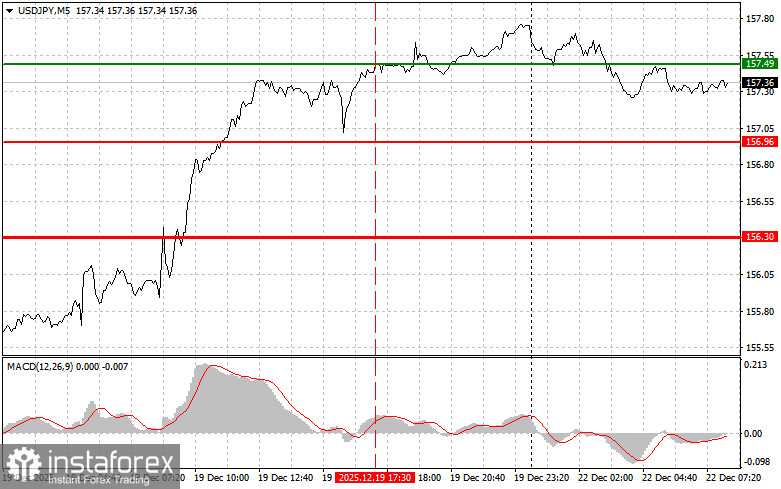
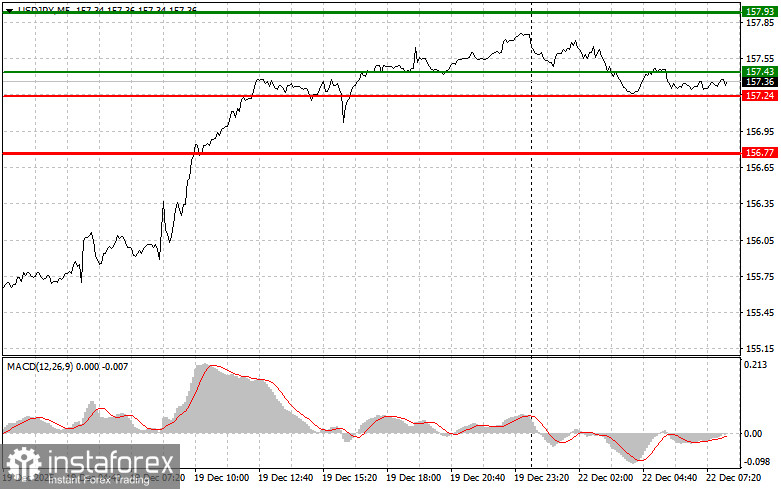
Scenario #1: I plan to buy USD/JPY today when it reaches the entry point around 157.43 (green line on the chart), targeting a move to 157.93 (thicker green line on the chart). At approximately 157.93, I intend to exit my long positions and sell immediately on a pullback, anticipating a 30-35-pip move back from the entry point. It is best to resume buying the pair on corrections and significant pullbacks in USD/JPY. Important! Before buying, ensure that the MACD indicator is above the zero mark and is just starting to rise from it.
Scenario #2: I also plan to buy USD/JPY today in the event of two consecutive tests of the price at 157.24 when the MACD indicator is in the oversold area. This will limit the pair's downward potential and lead to a market reversal upwards. A rise to opposing levels of 157.43 and 157.93 can be expected.
Scenario #1: I plan to sell USD/JPY today only after the 157.24 level is updated (red line on the chart), which will trigger a rapid decline in the pair. The key target for sellers will be the 156.77 level, where I intend to exit my short positions and immediately buy in the opposite direction, anticipating a 20-25-pip move back from that level. It is better to sell as high as possible. Important! Before selling, ensure that the MACD indicator is below the zero mark and is just starting to decline from it.
Scenario #2: I also plan to sell USD/JPY today if there are two consecutive tests of 157.43 while the MACD indicator is in the overbought area. This will limit the pair's upward potential and lead to a market reversal downwards. A decline to opposing levels of 157.24 and 156.77 can be expected.
Important: Beginner traders in the Forex market should make entry decisions cautiously. It is advisable to stay out of the market ahead of important fundamental reports to avoid getting caught in sharp price fluctuations. If you decide to trade during news releases, always set stop orders to minimize losses. Without stop orders, you can quickly lose your entire deposit, especially if you are trading large volumes without proper money management.
Remember that successful trading requires a clear trading plan, as in the example above. Making spontaneous trading decisions based on the current market situation is inherently a losing strategy for intraday traders.

