
यह भी देखें


 21.08.2026 01:16 PM
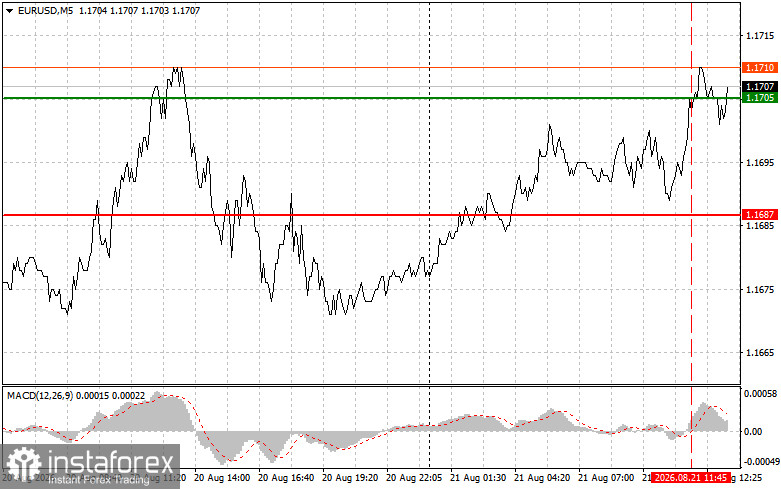
The test of 1.1705 occurred when the MACD indicator had just started moving upward from the zero line, confirming the validity of the entry point for a long position in the euro. However, even following strong eurozone data, the euro failed to make a significant advance, indicating that the market is overbought.
Eurozone manufacturing posted its best performance in more than four years in August, with the Manufacturing PMI surging to 52.8 from 51.9, its highest level since May 2022, while the Output Index rose to 53.4, its highest level in 54 months. The Composite PMI increased to 52.1, a nine-month high, while Services PMI remained unchanged at 51.7. PMI indices are based on company surveys and reflect the state of business activity, with the 50-point mark separating expansion from contraction. Therefore, such a strong increase confirmed an acceleration in the bloc's economy and supported the single currency. However, the key developments were not in the headline figures themselves but in the underlying improvements. New export orders increased for the first time in four and a half years, while the 38-month streak of declining manufacturing employment came to an end, as eurozone companies began hiring for the first time this year.
For the ECB, the conclusion was unexpectedly hawkish. With GDP growing steadily by around 0.3% in the third quarter, hiring recovering, and inflation still elevated, the hawkish bias is likely to persist, and further rate hikes in the near term cannot be ruled out. This is precisely what supported the euro, as the prospect of tighter monetary policy by the central bank favors the single currency.
The euro will spend the second half of the day awaiting the August U.S. PMIs for manufacturing, services, and the composite index. Business activity indices are leading indicators because they are among the first to capture changes in business sentiment, and their strength directly affects expectations for Fed policy. Given that the eurozone showed solid acceleration the previous day, the market will compare how resilient the U.S. economy looks against this backdrop.
The outlook for the single currency is cautious. Strong U.S. data could help the dollar strengthen at the end of the week, putting pressure on EUR/USD, while weak data would support the pair. However, some market participants may use a pullback in the single currency following strong U.S. data as an opportunity to initiate new long positions in risk assets, expecting the broader risk appetite to remain intact.
As for the intraday strategy, I will primarily focus on Scenarios #1 and #2.
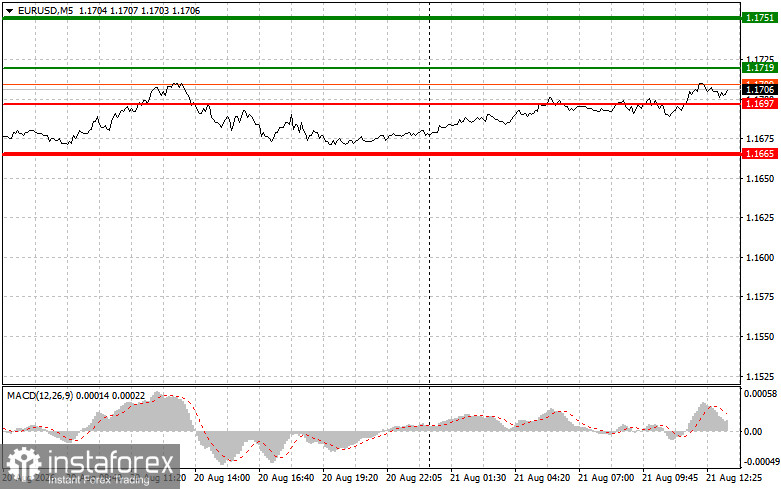
Scenario #1: Today, the euro can be bought when the price reaches around 1.1719 (the green line on the chart), with a target of 1.1751. At 1.1751, I plan to exit the market and also sell the euro in the opposite direction, targeting a move of 30–35 points from the entry point. The euro can be expected to rise today only if the U.S. data are weak. Important: Before buying, make sure that the MACD indicator is above the zero line and has only just started rising from it.
Scenario #2: I also plan to buy the euro today if the price tests 1.1697 twice consecutively while the MACD indicator is in the oversold zone. This should limit the pair's downward potential and trigger a reversal to the upside. A rise toward the opposite levels of 1.1719 and 1.1751 can be expected.
Scenario #1: I plan to sell the euro after the price reaches 1.1697 (the red line on the chart). The target will be 1.1665, where I plan to exit the market and immediately buy in the opposite direction, targeting a 20–25-point move in the opposite direction from the level. Downward pressure on the pair will return if the U.S. data are strong. Important: Before selling, make sure that the MACD indicator is below the zero line and has only just started declining from it.
Scenario #2: I also plan to sell the euro today if the price tests 1.1719 twice consecutively while the MACD indicator is in the overbought zone. This should limit the pair's upward potential and trigger a reversal to the downside. A decline toward the opposite levels of 1.1697 and 1.1665 can be expected.
Important: Beginner Forex traders should exercise extreme caution when making entry decisions. Before the release of important fundamental reports, it is best to stay out of the market to avoid exposure to sharp price fluctuations. If you decide to trade during a news release, always place stop orders to minimize losses. Without stop orders, you can lose your entire trading account very quickly, especially if you do not use proper money management and trade large position sizes.
And remember that successful trading requires a clear trading plan, such as the one presented above. Making spontaneous trading decisions based on current market conditions is inherently a losing strategy for an intraday trader.

