
यह भी देखें


 25.08.2026 05:44 AM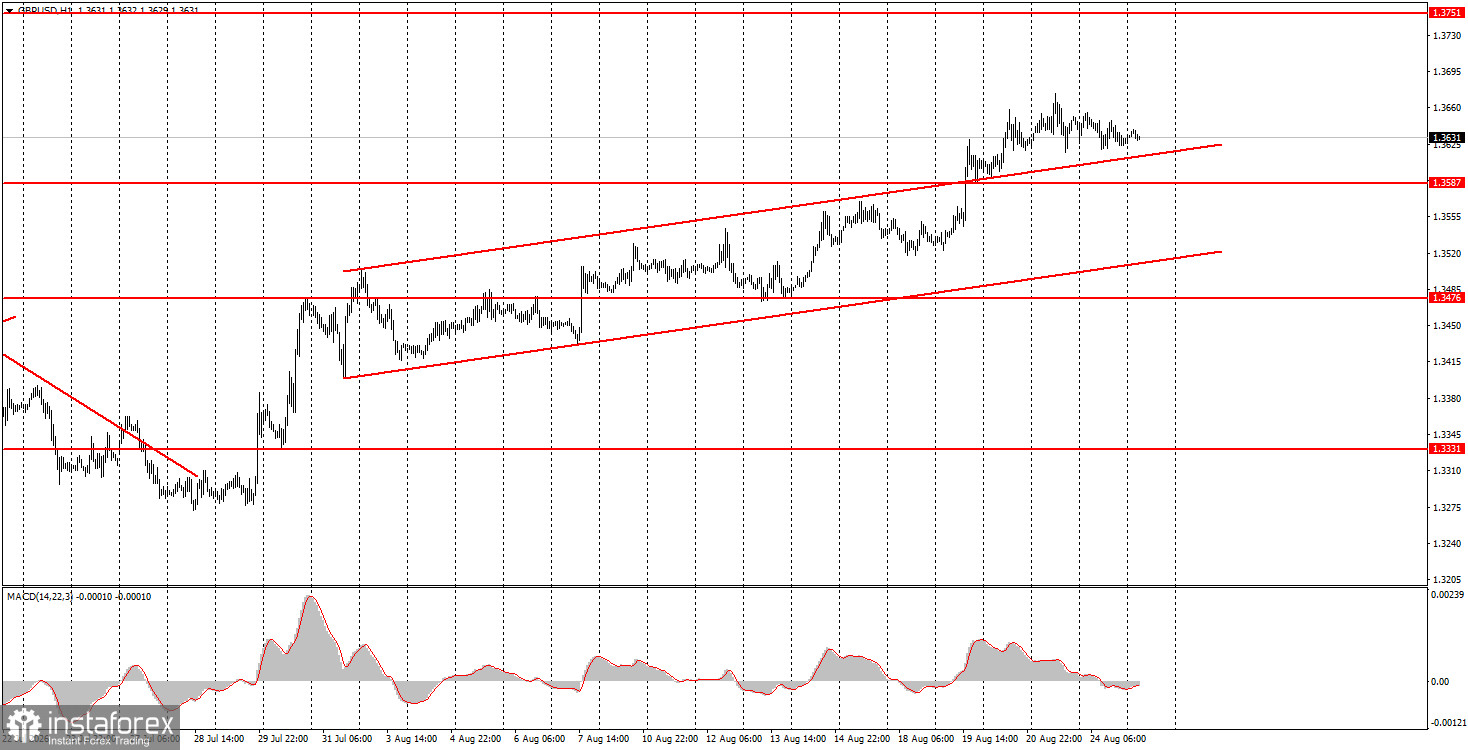
The GBP/USD pair showed minimal volatility on Monday but did not exhibit a downward inclination either. Thus, the GBP/USD pair is not even attempting to start a correction and is simply standing still, awaiting the next batch of important macroeconomic data. On Tuesday, the market is unlikely to see any significant data or news. While a few reports are scheduled for today, they are entirely secondary. The first important data will be released in the U.S. on Wednesday: the PCE index, durable goods orders, and the second estimate of GDP for the second quarter. Although, to be honest, we wouldn't expect too much from these reports either. The market is currently focused on key topics such as geopolitics, trade relations between the U.S. and China, monetary policy of the Federal Reserve, European Central Bank, and Bank of England, U.S. national debt, and the overall status of the U.S. economy. Therefore, the German business climate index or durable goods orders are unlikely to interest anyone at this time.
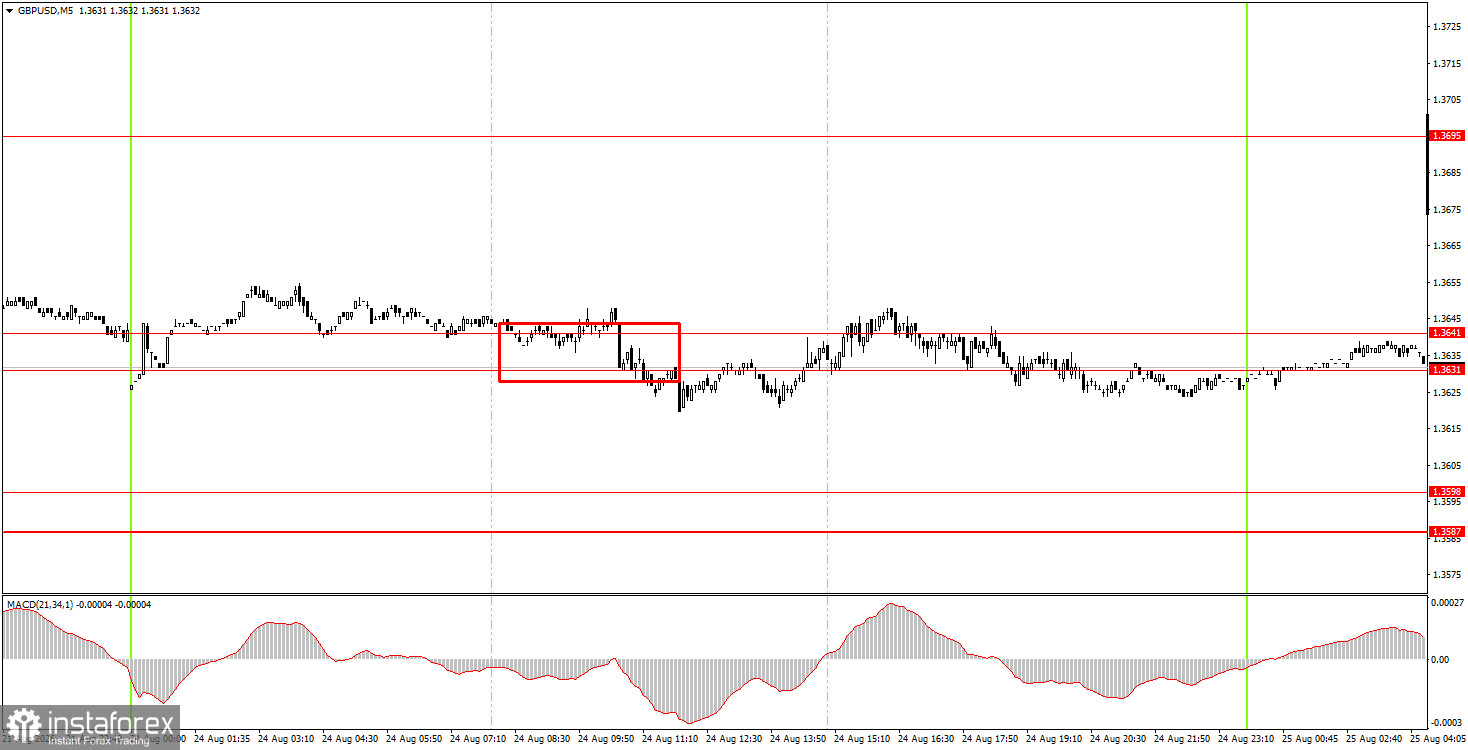
On the 5-minute timeframe, one or two trading signals were formally formed on Monday. Still, throughout the day, the movements were so scattered and disconnected from the technical levels that we would not have entered the market. Novice traders could have attempted to act on the first sell signal, which indicated a consolidation below the 1.3631-1.3641 area. This signal did not yield any profit, but it was worth a try.
On the hourly timeframe, the GBP/USD pair maintains its upward trend. In our opinion, the British pound should continue to rise, even if local factors do not support it. The weekly timeframe indicates continued movement from the lower boundary of the sideways channel to the upper boundary, and this movement is not yet complete. The market's confidence in a Fed rate hike in September is visibly diminishing, as all recent macroeconomic data and events have added pressure on the dollar. Only a consolidation below the ascending channel on the hourly timeframe would allow for expectations of a decline in the pair.
On Tuesday, novice traders may consider opening short positions if the price settles below the 1.3631-1.3641 area, targeting 1.3587-1.3598. Long positions can be initiated on a bounce from the 1.3631-1.3641 area, targeting 1.3695.
On the 5-minute timeframe, traders can now consider the levels 1.3259-1.3267, 1.3319-1.3331, 1.3380-1.3386, 1.3456-1.3476, 1.3587-1.3598, 1.3631-1.3641, 1.3695, and 1.3741. On Tuesday, there are no significant events or publications scheduled in the UK, and only a few entirely secondary reports will be released in the U.S. Hence, traders will once again have nothing to react to throughout the day, and volatility may be low.
Support and resistance price levels (areas) are the targets when opening buy or sell orders or sources of signals.
Red lines denote channels or trend lines that reflect the current trend and indicate in which direction trading is currently favored.
The MACD indicator (14,22,3) – histogram and signal line – is a supporting indicator that can also be used as a source of signals.
Important speeches and reports (as listed in the news calendar) can significantly influence the movement of the currency pair. Therefore, during their release, trading should be approached with utmost caution, or one should exit the market to avoid sharp price reversals against the preceding movement.
Beginners in Forex trading should remember that not every trade can be profitable. Developing a clear strategy and proper money management are essential for long-term trading success.

