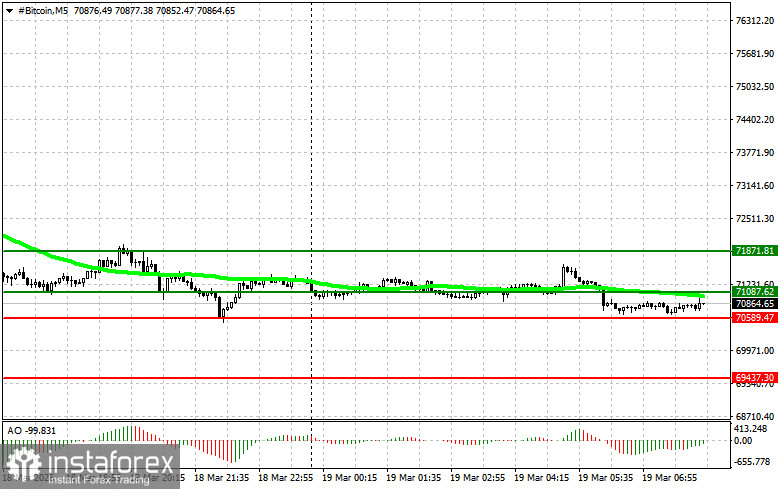
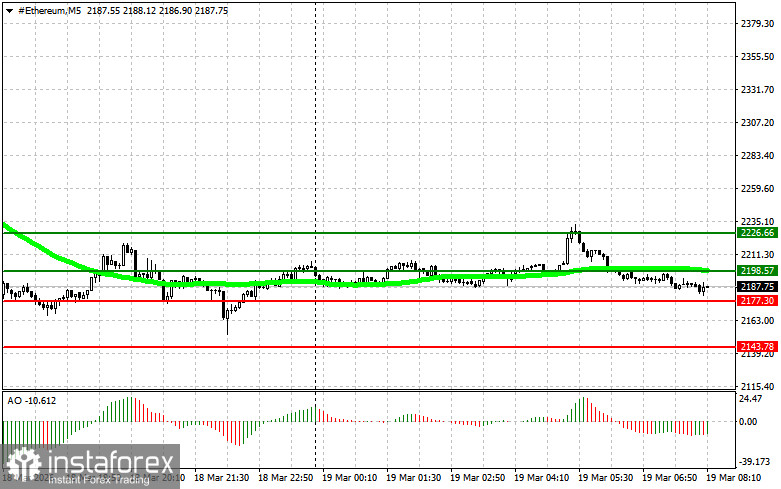
Bitcoin quickly dropped to around $71,000 yesterday and has continued to trade there. Ethereum also fell below $2,200, but it still has a chance of growth.
The primary pressure on the cryptocurrency market was evident even before the Federal Reserve's decision on interest rates, which many traders did not particularly favor. Contrary to expectations of a more dovish policy due to the US war with Iran, the committee preferred to maintain the previous borrowing conditions and its earlier, more stringent plans for further rate cuts. This decision, made against the backdrop of escalating geopolitical tensions, caught many analysts and investors by surprise, who were anticipating a more cautious approach to monetary policy.
It was presumed that the global slowdown, exacerbated by the conflict in the Middle East, would prompt the central bank to lower rates, which would support the economy and financial markets. However, it seems that the committee holds a different view, believing that the current economic situation allows for maintaining the existing, more stringent parameters.
The consequences of such a decision were immediate. There was a sharp decline in risk assets as investors began pulling funds from more volatile instruments, preferring safer investments. This, in turn, negatively impacted the cryptocurrency market, which, being highly sensitive to investor sentiment, felt the brunt of the decline. The drop in digital asset prices reflects the broader decline in risk appetite across global financial markets.
Regarding the intraday strategy in the cryptocurrency market, I will continue to act on any significant pullbacks in Bitcoin and Ethereum while anticipating a continued long-term bullish market, which has not disappeared.
As for short-term trading, the strategy and conditions are described below.
Bitcoin
Buy Scenario
- Scenario #1: I plan to buy Bitcoin today at the entry point around $71,000, with a target of $71,800 for growth. At around $71,800, I plan to exit the buys and sell immediately on the bounce. Before buying on a breakout, ensure that the 50-day moving average is below the current price, and the Awesome indicator is above zero.
- Scenario #2: You can also buy Bitcoin from the lower boundary of $70,500 if there is no market reaction to its breakout backward toward the levels of $71,000 and $71,800.
Sell Scenario
- Scenario #1: I will sell Bitcoin today upon reaching the entry point around $70,500, with a target of falling to $69,400. At around $69,400, I plan to exit the sells and buy immediately on the bounce. Before selling on a breakout, ensure that the 50-day moving average is above the current price, and the Awesome indicator is below zero.
- Scenario #2: You can sell Bitcoin from the upper boundary of $71,000 if there is no market reaction to its breakout backward toward the levels of $70,500 and $69,400.
Ethereum
Buy Scenario
- Scenario #1: I plan to buy Ethereum today upon reaching the entry point around $2,198, with a target of growth to $2,226. At around $2,226, I plan to exit the buys and sell immediately on the bounce. Before buying on a breakout, ensure that the 50-day moving average is below the current price, and the Awesome indicator is above zero.
- Scenario #2: You can buy Ethereum from the lower boundary of $2,177 if there is no market reaction to its breakout backward toward the levels of $2,198 and $2,226.
Sell Scenario
- Scenario #1: I will sell Ethereum today upon reaching the entry point around $2,177, with a target of falling to $2,143. At around $2,143, I plan to exit the sells and buy immediately on the bounce. Before selling on a breakout, ensure that the 50-day moving average is above the current price, and the Awesome indicator is below zero.
- Scenario #2: You can sell Ethereum from the upper boundary of $2,198 if there is no market reaction to its breakout backward toward the levels of $2,177 and $2,143.
Dapatkan perubahan kadar mata wang kripto bersama InstaTrade
Muat turun MetaTrader 4 dan buka dagangan pertama anda



 19.03.2026 08:50 AM