
Lihat juga


 28.04.2026 08:08 PM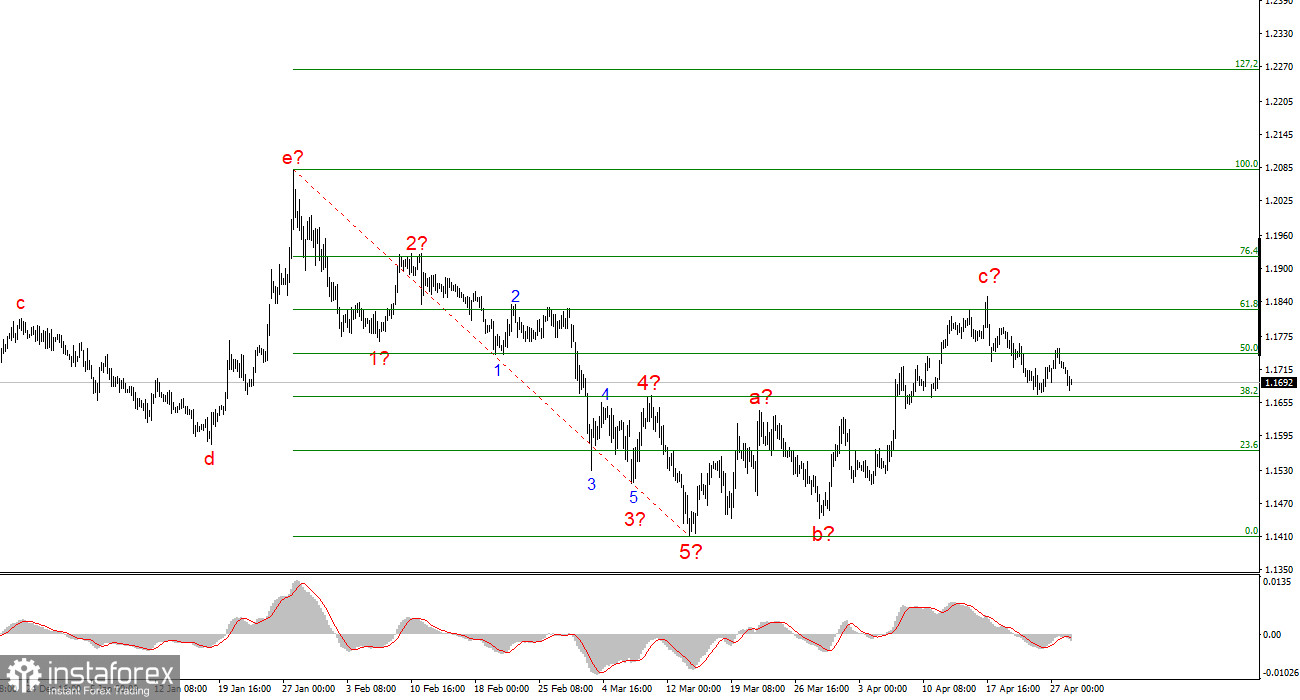
The wave pattern on the 4-hour chart for EUR/USD has changed. There is still no indication of a cancellation of the upward trend segment (lower chart), which began in January of last year; however, the wave structure now appears highly ambiguous. In such situations, I recommend switching to a lower timeframe (upper chart) and focusing on the simplest and smallest wave structures to form a short-term forecast, which is sufficient for opening positions. Wave structures can be highly complex and allow for multiple scenarios. The simplest approach is to trade based on the standard "five-three" pattern.
In the chart above, a classic five-wave impulsive structure with an extended third wave can be identified. If this is correct, then this structure has been completed, and a corrective sequence of at least three waves is currently developing. Three waves have already formed, so the market is likely to develop at least one more corrective wave in the near term. Future developments will depend on geopolitics: either a more complex corrective structure will form, or a new downward trend segment will begin.
The EUR/USD pair declined by about 20 points on Tuesday, and market volatility remains relatively low. At this stage, it can be assumed that the upward corrective wave structure may transform into an impulsive one, although this conclusion is based primarily on the weak decline observed over the past two weeks. It should be noted that impulsive movements are typically sharper than corrective ones. Are there grounds to expect euro growth under the current news background?
In my view, there are. The geopolitical factor is gradually losing its influence on the market, as its primary impact was on the US dollar, which investors used as a safe-haven currency. However, most analysts have noted that risk-off flows cannot persist indefinitely. At this point, it can be assumed that investors have already reduced exposure related to the Middle East. Tomorrow, the Federal Reserve will hold a meeting, where monetary policy parameters are expected to remain unchanged with near certainty. Therefore, the main focus will be on Jerome Powell's speech, which will be his final meeting as Fed Chair.
What can Jerome Powell signal? It is highly likely that during his final speech, Powell will avoid introducing uncertainty or increasing market tension. In two weeks, Kevin Warsh is expected to take over as Fed Chair, and he will likely have his own economic perspective and monetary policy approach. Therefore, Powell is unlikely to signal any shift in the current policy stance, which assumes that the interest rate remains at least through the end of the year ? implies keeping interest rates unchanged at least through the end of the year. As a result, the US dollar may lack strong support following the meeting, as the Fed's stance is unlikely to become more hawkish.
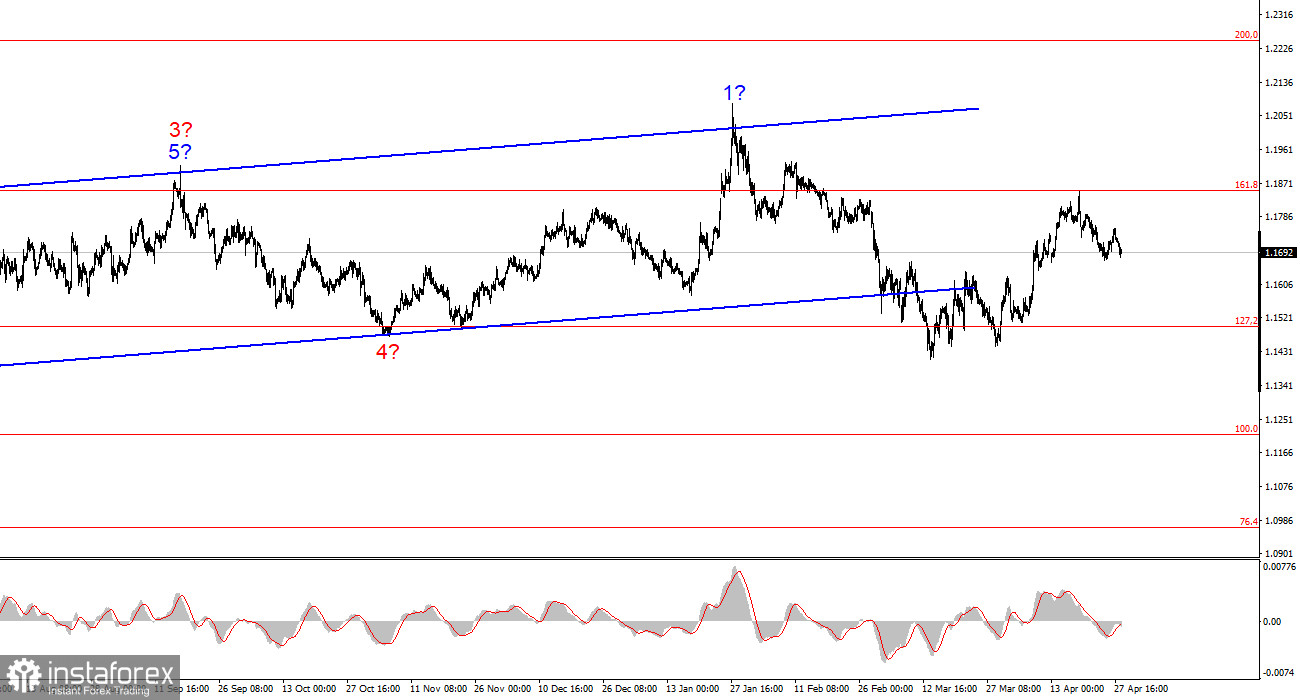
Based on the EUR/USD analysis, the pair remains within an upward trend segment (lower chart), while in the short term it is within a corrective structure. The corrective wave structure appears largely complete and may only become more complex and extended if the geopolitical situation in the Middle East improves. Otherwise, a new downward wave structure may begin from current levels. A corrective phase has already formed, and further direction will depend on market expectations regarding the outcome of negotiations.
On the lower timeframe, the entire upward trend segment is visible. The wave structure is not entirely typical, as corrective waves differ in size. For example, the higher-degree wave 2 is smaller than the internal wave 2 within wave 3. However, such cases do occur. It is important to focus on clear and identifiable structures rather than strictly labeling every wave. Recent waves are difficult to interpret, so the analysis is based on the higher timeframe.
Key principles of this analysis:


