
Lihat juga


 05.10.2026 07:49 AM
The week began unpleasantly for the euro. The single currency hit a low not seen since May 2025, despite weak US employment data that should have weighed on the dollar. The pound looks calmer by comparison and remains tied to sentiment around the US currency, which is also holding as a safe haven while Europe is unsettled.

Policy, not statistics, is moving the euro now. Investors are increasingly worried about France and Spain, and when budgetary and political risks in the region come to the fore, the currency loses its usual support from rate expectations. This contrasts with the European Central Bank's stance — in September it raised the deposit rate to 2.50%, after which the market noticeably priced in a higher chance of another move in October. In normal times such hawkish rhetoric would support the euro, but today the risk premium outweighs it.
The danger is the combination of two uncertainties: fiscal and political. France has a chronic trade deficit and business activity has been contracting for many months. Spain is growing briskly but remains among the countries with the highest inflation in the eurozone. When these weaknesses are compounded by political noise from major party disputes, investors demand more compensation for holding euro-area assets, and the currency reacts first. The dollar meanwhile benefits as a quiet haven, so weak US employment helped the euro far less than it otherwise might have.
For the pound, the morning brings no domestic catalysts, so it lives in the shadow of two external themes. First is the US dollar after Friday's report; second is the UK budget, around which the government bond market remains nervous. The Bank of England is in a difficult position: three MPC members voted in July for immediate tightening, while domestic labor-market indicators are cooling.
As for the US labor-market report itself, it noticeably changed sentiment around the dollar. Job growth was far below the past year's average, and revisions to July and August made the summer picture look even worse. This is especially striking after August's unusually high print — 162,000 versus an expected 55,000 — which had led the market to believe a turnaround was underway. That result now appears more like an outlier, and pricing in Federal Reserve tightening has become harder. Unemployment remained in a narrow band, but that figure is misleading here. Labor-force participation is falling, hiring has effectively stalled, and wage growth has slowed — and the latter weakens the hawks' case. Concerns about a wage-price spiral have diminished, giving the Fed an argument for a pause. Currencies whose rate trajectories are already tighter benefit from this. The euro is in a better position because the ECB has already raised rates and can continue to do so, and eurozone inflation accelerated to 3.8% in September. The pound gains some support from a weaker dollar, but its own foundation is thinner because the UK labor market is cooling and the budget issue persists. The main barometer for both pairs, in my view, is US Treasury yields. If they continue to fall, holding dollars becomes less attractive, and chances for upward corrections in the euro and pound remain.
Today the euro will also have a chance to claw back some losses. During the European session, final services and composite PMI readings will be released, along with the Sentix investor-sentiment index and producer-price data. PMI is compiled from a purchasing-managers' survey, and readings above 50 indicate expansion. I expect reasonably good numbers, but I believe any move will remain corrective until clarity emerges on France and Spain.
For the pound, the calendar also livens up today. In the first half of the day, final services and composite PMIs for September will be published. These prints matter not on their own, but as a quick check of how the UK economy is coping with high energy costs and budgetary uncertainty. If the revisions come in stronger, the pound could try to rally — strong activity would reinforce the view that it is too early for the Bank of England to consider easing and would bolster the case for those favoring further tightening.
For the euro, the upside breakout point is 1.1210, with targets 1.1259 and 1.1307. I see this move as a rebound rather than a trend change. It requires strong PMIs and calmness around France; I trust the first target much more than the second. To the downside, the trigger is 1.1165, with targets 1.1133 and 1.1097. This direction aligns with the day's main flow, since the May-2025 low was recently refreshed and the political-risk premium remains. The distance between the points is only 45 pips, so the market can easily run both within one session; I would not trade the first touch. My priority is the sell side, but only if price consolidates below 1.1165 after the data.
For the pound, I consider long positions above 1.3223 with targets 1.3265 and 1.3307, and short positions below 1.3180 with targets 1.3137 and 1.3097. The range is 43 pips, and the pound will likely spend the morning inside it until UK PMIs arrive. A weak dollar after Friday pushes GBP up, and 1.3265 is reachable, but holding that move will be hard because the pound's support is thin. I would not count heavily on 1.3307. Shorts become attractive if the dollar regains strength or the budget issue returns to the fore.
Today the reference levels sit very close to breakout points, so it is especially important not to confuse the two.
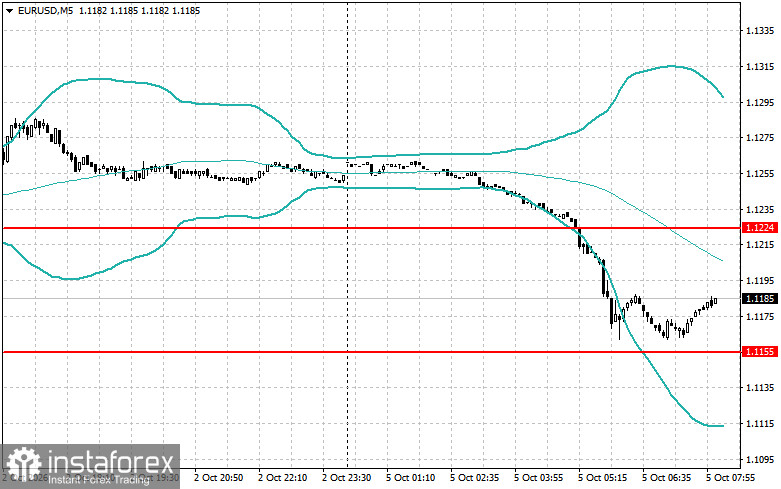
For the euro, the upper reference is 1.1224, 14 pips above the breakout 1.1210 and on the way to the first target 1.1259. If the pair firmly consolidates above 1.1210, then 1.1224 is just a stopover and selling there is forbidden. But if price spikes above 1.1224, fails to hold, and returns below 1.1210, I consider selling and place the stop beyond the failed-attempt high. The lower reference, 1.1155, lies 10 pips below the breakout at 1.1165. Here I wait for a poke below 1.1155, an inability to continue lower, and a return above 1.1165 — only then do I consider long positions, with the stop beneath the poke low. This scenario fits if data prints near expectations and the market, after the first figure, begins to retrace.
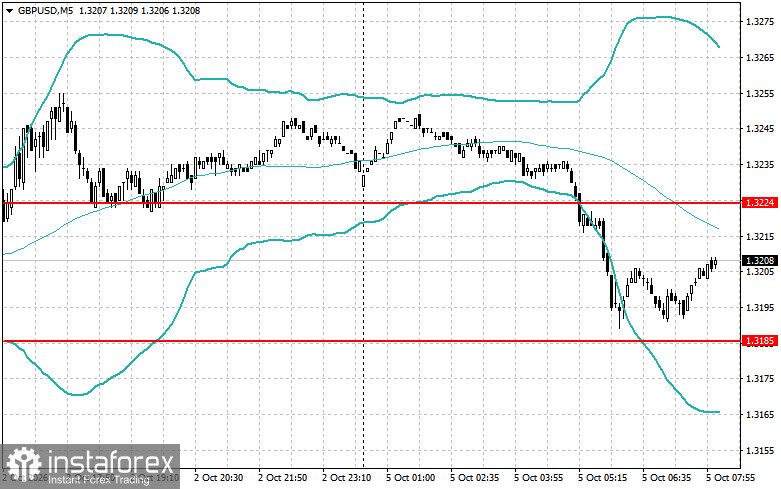
For the pound, the upper reference 1.3224 is only one pip above the breakout 1.3223 — effectively the same level. It is impossible to distinguish a real breakout from a false one on the first touch, so novices must be extra cautious. If price passes and convincingly holds above, the move toward 1.3265 is underway and selling is forbidden. If it spikes up then quickly falls back below 1.3223, the mean-reversion sell works, and the stop goes above the local high. The lower reference 1.3185 sits five pips above the breakout 1.3180, i.e., inside the range, so buying from there is riskier than it looks. I accept the return idea only if price dips under 1.3185 but does not reach 1.3180 and quickly returns above. If it touched 1.3180 and consolidated below, the return is canceled, and a downside breakout is in play. Before UK data, it is fine to skip these scenarios; after publication, watch which way the market pushes the dollar.


