
Lihat juga


 05.10.2026 08:37 AM
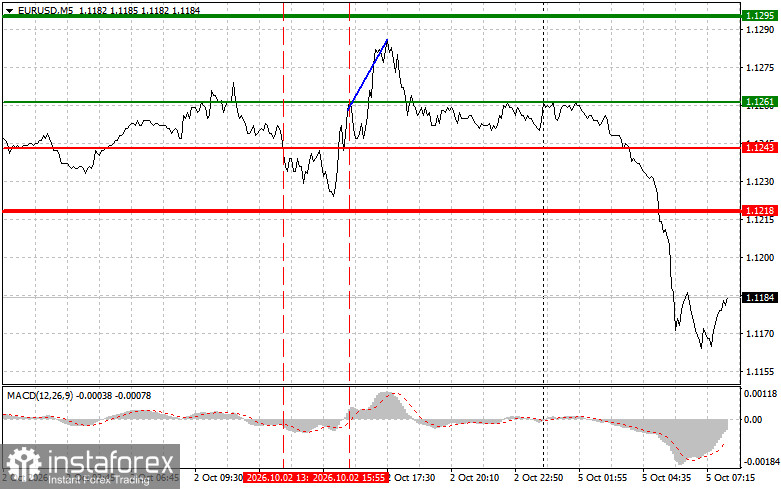
Price tested 1.1243 when the MACD indicator moved far below the zero line, limiting the pair's downside potential. The test of 1.1261 coincided with MACD beginning to rise from zero, allowing a buy entry that produced a good 20-pip move.
Weak US employment data undermined the dollar's main support, and the euro took advantage. September job growth fell well below the twelve-month average, and revisions to the prior two months added negativity. The report's internal picture is telling: unemployment stayed in a narrow band, but hiring nearly stopped and average hourly earnings grew more slowly. For a Federal Reserve focused on price stability under Chair Warsh, this is an important signal.
However, after Friday's correction, today began badly for the euro: the currency fell to its lowest level since May 2025 amid deteriorating sentiment around political and fiscal risks in the region, especially France and Spain. Notably, this pressure arrived despite relatively high eurozone inflation in September.
Today's euro data block is more important than usual. Final services and composite PMIs will show how resilient activity was at the start of autumn; the Sentix investor-sentiment index will reflect how investors really view the region and is sensitive to politics; producer prices will add another brushstroke to the inflation picture, since rising industrial costs from expensive energy can pass through to consumer prices. Overall readings are expected to be decent, and upward revisions for September could give the euro a modest reprieve.
For intraday strategy, I will rely mainly on Scenario 1 and Scenario 2 below.
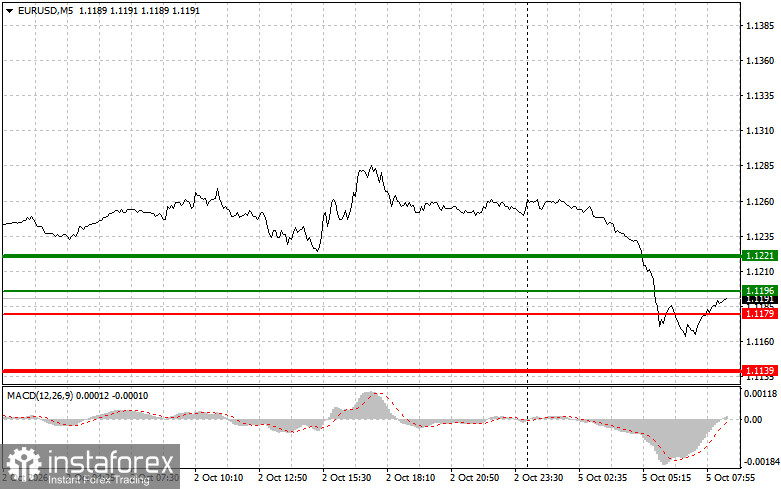
Scenario 1: Buy the euro today if price reaches around 1.1196 (green line), targeting 1.1221. Plan to exit at 1.1221 and sell on a reversal expecting 30–35 pips from the entry. Expect euro strength only after strong data. Important: before buying, ensure MACD is above zero and only beginning its rise.
Scenario 2: Also buy the euro if there are two consecutive tests of 1.1179 while MACD is in the oversold area. This would limit downside potential and trigger an upward reversal. Expect moves toward 1.1196 and 1.1221.
Scenario 1: Sell the euro after it reaches 1.1179 (red line). Target 1.1139, where I plan to exit and immediately buy the reverse, expecting a 20–25 pip countermove. Pressure will return on poor data. Important: before selling, ensure MACD is below zero and only beginning to fall.
Scenario 2: Also sell if there are two consecutive tests of 1.1196 while MACD is in the overbought area. This would cap upside and trigger a downward reversal. Expect declines to 1.1179 and 1.1139.
Thin green line – entry price at which you can buy the trading instrument.
Thick green line – approximate price where you can place Take Profit or manually lock in profits, since further upside above this level is unlikely.
Thin red line – entry price at which you can sell the trading instrument.
Thick red line – approximate price where you can place Take Profit or manually lock in profits, since further downside below this level is unlikely.
MACD indicator. When entering the market, it is important to follow the overbought and oversold zones.
Important. Beginner traders in the Forex market must be very cautious when making entry decisions. It is best to stay out of the market before the release of important fundamental reports to avoid getting caught in sharp price swings. If you decide to trade during news releases, always place stop orders to minimize losses. Without stop orders,, you can quickly lose your entire deposit, especially if you don't use money management and trade large volumes.
Remember that successful trading requires a clear trading plan, like the example above. Spontaneous trading decisions based on the current market situation are inherently a losing strategy for an intraday trader.


