
یہ بھی دیکھیں


 27.07.2026 07:29 AM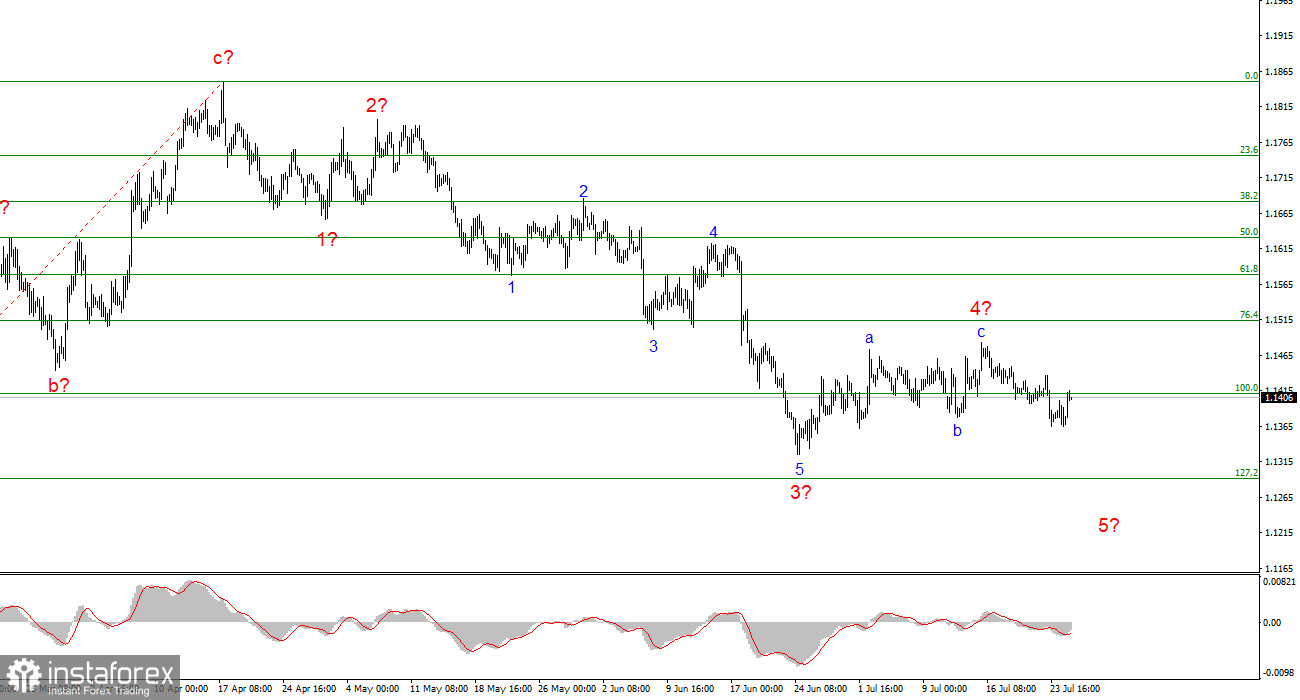
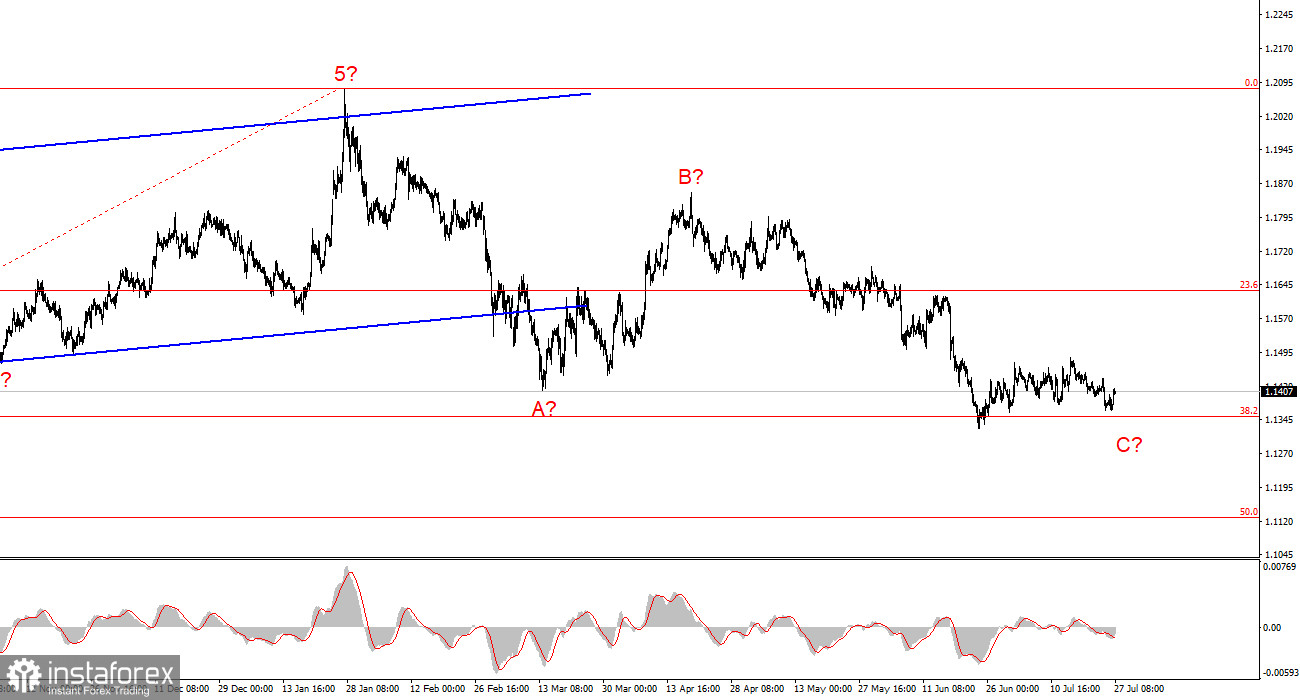
The wave pattern on the 4-hour chart for the EUR/USD instrument is becoming more complex. While there is still no talk of canceling the upward segment of the trend that started in January of last year (as shown in the lower image), the wave structure has taken on a corrective form. In the long term, we should expect the formation of wave C, with its low situated below the low of wave A. Currently, the low of wave C lies below the low of wave A, so wave C could complete at any moment. However, with a favorable news backdrop for the dollar, this wave could take on a more extended form.
On a smaller scale, I can highlight a classic five-wave downward structure. If this assumption is correct, we are currently in wave 4, while wave 3 has taken on a five-wave form. After completing this structure, the instrument may transition into an upward wave sequence. However, according to the current wave pattern, wave 5 is being formed. Consequently, the euro could drop to the 13 figure or lower.
Throughout Friday, the EUR/USD instrument hardly changed, and the market once again paid little attention to economic data. However, by that measure, the amplitude of movement was just 17 pips, indicating very weak movement. In the first half of the day, the euro showed minimal growth, and in the second half, it experienced a similar decline. The business activity indices in the services and manufacturing sectors of Germany stood at 49.6 and 52.2, respectively, exceeding market expectations. The business activity indices in the services and manufacturing sectors of the eurozone were 51.6 and 52.0, respectively, also surpassing expectations. Consequently, all reports from the eurozone were positive. However, the euro gained only 20 pips overnight.
In the second half of the day, demand for the US dollar rose. The US services PMI came in better than market expectations, while the manufacturing PMI did worse. However, the services sector posted an impressively high figure, so again, it can be said that the market accounted for this data. But another question arises: did traders feel any better about the 20-pip reaction to six reports? When we speak of market reaction, we imply that such movement should yield profits. A 20-pip movement is extremely difficult to monetize. Thus, whether there was market reaction or not — it is absolutely irrelevant. There was no movement worth trading; that is the key point.
Monday began with a decline in the US dollar, as over the weekend Donald Trump announced the cessation of strikes on Iran and the resumption of negotiations. The outcome of the new "diplomatic story" between Tehran and Washington is a question worthy of a Hollywood portrayal. According to the current wave structure, the instrument's decline is not over. Therefore, I don't believe that the market will abandon dollar purchases just because of another fictitious ceasefire.
Based on the conducted analysis of EUR/USD, I conclude that the instrument remains within the framework of the upward segment of the trend (as shown in the lower image), while in the shorter term, it is within a downward segment. In my view, this is a good time to consider establishing long positions, although the instrument may still drop to the 13 figure within the context of wave 5 in C. The wave pattern often brings surprises, so I would start repositioning towards buying now.
On a larger scale, an upward segment of the trend is visible, after which a corrective wave structure began to form. In the near term, expect the formation of wave C with targets located around the 1.1352 mark, corresponding to the 38.2% Fibonacci level. After completing the A-B-C structure, a new long-term upward trend may begin.


