
یہ بھی دیکھیں


 05.10.2026 02:39 PM
Bitcoin is trading around $86,000, and Ether holds near $2,720 after a 3% rise over seven days. Total market capitalization is about $2.93 trillion, and the Fear & Greed Index rose to 70, the greed zone, from 65 a day earlier.

That is confirmed by spot ETF flows. According to SoSoValue, Bitcoin funds attracted $241 million last week—the third consecutive week of inflows—and cumulative inflows since launch have risen to $57.8 billion. Recall that a week earlier funds gathered $2.4 billion, so the pace has clearly slowed, but the direction remains intact. Ether funds, by contrast, lost $138 million after a $690 million inflow the week before. Outflows continued yesterday: about $118 million left in Ether ETFs over three trading days. The beneficiary here is Bitcoin, which remains the main institutional on-ramp, while Ethereum loses as its price rises but funds shrink.
The altcoin picture is mixed. The largest inflow after Bitcoin was BNB with $97.46 million. Next came NEAR with $35.99 million, LINK with $8.3 million, XRP with $4.74 million, LTC with $2.63 million, HBAR with $2.53 million, and SOL with $2.43 million. Small gains were recorded for DOGE ($327,000) and AVAX ($268,000), while TRX and DOT saw no flows. HYPE also recorded inflows. The week's biggest outsider was Zcash with $93.56 million of outflows—reportedly its first weekly outflow ever. In total, Ether and Zcash lost about $231.6 million, more than the entire inflow into altcoins excluding Bitcoin.
I read this as a shift in institutional demand. Money goes into Bitcoin and into select stories such as BNB and NEAR, while Ether and privacy coins lose fund support. The causal chain is simple: weak US employment on October 2 reduced the odds of a Fed hike, the dollar weakened on the print, and Bitcoin rose, bringing ETF inflows back. The greed index reduces the margin for error: when it sits near 70, good news is already priced in, and the market becomes more sensitive to disappointments.
My base case remains bullish. While Bitcoin holds above $85,000, I expect another push at $87,600, the level that stopped the two previous impulses. A close above there would open the way to $90,000, while a return below $85,000 would put the price back into the September range. I think Ether will find it harder to catch Bitcoin while fund outflows continue.
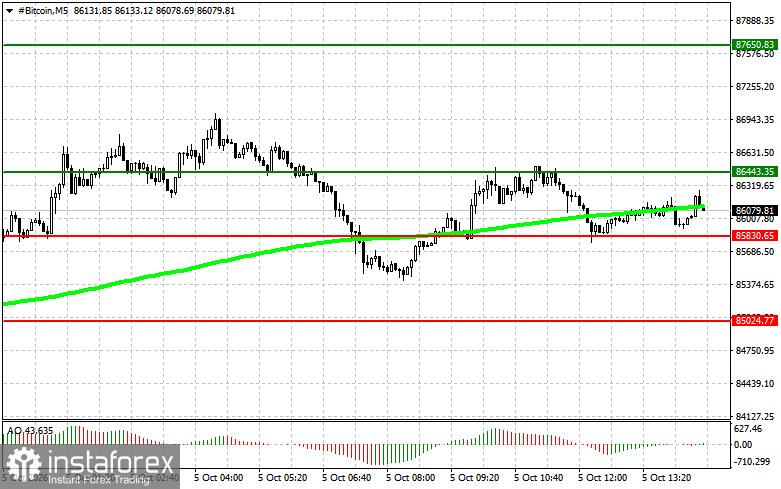
Bitcoin is trading inside a narrow corridor between support at $85,800 and resistance at $86,400, with outer boundaries at $85,000 and $87,600. The plan is built around two mirror scenarios with a full set of breakout and rejection cases. There are two entries for longs. First, a break above $86,400 with a close: buy targeting $87,600, where I would take profit and consider a short on the pullback, provided the price remains above the 50-day moving average and the Awesome indicator is above zero. Second, a bounce from $85,800 if a downside break fails and the drop proves false: buy with an initial return to $86,400 and then $87,600.
Sells are symmetric. A confirmed break below $85,800 gives a short target of $85,000, provided the 50-day average lies above price and Awesome is below zero. If the break above $86,400 fails and the price returns below that level, a short from resistance targets a return to $85,800 and then $85,000. For reference, the 50-day moving average sits near $79,495, so with the current price level, shorts remain counter-trend.
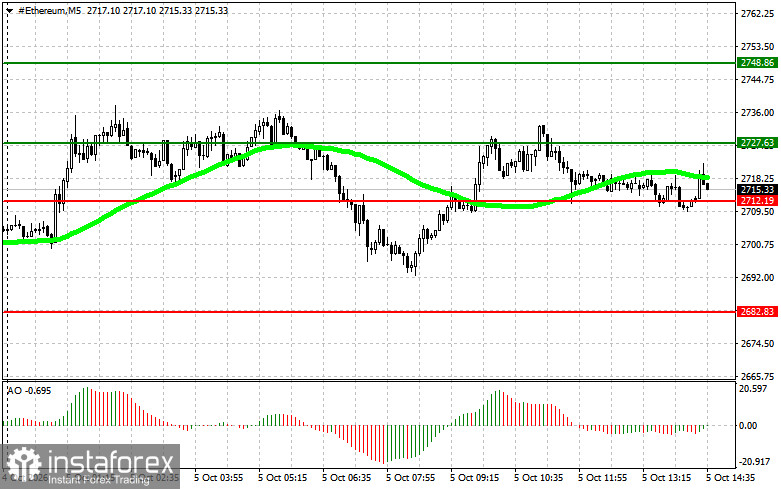
As for Ether, the logic mirrors Bitcoin on its own price scale: an inner corridor between support at $2,712 and resistance at $2,727, with outer boundaries at $2,682 and $2,748. Buy on a break above $2,727 targeting $2,748, where profits are taken and a short on the pullback may be considered; the condition is the same—price above the 50-day average and Awesome above zero. Buy on a bounce from $2,712 if a downside break fails, with initial targets of $2,727 and then $2,748.
For sells, a confirmed break below $2,712 opens a short toward $2,682 provided the 50-day average is above price and Awesome is below zero. A rejection from $2,727 after a failed upside breakout gives a short back to $2,712 and then $2,682. Both indicators remain filters to cut false moves, not standalone entry signals, so trades are taken only after real price confirmation of the specified levels.


