
یہ بھی دیکھیں


 05.11.2026 08:37 AM
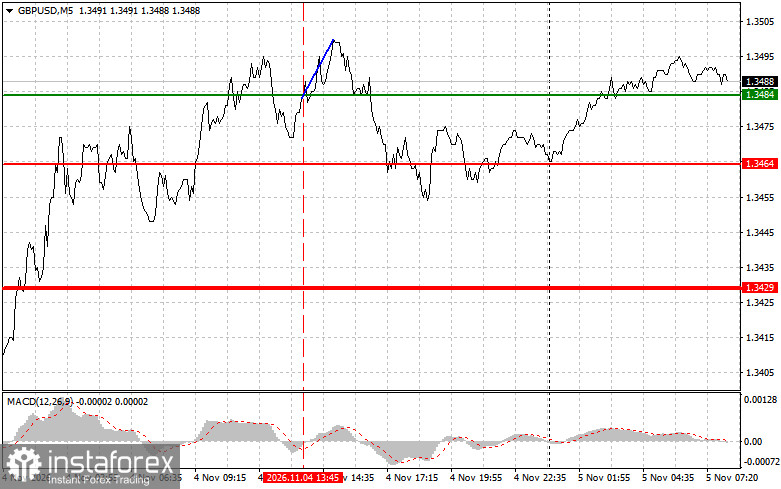
The test of the 1.3484 price level occurred when the MACD indicator had just begun moving upward from the zero line, confirming a valid entry point for buying the pound. However, the pound rose by only 10 points.
Yesterday, the pound edged lower against the dollar, as U.S. data supported demand for the U.S. currency, while UK figures came in slightly below expectations. The ADP report had the strongest impact, showing that the U.S. private sector added 86,000 jobs in October, compared with the expected 67,000. The trade deficit also narrowed significantly, which is generally considered a positive sign for the economy. According to the ISM, the services sector fell slightly short of forecasts but remained in expansion territory, so the report did not cause any major disappointment. Against this backdrop, UK data looked weaker. The final Services PMI came in at 52.8, compared with the expected 53.1, while the composite index also fell slightly short of the forecast.
Today is one of the busiest days of the week for the pound. The Bank of England will announce its decision on the key interest rate, which is expected to rise to 4.0%. Traders have already priced in this increase. As a result, attention has shifted to the tone of the central bank's statement. The market expects a seven-to-two vote in favor of a rate hike, with two members voting to keep rates unchanged. Any deviation from this expected split will be interpreted as a signal about the future policy path. The decision will be accompanied by the monetary policy summary and report, followed by a speech from Bailey. If he signals that monetary tightening will continue, the pound could gain, as hawkish rhetoric generally attracts buyers. More dovish comments, by contrast, would weigh on the British currency, even if the rate is raised. GBP/USD is likely to respond primarily to Bailey's remarks today, and a commitment to maintaining a hawkish policy stance could provide the pound with its main source of support.
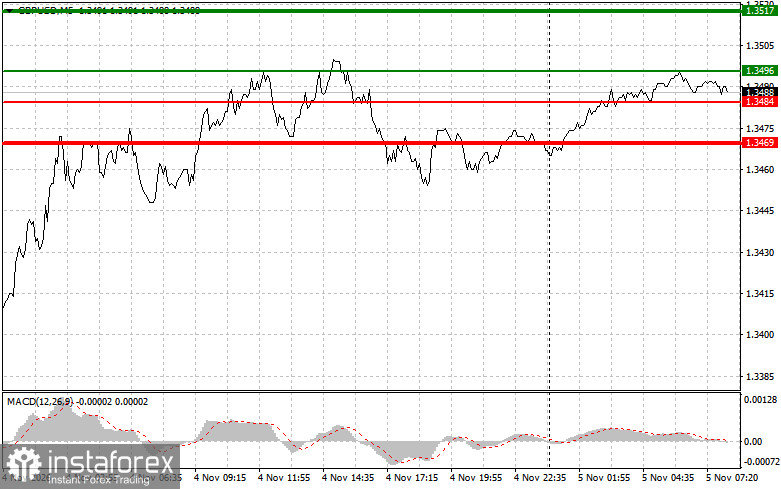
As for the intraday strategy, the focus will be primarily on the implementation of Scenarios No. 1 and No. 2.
Scenario No. 1: Buying the pound is planned today when the price reaches the entry point around 1.3496 (the green line on the chart), with a target at 1.3517 (the thicker green line on the chart). Around 1.3517, the plan is to close long positions and open short positions in the opposite direction, targeting a 30–35-point move back from that level. Further gains in the pound today would be possible if the bullish market continues. Important: Before buying, make sure that the MACD indicator is above the zero line and has only just begun rising from it.
Scenario No. 2: Buying the pound is also planned today if the price tests 1.3484 twice consecutively while the MACD indicator is in oversold territory. This would limit the pair's downward potential and trigger an upward market reversal. A rise toward the next levels of 1.3496 and 1.3517 can be expected.
Scenario No. 1: Selling the pound is planned today after the 1.3484 level is broken (the red line on the chart), which should lead to a rapid decline in the pair. The sellers' key target will be 1.3469, where the plan is to close short positions and immediately open long positions in the opposite direction, targeting a 20–25-point move back from that level. Negative news would put the pound under renewed pressure. Important: Before selling, make sure that the MACD indicator is below the zero line and has only just begun declining from it.
Scenario No. 2: Selling the pound is also planned today if the price tests 1.3496 twice consecutively while the MACD indicator is in overbought territory. This would limit the pair's upward potential and trigger a downward market reversal. A decline toward the next levels of 1.3484 and 1.3469 can be expected.
Important. Beginner Forex traders should be very cautious when making market entry decisions. It is best to stay out of the market before the release of major fundamental reports to avoid exposure to sharp exchange rate fluctuations. If trading during news releases, always place Stop Loss orders to minimize losses. Without Stop Loss orders, the entire deposit can be lost very quickly, especially when trading large volumes without using proper money management.
Remember that successful trading requires a clear trading plan, such as the one outlined above. Making spontaneous trading decisions based on current market conditions is a losing strategy for an intraday trader from the outset.


