
Veja também


 07.07.2026 03:04 PM
While Bitcoin is struggling due to waves of selling from large market players, the Trump administration's plan to create a strategic Bitcoin reserve has run into an interagency tug-of-war.

The reserve was originally planned to be housed in the US Treasury Department, as envisaged by the executive order Trump signed in March 2025. But doubts arose during implementation: does the Treasury have the legal authority to hold a highly volatile digital asset indefinitely as a permanent reserve instrument? The order explicitly instructed that Bitcoin under Treasury control "shall not be sold and must be retained as a reserve asset," and it is precisely that indefinite retention that creates legal uncertainty.
Many experts have pointed out that Bitcoin obtained through seizures has traditionally been linked to law?enforcement procedures, not to a long-term state reserve strategy. Against that background, the Department of Commerce is increasingly being considered as an alternative. The argument is that the Department of Commerce is more closely connected to the technology and innovation agenda and to economic competitiveness, which theoretically better fit the framework of "Bitcoin as a strategic technological asset" than Treasury's traditional fiscal mandate.
White House spokesperson Liz Houston recently said the administration is continuing to assess the optimal structure for a strategic reserve and a government stockpile of digital assets, stressing that Trump's goal remains the same: to cement the US position as the world's cryptocurrency capital.
Meanwhile, the ARMA bill is being drafted in Congress to codify the reserve into law, establish a 20-year holding period for coins, and provide for the accumulation of up to 1 million bitcoins over five years via "budget?neutral" mechanisms (i.e., without direct expenditures from the federal budget). However, until either the executive or legislative branch completes the process, the real fate of the world's largest government bitcoin reserve remains hostage to an intra-agency dispute over who has the legal right to manage it and on what basis.
Trading recommendations
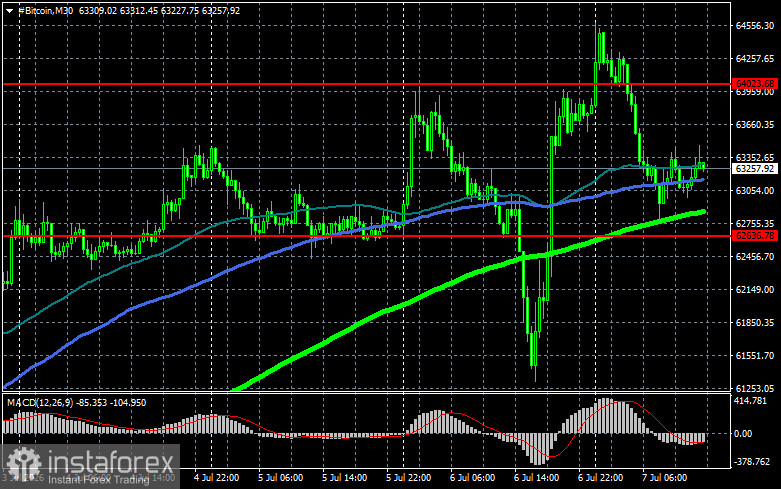
Bitcoin
Buyers are currently targeting a return to $64,000, which would open a direct path to $65,500, and from there toward $67,700—breaching that level would signal attempts to rekindle a bull market. On dips, buyers are expected at $62,600; a drop back below that area could quickly push BTC toward $60,600. The furthest downside target is around $58,500.
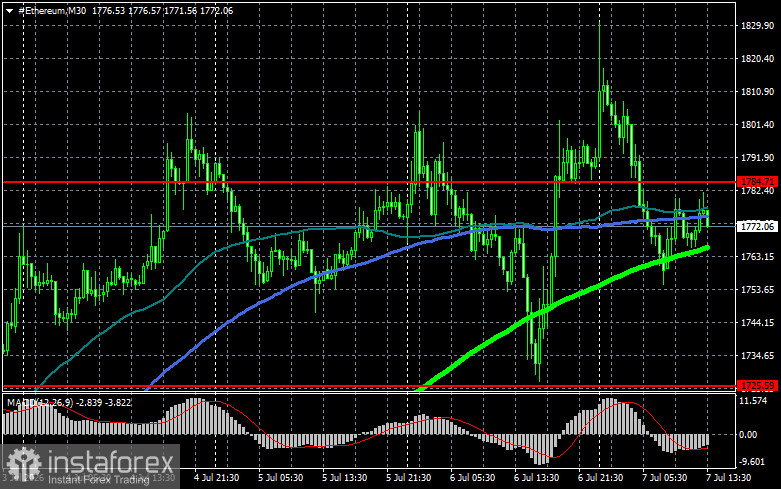
Ethereum
A decisive hold above $1,784 would open a direct path to $1,838. The next upside target is the high near $1,901; a break above that would indicate strengthening bullish sentiment and renewed buyer interest. On the downside, buyers are expected at $1,725; a return below that area could quickly send ETH toward $1,650. The furthest downside target is around $1,573.
What's on the chart
Price testing or crossing any of these moving averages often either halts movement or injects fresh momentum into the market.


