Trade Analysis and Tips for Trading the Japanese Yen
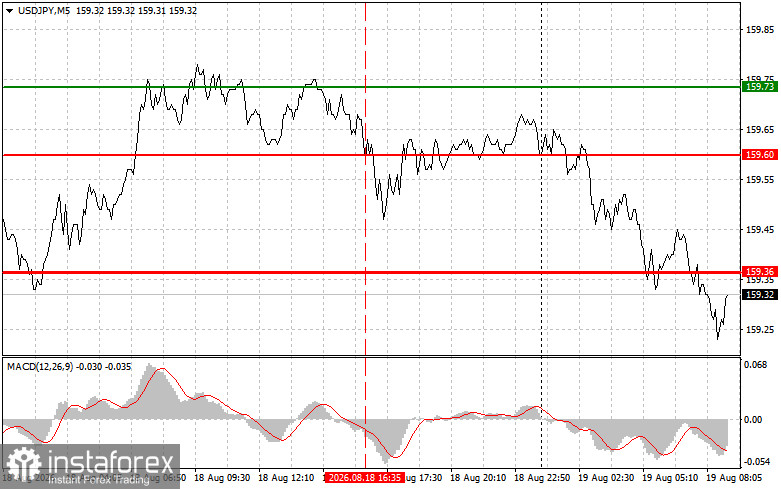
The price test at 159.60 occurred when the MACD indicator had moved significantly below the zero mark, limiting the pair's downside potential.
The Japanese yen gained an advantage over the dollar as the U.S. economy once again showed two-speed dynamics. Industrial production grew by only 0.2% month-on-month, while the housing sector intensified the contradictory picture, as actual new home starts plummeted by 12.4%. For the Federal Reserve, this indicated mixed signals, and the dollar found no support in it. For the yen, the lack of strength in the dollar became an opportunity to hold its positions, as the absence of a strengthened American currency weakened pressure on the yen. The gap in approaches between the Fed and the cautious Bank of Japan remains wide; however, mixed U.S. data did not allow the dollar to sustain its push, slowing the growth of the USD/JPY pair.
The future of USD/JPY will depend on which of the two economic-growth rates in the American economy proves more significant for the market. Today, the FOMC minutes are expected to help clarify the situation.
Regarding the intraday strategy, I will focus more on implementing scenarios No. 1 and No. 2.
Buy Scenarios
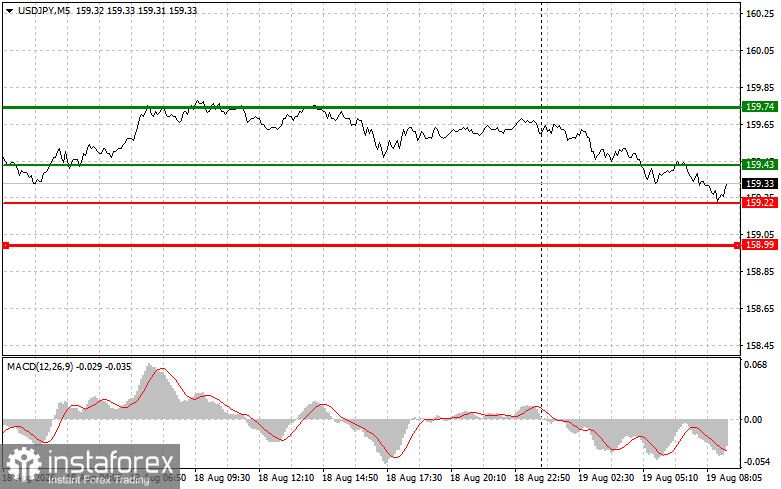
Scenario No. 1: I plan to buy USD/JPY today when it reaches around 159.43 (green line on the chart), targeting a move to 159.74 (thicker green line on the chart). At around 159.74, I plan to exit my long positions and sell in the opposite direction, expecting movement of 30-35 pips from the entry point. It is best to return to buying the pair during corrections and significant pullbacks of USD/JPY. Important! Before buying, ensure that the MACD indicator is above the zero mark and is just starting its rise from it.
Scenario No. 2: I also plan to buy USD/JPY today in the event of two consecutive tests of 159.22, with the MACD indicator in the oversold area. This will limit the pair's downside potential and lead to an upward market reversal. Growth can be expected towards the opposite levels of 159.43 and 159.74.
Sell Scenarios
Scenario No. 1: I plan to sell USD/JPY today after updating the level of 159.22 (red line on the chart), which will lead to a rapid decline of the pair. The key target for sellers will be 158.99, where I plan to exit my short positions and immediately buy in the opposite direction, expecting movement of 20-25 pips in the opposite direction from the level. Sellers could return at any moment; only a hint from the central bank is needed. Important! Before selling, ensure that the MACD indicator is below the zero mark and is just starting its decline from it.
Scenario No. 2: I also plan to sell USD/JPY today if there are two consecutive tests of 159.43 while the MACD indicator is in the overbought area. This will limit the pair's upside potential and lead to a downward market reversal. A decline can be expected towards the opposite levels of 159.22 and 158.99.
What the Chart Shows:
Thin green line – entry price for buying the trading instrument;
Thick green line – estimated price where take profit can be set, or profit can be realized, as further growth above this level is unlikely;
Thin red line – entry price for selling the trading instrument;
Thick red line – estimated price where take profit can be set, or profit can be realized, as further decline below this level is unlikely;
MACD Indicator. When entering the market, it is important to be guided by overbought and oversold zones.
Important: Beginner forex traders need to make entry decisions very cautiously. Before key fundamental reports are released, it is best to stay out of the market to avoid sharp price fluctuations. If you decide to trade during news releases, always set stop orders to minimize losses. Without placing stop orders, you can quickly lose your entire deposit, especially if you do not practice money management and trade large volumes.
And remember, successful trading requires a clear trading plan, as outlined above. Making spontaneous trading decisions based on the current market situation is inherently a losing strategy for intraday traders.
You have already liked this post today
*A análise de mercado aqui postada destina-se a aumentar o seu conhecimento, mas não dar instruções para fazer uma negociação.



 19.08.2026 09:00 AM