
Veja também


 10.11.2026 09:01 AM
The test of the 1.1198 price level occurred when the MACD indicator was just beginning to move upward from the zero line, confirming that it was an appropriate entry point for a long position on the euro. As a result, the pair rose toward the target level of 1.1217.
The euro continued to recover yesterday from the decline that followed Friday's US labor market report, which showed an increase of 165,000 jobs against a forecast of 65,000, while the unemployment rate fell to 4.1%. In the evening, two Federal Reserve officials made comments that would normally support the US dollar, but the euro managed to absorb this pressure as well. Barkin pointed to persistently high prices and the balance of inflation risks, as did Goolsbee.
There will be no eurozone economic data releases during the first half of today, so the potential for further recovery remains. In the absence of economic data, market attention shifts to expectations regarding the ECB, which continue to favor the euro. It is worth recalling that the deposit rate stands at 2.50%, while the market expects a final increase to 2.75% at the December 17 meeting. Meanwhile, eurozone inflation rose to 4.0% in October, compared with 3.8% in September.
Another factor influencing market sentiment is the question of who will succeed Christine Lagarde, whose term as ECB President will end on February 7, 2027. Finance ministers discussed potential candidates for the position yesterday, while EU leaders will return to the issue on November 26–27. Possible candidates include Klaas Knot, who is considered hawkish, and Pablo Hernandez de Cos, who is generally regarded as more dovish. Therefore, any news about the leading candidate could influence market expectations regarding interest rates.
As for the intraday strategy, the focus will primarily be on the implementation of Scenarios #1 and #2.
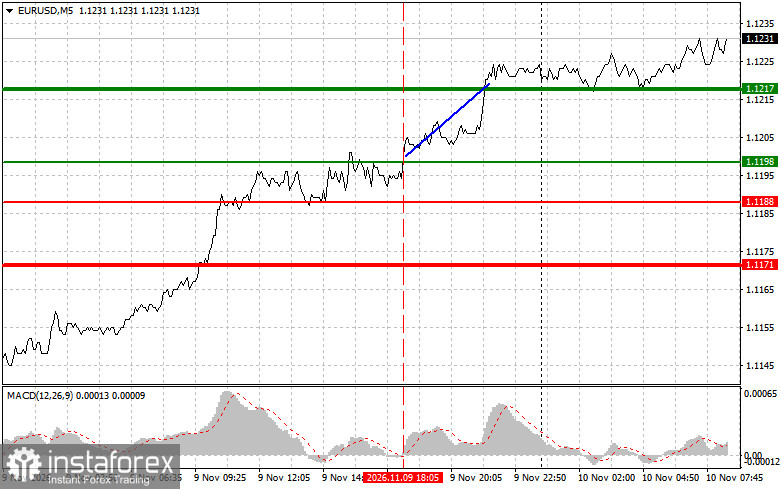
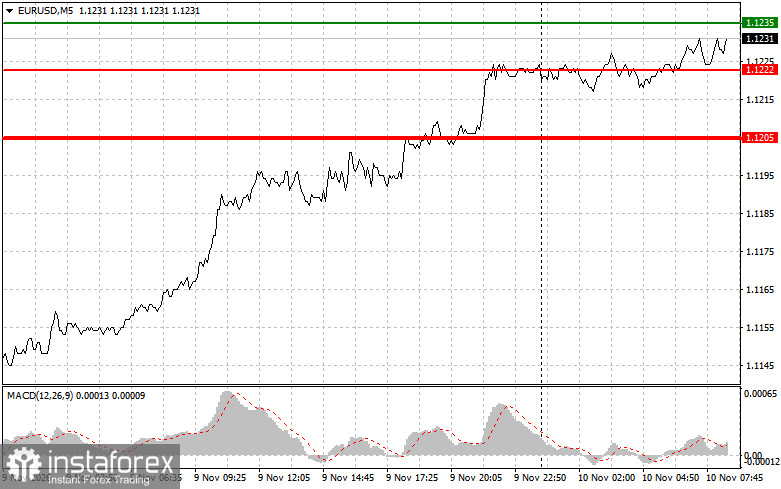
Scenario #1: Today, the euro can be bought when the price reaches the 1.1235 level (the green line on the chart), with an upward target at 1.1257. At 1.1257, the position can be closed, and a short position can also be opened in anticipation of a downward move of 30–35 points from the entry point. Further euro appreciation today can only be expected if economic data are positive.
Important! Before opening a long position, make sure that the MACD indicator is above the zero line and is just beginning to move upward from it.
Scenario #2: The euro can also be bought today if the price tests the 1.1222 level twice consecutively while the MACD indicator is in the oversold area. This would limit the pair's downward potential and trigger a reversal to the upside. A rise toward the opposite levels of 1.1235 and 1.1257 can then be expected.
Scenario #1: The euro is expected to be sold after the price reaches 1.1222 (the red line on the chart). The target will be 1.1205, where the position can be closed and a long position opened immediately in the opposite direction, targeting a 20–25-point move upward from that level. Downward pressure on the pair is likely to return if economic data are weak.
Important! Before opening a short position, make sure that the MACD indicator is below the zero line and is just beginning to move downward from it.
Scenario #2: The euro can also be sold today if the price tests the 1.1235 level twice consecutively while the MACD indicator is in the overbought area. This would limit the pair's upward potential and trigger a reversal to the downside. A decline toward the opposite levels of 1.1222 and 1.1205 can then be expected.
Important. Beginner Forex traders should exercise extreme caution when making entry decisions. Before the release of important fundamental reports, it is generally best to stay out of the market to avoid exposure to sharp exchange rate fluctuations. If trading during news releases, always place stop-loss orders to minimize potential losses. Without stop-loss orders, the entire trading account can be depleted very quickly, especially when position sizing is not managed properly and large trading volumes are used.
It is also important to remember that successful trading requires a clearly defined trading plan, such as the one outlined above. Making spontaneous trading decisions based on current market conditions is inherently a losing strategy for an intraday trader.


