
Vea también


 06.10.2026 01:13 PM
Analysis of Trades and Trading Tips for the Japanese Yen
Due to low market volatility, the levels indicated earlier were not tested during the first half of the day. As a result, no trades were opened.
Today, Bank of Japan Governor Kazuo Ueda spoke. His speech was the first since the rate was raised to 1.25% in September, but the yen showed almost no reaction to his comments. USD/JPY even rose by 0.18% to 158.20. Ueda said that the economy is recovering moderately, inflation is approaching 2%, and the bank will continue raising interest rates. The main point of his speech was that the focus should now be on keeping inflation near its target rather than accelerating it and preventing it from rising too far above the target. According to Ueda, upward pressure on prices is coming from higher raw material costs due to the war with Iran, strong demand for artificial intelligence technologies, and the weak yen.
The market had expected a clearer signal regarding October but instead received confirmation of the previous policy direction without specific timing. Ueda left the pace and timing of future steps open and said that financial conditions remain accommodative, meaning there is room for further rate increases. This is why the yen did not strengthen. For the yen, this means that monetary policy will provide support, but gradually and in stages. The Bank of Japan is clearly not planning to stop raising rates, and each increase gradually reduces the gap with U.S. interest rates, which has contributed to the yen's prolonged weakness. However, as long as the dollar remains strong and U.S. yields remain high, this will not be sufficient to trigger a reversal.
U.S. data and comments from Federal Reserve officials are expected next and will be more important for USD/JPY than Japanese economic data. A dovish tone from FOMC members would support the yen, while USD/JPY would return to sideways trading. Hawkish comments, by contrast, would push the pair higher.
As for the intraday strategy, greater emphasis will be placed on the implementation of Scenarios No. 1 and No. 2.
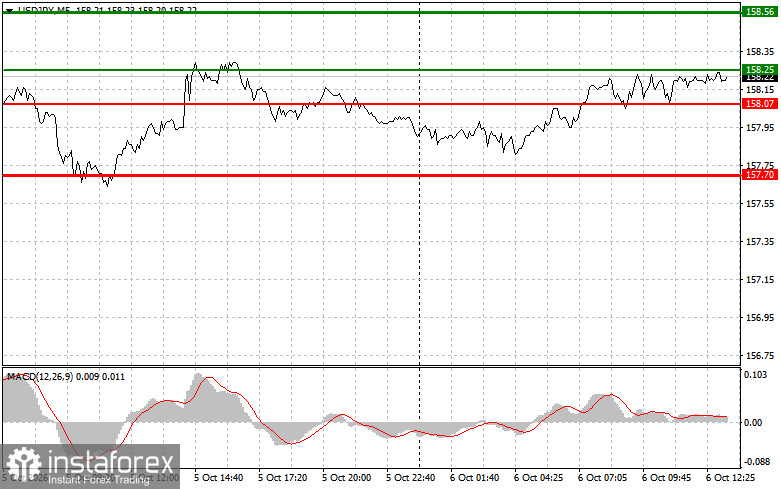
Buy Signal
Scenario No. 1: Today, USD/JPY can be bought when the entry price reaches around 158.25 (the green line on the chart), with the target of rising to 158.56 (the thicker green line on the chart). Around 158.56, the long position can be closed and a short position opened, targeting a 30–35-point move in the opposite direction from the level. A rise in the pair can be expected today, but the potential is relatively limited. Important! Before buying, make sure that the MACD indicator is above the zero line and has just started rising from it.
Scenario No. 2: USD/JPY can also be bought today if the price tests 158.07 twice consecutively while the MACD indicator is in the oversold zone. This will limit the pair's downward potential and may result in a reversal to the upside. A rise toward the opposite levels of 158.25 and 158.56 can be expected.
Sell Signal
Scenario No. 1: Today, USD/JPY can be sold after the 158.07 level is broken (the red line on the chart), which would result in a rapid decline in the pair. The key target for sellers will be 157.70, where the short position can be closed and a long position opened immediately, targeting a 20–25-point move in the opposite direction from the level. Downward pressure on the pair may return today if the central bank intervenes. Important! Before selling, make sure that the MACD indicator is below the zero line and has just started declining from it.
Scenario No. 2: USD/JPY can also be sold today if the price tests 158.25 twice consecutively while the MACD indicator is in the overbought zone. This will limit the pair's upward potential and may result in a reversal to the downside. A decline toward the opposite levels of 158.07 and 157.70 can be expected.
What Is Shown on the Chart:
Important. Beginner Forex traders should exercise extreme caution when making market-entry decisions. Before the release of important fundamental reports, it is preferable to remain out of the market to avoid exposure to sharp exchange-rate fluctuations. If you decide to trade during news releases, always place stop orders to minimize losses. Without stop orders, you can lose the entire deposit very quickly, especially if you do not use proper money management and trade large volumes.
Remember that successful trading requires a clear trading plan, such as the one presented above. Making spontaneous trading decisions based on the current market situation is inherently an unsuccessful strategy for an intraday trader.


