
Vea también


 09.11.2026 07:23 AM
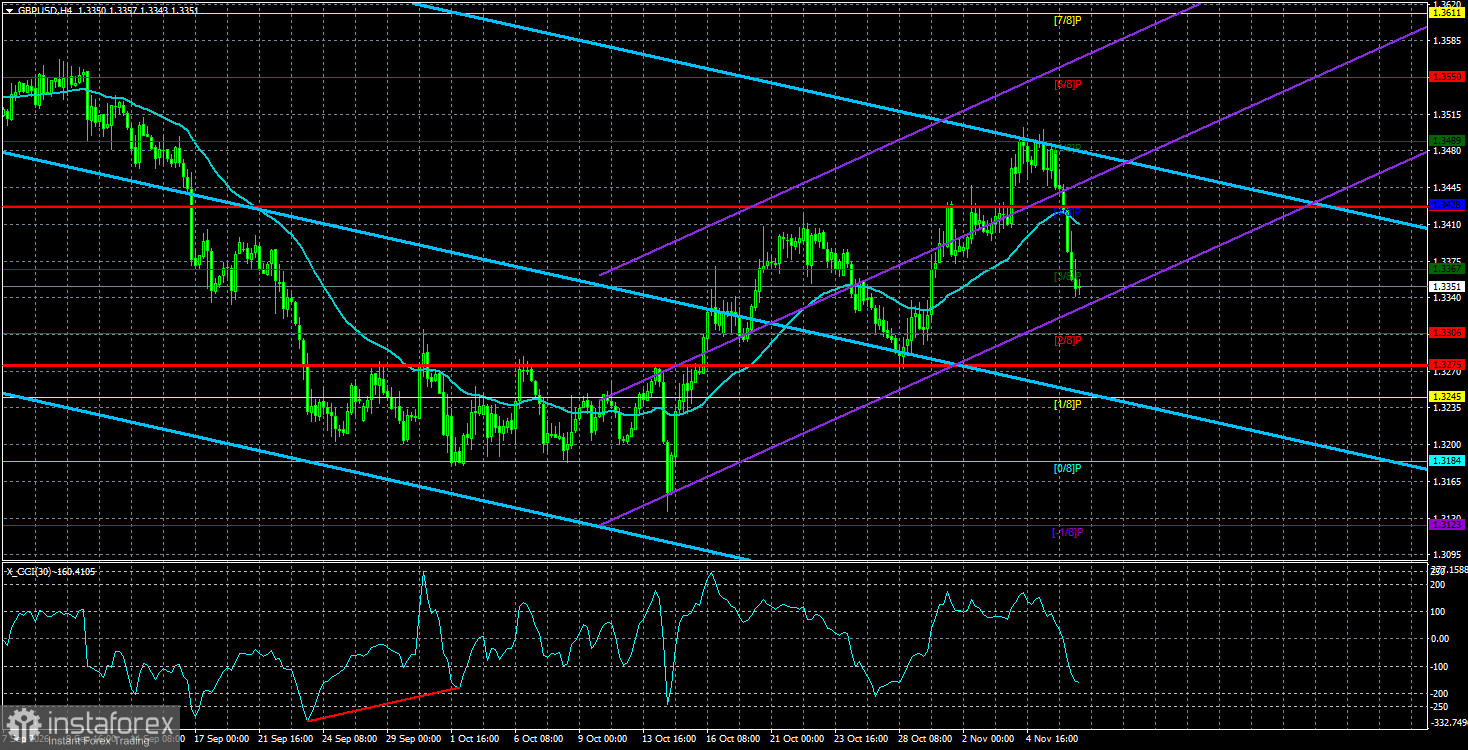
The GBP/USD currency pair also declined on Friday. Just as in the case of the euro, the decline in prices had already begun on Thursday.
The Nonfarm Payrolls report and the unemployment rate certainly also supported the US dollar, but they were not the main reasons for the US currency's strengthening in the second half of last week.
It is worth recalling that although the euro and the pound showed almost identical movements on Thursday and Friday, they had performed very differently over the previous month. The sideways channels on the daily and weekly timeframes remain relevant for the British pound. Therefore, even after the sharp decline on Thursday and Friday, only further growth is expected, at least for technical reasons. It is also worth recalling that the Bank of England began tightening monetary policy last week, and the outcome of the regulator's meeting could even be described as more hawkish than traders had anticipated. All members of the Bank of England's Monetary Policy Committee voted in favor of raising the key interest rate, whereas the market had expected a 7–2 split in the vote.
Thus, there are no grounds for the British pound to fall below the sideways channel on the daily chart. The sideways movement remains intact, while nothing has changed for the US economy so far as a result of the Democrats' victory in the elections. Nothing is likely to change in US politics over the next two months, as the new Congress will not convene until early January. Some time will then be needed to draft bills, followed by prolonged political battles with Donald Trump. These battles will begin with the 2027 budget proposal.
The US economy potentially faces another government shutdown, which is unlikely to boost optimism among dollar bulls. Therefore, the dollar and the pound appear to be in roughly equal positions in the medium term. However, the long-term upward trend that began in 2022 remains intact. The sideways movement will not last forever and will eventually come to an end. Consequently, a renewed rise in the British pound is expected in any case.
What could support the dollar or the pound in the near future? Market attention may turn to the conflicts between Ukraine and Russia, as well as between the United States and Iran. There are slim chances that these conflicts could come to an end, although Kyiv and Moscow remain very far from reaching an agreement. The same applies to Washington and Tehran. However, ordinary citizens and even news agencies that regularly publish insider information are unlikely to have completely reliable information about the progress of negotiations or the positions of all four parties. Therefore, some possibility of peace remains. If peace negotiations at least get underway, energy prices are unlikely to continue rising. This would lead to slower inflation, prompting central banks to adjust their monetary policy outlooks. No one currently knows what these revised outlooks will be, and they cannot be predicted. Therefore, it would be unwise to attempt to forecast developments two months ahead. The main point for now is that the pound remains within the sideways channel between 1.3150 and 1.3780, meaning that it could continue rising toward the channel's upper boundary.
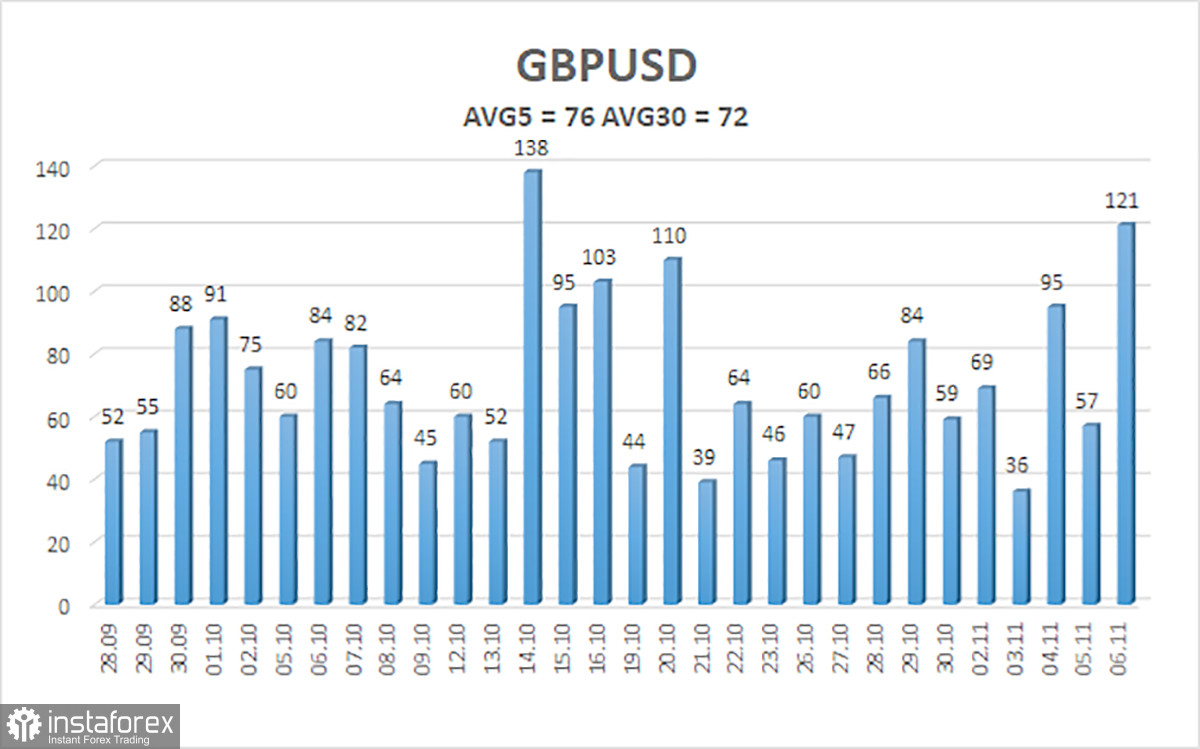
The average volatility of the GBP/USD pair over the last five trading days is 76 points. For the pound/dollar pair, this is an average reading. Therefore, on Monday, November 9, movement is expected within the range bounded by 1.3275 and 1.3428. The upper linear regression channel has turned downward again. The CCI indicator has not recently entered overbought or oversold territory or formed any divergences.
Nearest support levels:
S1 – 1.3367
S2 – 1.3306
S3 – 1.3245
Nearest resistance levels:
R1 – 1.3428
R2 – 1.3489
R3 – 1.3550
Trading Recommendations:
The GBP/USD currency pair continues to follow an upward trend that could form part of the broader trend that began in 2022. Donald Trump's policies will continue to put pressure on the US economy, so no long-term appreciation of the US currency is expected. So far, 2026 has been a positive year for the dollar due to geopolitical developments and inflation, which have prompted capital to seek safe havens and forced the Federal Reserve to resume monetary tightening. However, the weekly timeframe still shows a sideways range between 1.3150 and 1.3780 within the four-year upward trend, supporting expectations of further appreciation in the British pound over the medium term. Long positions with targets at 1.3489 and 1.3550 can be considered when the price is above the moving average. If the price moves below the moving average, short positions with targets at 1.3306 and 1.3275 can be considered.
Explanations for the illustrations:
Linear regression channels help identify the current trend. If both channels point in the same direction, the current trend is strong.
The moving average (settings: 20.0, smoothed) identifies the short-term trend and the direction in which trades should currently be placed.
Murray levels indicate target levels for price movements and corrections.
Volatility levels (red lines) indicate the likely price range within which the pair will trade over the next 24 hours, based on current volatility readings.
The CCI indicator: a move into oversold territory (below -250) or overbought territory (above +250) indicates that a reversal in the opposite direction may be approaching.


