
Xem thêm


 05.10.2026 01:37 PM
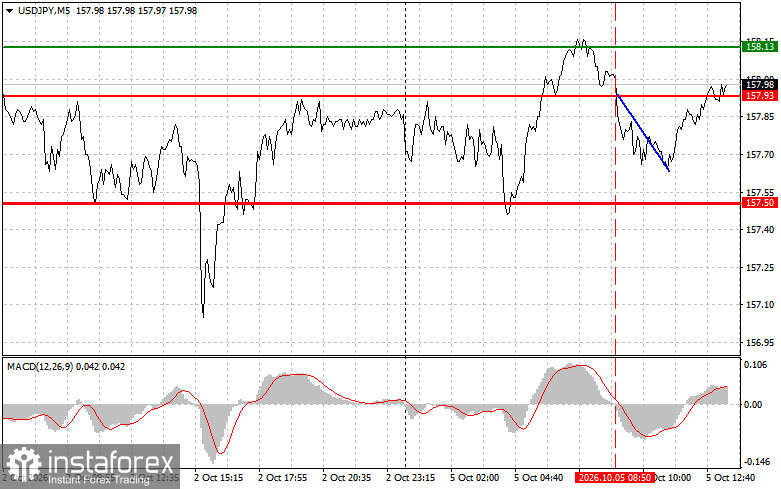
The test of 157.93 occurred when the MACD indicator had just started moving downward from the zero line, confirming the validity of the entry point for selling the dollar. As a result, the pair declined by 15 points.
For the yen, this evening is important because of the impact of Treasury yields. US services data, namely the September PMI, the composite index, and the ISM index, are unlikely to prompt the Bank of Japan to change its plans, but they could easily affect the USD/JPY pair. This is precisely why the market is monitoring each release so closely. If the data are strong, pressure on the pair will return quickly. Strong services data will push Treasury yields higher, and the interest-rate differential will again support the dollar. In that case, the yen will lose some of the support it received during the first half of the day. Let me remind you that the Japanese data released in the morning were neutral anyway. The services business activity index fell to 51.3, while the composite PMI came in at 52.3. They were not enough to provide additional support for the yen, and much will now depend on external factors. Weak US data, on the other hand, will help the yen maintain its upward correction.
As for the intraday strategy, I will focus more on implementing Scenarios No. 1 and No. 2.
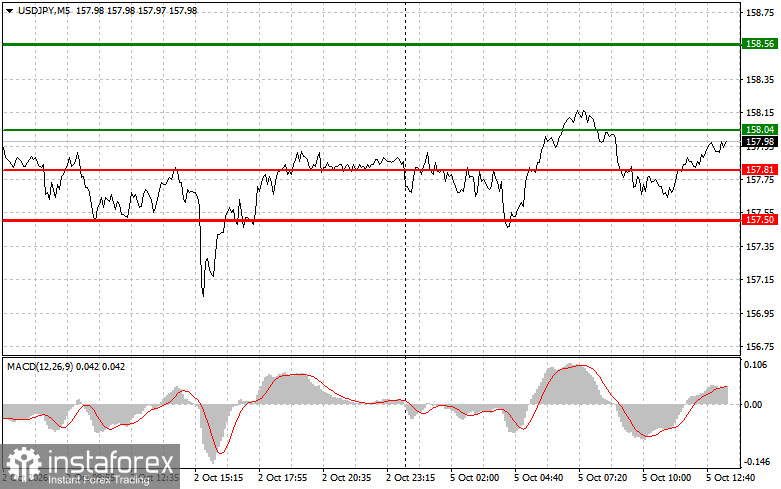
Scenario No. 1: I plan to buy USD/JPY today when the price reaches the entry point around 158.04 (the thin green line on the chart), targeting a rise toward 158.56 (the thicker green line on the chart). Around 158.56, I will close long positions and open short positions, targeting a move of 30–35 points in the opposite direction from the level. A rise in the pair today is possible, but the upward potential is relatively limited. Important! Before buying, make sure that the MACD indicator is above the zero line and has only just started rising from it.
Scenario No. 2: I also plan to buy USD/JPY today if the price tests 157.81 twice consecutively while the MACD indicator is in the oversold area. This will limit the pair's downward potential and may result in an upward reversal. A rise toward the opposite levels of 158.04 and 158.56 can be expected.
Scenario No. 1: I plan to sell USD/JPY today after the 157.81 level is updated (the thin red line on the chart), which should lead to a rapid decline in the pair. The key target for sellers will be 157.50, where I will close short positions and immediately open long positions, targeting a move of 20–25 points in the opposite direction from the level. Pressure on the pair will return today if the central bank intervenes. Important! Before selling, make sure that the MACD indicator is below the zero line and has only just started falling from it.
Scenario No. 2: I also plan to sell USD/JPY today if the price tests 158.04 twice consecutively while the MACD indicator is in the overbought area. This will limit the pair's upward potential and may result in a downward reversal. A decline toward the opposite levels of 157.81 and 157.50 can be expected.
Important. Beginner Forex traders should make entry decisions very carefully. Before the release of important fundamental reports, it is generally best to remain out of the market to avoid exposure to sharp exchange-rate fluctuations. If you decide to trade during news releases, always use stop orders to minimize losses. Without stop orders, you can lose your entire account balance very quickly, especially if you do not use proper money management and trade with large position sizes.
Remember that successful trading requires a clear trading plan, such as the one presented above. Making spontaneous trading decisions based on the current market situation is inherently an unsuccessful strategy for an intraday trader.

