
আরও দেখুন


 05.11.2026 06:41 AM
The EUR/USD currency pair posted a fairly decent gain on Wednesday, although the increase was not particularly strong. Throughout the day on Tuesday, the trading community focused on a single topic: the US Congressional elections. To briefly recap, as expected, the Democrats defeated the Republicans decisively. Now consider this question honestly: did anyone really doubt this outcome? Several months ago, Donald Trump stated that he was prepared to pay every American $5,000 for voting Republican, describing the payment as a "loyalty dividend." However, this proposal was never implemented, and American voters were unwilling to place their trust in Donald Trump once again. Even if Trump had distributed $5,000 to every voter, the election results would probably have changed very little.
It is important to understand that Trump's policy involves giving with one hand and taking back twice as much with the other. What is the point of reducing certain types of taxes under the One Big Beautiful Bill Act, which Trump pushed through, if he collected approximately $300 billion in unlawful tariffs from Americans in 2025 and is making them pay twice as much for fuel throughout 2026? As a result, American voters finally considered the long-term consequences and decided that voting for virtually anyone without political ties to Donald Trump was a better option. Ultimately, the Democrats secured one of their most significant victories in recent decades.
However, elections are one thing, but a change in the composition of Congress alone does little for the dollar, the US economy, or the United States itself. The Democrats must now demonstrate that the American people were right to place their trust in them. Only when positive changes begin to emerge will it be possible to discuss potential changes in the US dollar's exchange rate. For now, the only clear outcome is a decisive and entirely predictable victory for the Democratic Party. Moreover, Donald Trump himself created favorable conditions for the Democrats' success. Given the current state of the country's administration, the Democrats will not need to make much effort to achieve better results. It will be extremely difficult to produce outcomes worse than those under Trump's administration.
Turning back to the economy, the European currency remains close to the bottom of the market. On Wednesday, the European Union published its October inflation report, which showed an increase in the indicator to 4%, in line with forecasts. Although the actual figure matched expectations, those expectations had implied gains for the European currency. However, over the past two months, the euro has failed not only to establish an upward trend but even to produce a meaningful corrective rebound. Consequently, there was once again virtually no market reaction to the inflation report on Wednesday, and market participants once again ignored the ECB's monetary policy outlook, despite the fact that the central bank is expected to raise interest rates for the third time this year at its next meeting.
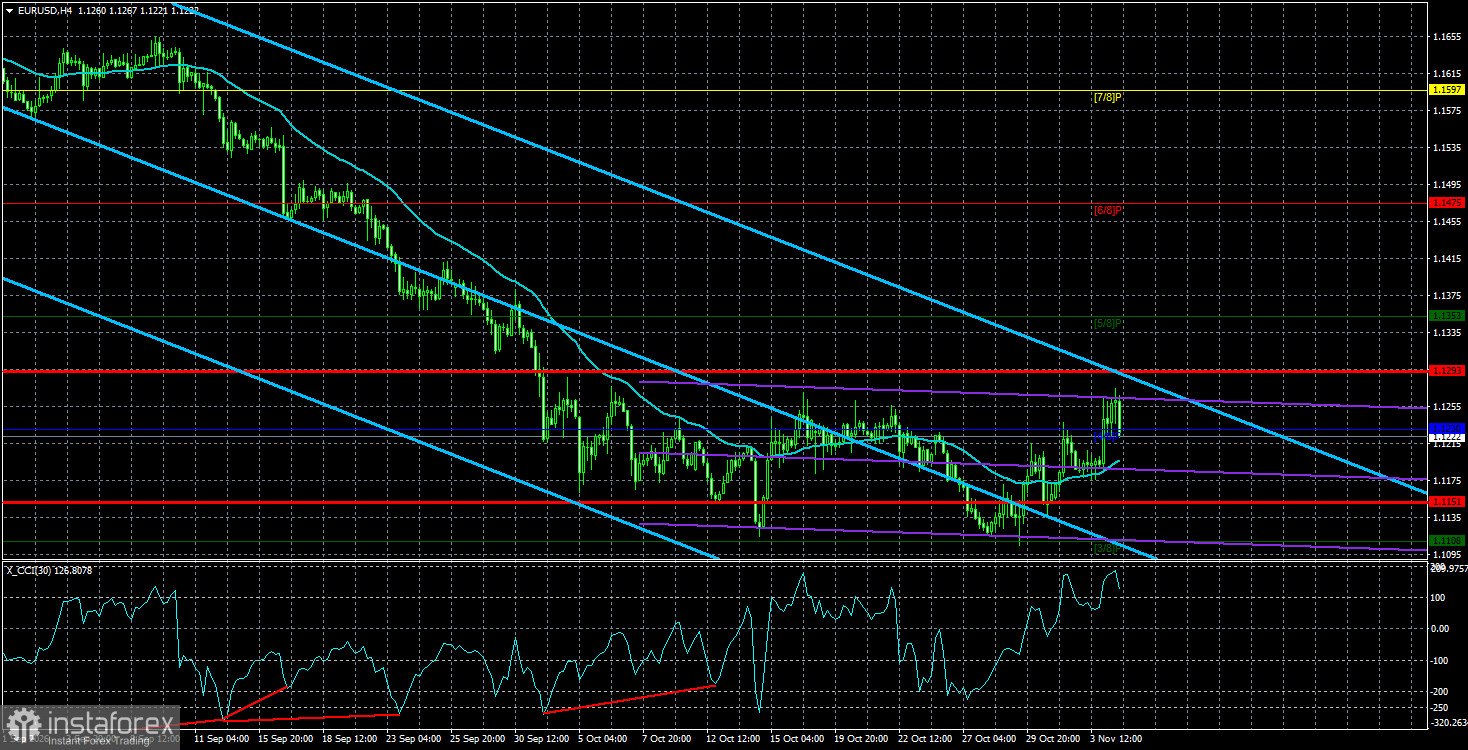
The situation for the European currency remained entirely unchanged on Wednesday. The euro posted another modest gain despite having the potential to rise three times as much. The market continues to largely ignore factors that should support the European currency. The sideways range on the 4-hour timeframe between 1.1110 and 1.1260 remains intact. The daily timeframe continues to show a downward trend, while the weekly timeframe indicates a downward correction. The outlook for the euro is not improving, regardless of the news available to market participants.
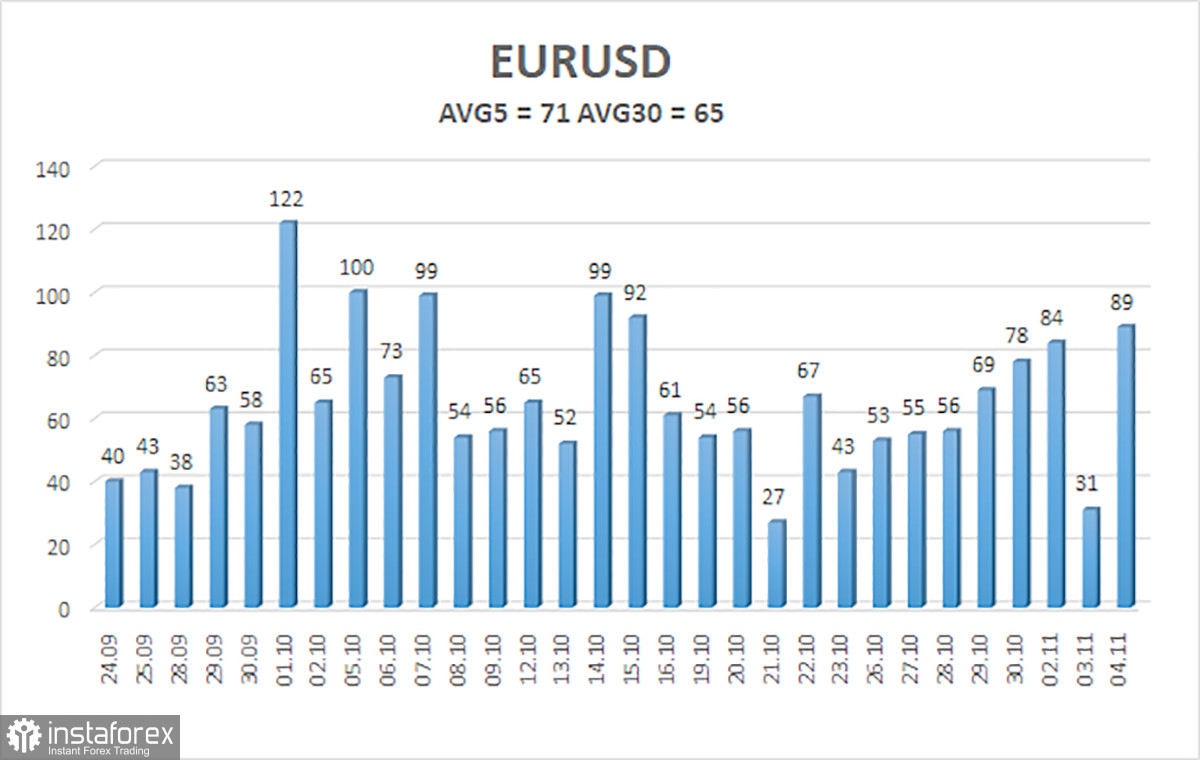
The average volatility of the EUR/USD currency pair over the last five trading days, as of November 5, stands at 71 points and is classified as "medium." On Thursday, the pair is expected to trade between 1.1151 and 1.1293. The upper linear regression channel is pointing downward, indicating another potential trend reversal. The CCI indicator has entered oversold territory five times and formed four bullish divergences, all of which have been ignored by traders. The irrational downward trend remains in place.
Nearest support levels:
S1 – 1.1108
S2 – 1.0986
S3 – 1.0864
Nearest resistance levels:
R1 – 1.1230
R2 – 1.1353
R3 – 1.1475
Trading Recommendations:
The EUR/USD pair remains in a downward trend, despite the lack of sufficient fundamental, macroeconomic, and geopolitical factors to justify its continuation. The overall fundamental outlook for the US dollar remains negative. However, in 2026, geopolitical developments initially, followed by the Federal Reserve's hawkish stance, provided substantial support for the US currency. If the price remains below the moving average, short positions can be considered, with targets at 1.1151 and 1.1108. If the price moves above the moving average, long positions remain relevant, with targets at 1.1293 and 1.1353.
Explanations for the Illustrations:
Linear regression channels help identify the current trend. If both channels point in the same direction, the prevailing trend is considered strong.
The moving average (settings: 20.0, smoothed) identifies the short-term trend and indicates the direction in which trading should currently be conducted.
Murrey levels are target levels for price movements and corrections.
Volatility levels (red lines) indicate the probable price range within which the pair is expected to trade over the next 24 hours, based on current volatility readings.
The CCI indicator: readings below -250 indicate oversold territory, while readings above +250 indicate overbought territory. Such readings suggest that a trend reversal in the opposite direction may be approaching.


