


 05.10.2026 11:40 AM
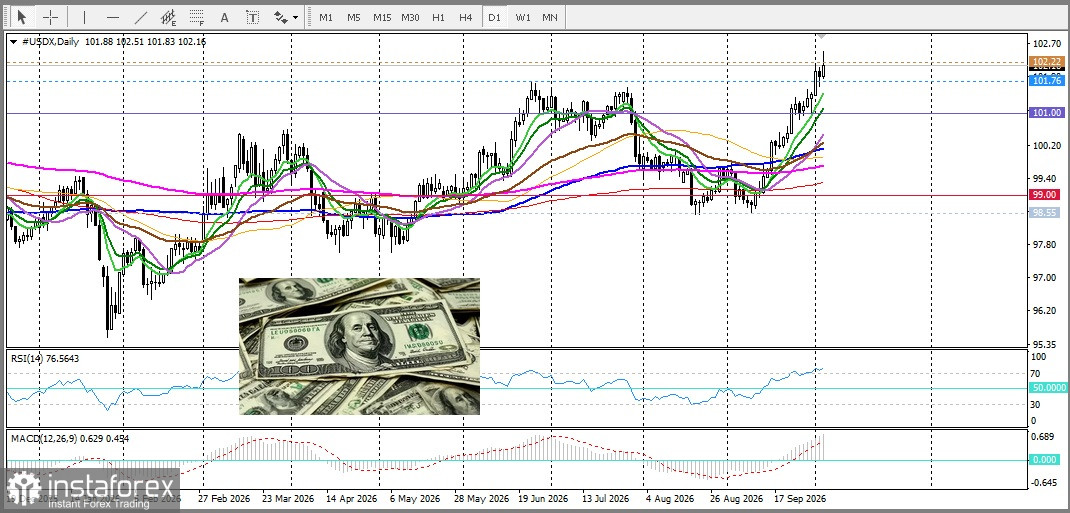
During the early European session on Monday, gold (XAU/USD) is showing a moderate increase but remains within last week's range amid conflicting market signals. Lower expectations for a Federal Reserve interest rate hike in October have led to a decline in US Treasury yields from multi-year highs, providing some support for gold. Nevertheless, the US dollar has strengthened sharply, reaching a new high since April 2025, which limits gold's upward potential.
ABN Amro analysts consider the latest US labor market report to be "consistent with the baseline scenario," noting that "the previous improvement in the labor market observed in the two preceding reports turned out to be something of an illusion." They note that "the three-month average of 51,000 appears fairly stable relative to labor supply, but does not indicate an overheated labor market." Given the slowdown in employment growth, particularly in light of the previously released weak PCE data, the analysts believe that the Fed no longer needs to raise interest rates in October.
Nevertheless, ABN Amro analysts continue to expect further monetary policy tightening by the end of the year, suggesting that "inflationary pressure caused by the energy shock will likely force the Fed to raise rates in December, similarly to what it did in September, in order to prevent higher costs from being passed on to consumer prices and wages."
The CME Group FedWatch Tool also shows that traders currently assess the probability of a rate hike by the end of the year at around 85%. In addition, uncertainty related to conflicts in the Middle East and escalating tensions between Russia and Ukraine continues to support the US dollar as a safe-haven asset. In this context, it is worth noting Iranian Foreign Minister Abbas Araghchi's statement that the conflict with the United States has no military solution, although Tehran is prepared for a possible war. Iranian Parliament Speaker Mohammad Bagher Ghalibaf also stated that the Strait of Hormuz would not be reopened until certain conditions were met.
In addition, Yemen's Presidential Leadership Council Chairman Rashad al-Alimi announced the start of a military operation to retake territories controlled by the Houthis. There were also reports of deadly airstrikes in Ukraine affecting the Kyiv region, Kharkiv, and Dnipro. In response, Ukrainian President Volodymyr Zelenskyy stated on social media that Russia would inevitably face retaliatory measures. These factors maintain a geopolitical risk premium and support the US dollar, requiring a cautious approach from those considering buying gold.
Today, attention should be paid to the release of the US ISM Services PMI. These data, together with speeches by influential members of the Federal Open Market Committee (FOMC), are expected to provide new signals for gold price movements.
From a technical perspective, XAU/USD maintains a bearish bias in the short term, remaining below key moving averages. The pair is supported by a zone slightly above the round level of 4100. The immediate resistance is provided by the round level of 4200. The oscillators are negative, confirming the sellers' advantage.


