
Lihat juga


 10.11.2026 01:37 PM
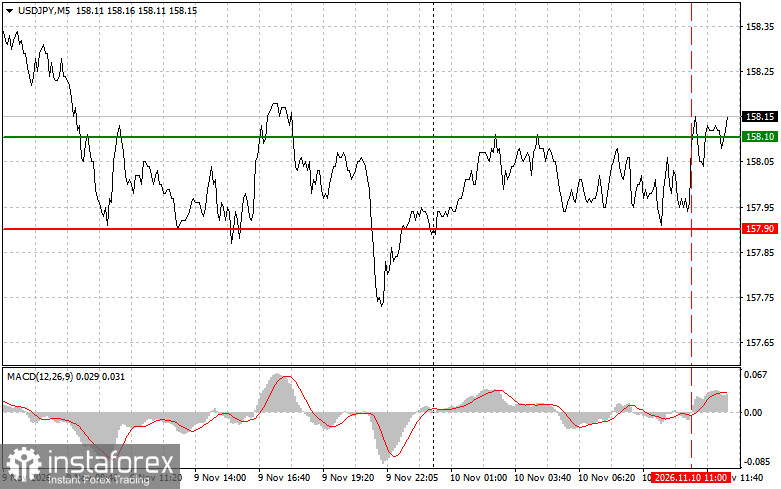
The price test at 158.10 in the first half of the day occurred as the MACD indicator began to move up from the zero line; however, this did not lead to a large rally in the pair.
Japan's data today proved unconvincing for the yen. The current-account surplus in September was £1,817.7 billion against expected £2,790.0 billion and £2,910.5 billion a month earlier, while bank lending grew 5.2% versus an expected 5.4%. A weaker external balance reduces inflows of foreign currency that normally support the national currency, and the deterioration in sentiment indicates that domestic demand remains fragile.
Attention now shifts to the US consumer-price index for October, expected at 0.3% after 0.6% in September, with core at 0.2% after 0.3%. After the September report, the dollar jumped sharply on October 14 even though inflation merely matched forecasts, and a repeat reaction is possible. Ten-year US Treasury yields around 4.87% versus 5.02% on October 28 give the dollar somewhat less support, but the probability of a Federal Reserve hike in December is close to 80%, and speeches by Waller and Bowman could cement that outlook.
The Bank of Japan remains an important counterweight. The policy rate is 1.25%; on October 30 the committee kept it by an 8–1 vote. Many expect a hike in December because nominal wages rose 4.6% in September versus a forecast of 3.8% and 3.9% a month earlier. But with weak current accounts and business sentiment, that argument is insufficient to guarantee a strong yen. In my view, a sharp rise in US inflation and hawkish comments from Federal Reserve officials will leave yen buyers with little chance, while soft prints would give the pair room for a correction.
For intraday strategy, I will mainly rely on the implementation of scenarios No. 1 and No. 2.
Scenario No. 1: I plan to buy USD/JPY today when the entry point around 158.25 (green line on the chart) is reached, with a target of rising to 158.65 (thicker green line on the chart). Around 158.65, I will exit long positions and open short positions in the opposite direction (expecting a 30–35 pip move away from the level). Expect the pair to rise today only after strong US data. Important! Before buying, make sure the MACD indicator is above the zero line and is just beginning to rise from it.
Scenario No. 2: I also plan to buy USD/JPY today in the event of two consecutive tests of 158.03 while the MACD indicator is in the oversold area. This will limit the pair's downside potential and lead to an upward reversal. You can expect a rise to the opposite levels of 158.25 and 158.65.
Scenario No. 1: I plan to sell USD/JPY today after the 158.03 level breaks (red line on the chart), which will lead to a rapid decline in the pair. The key target for sellers is 157.59, where I will exit shorts and immediately open longs in the opposite direction (expecting a 20–25 pip move away from the level). Pressure on the pair today will return if there is central-bank intervention. Important! Before selling, make sure the MACD indicator is below the zero line and is just beginning to fall from it.
Scenario No. 2: I also plan to sell USD/JPY today in the event of two consecutive tests of 158.25 while the MACD indicator is in the overbought area. This will limit the pair's upside potential and lead to a downward reversal. You can expect a decline to the opposite levels of 158.03 and 157.59.
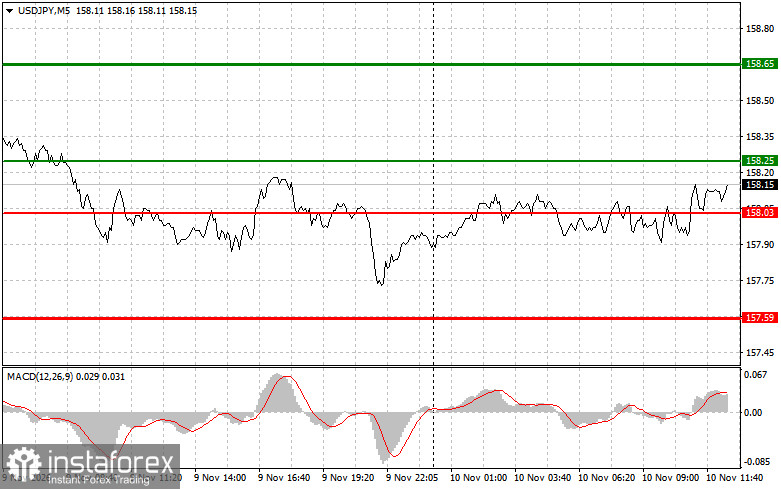
Thin green line – the entry price at which you can buy the trading instrument;
Thick green line – the suggested price where you can place a Take Profit or manually lock in gains, since further upside above this level is unlikely;
Thin red line – the entry price at which you can sell the trading instrument;
Thick red line – the suggested price where you can place a Take Profit or manually lock in gains, since further downside below this level is unlikely;
MACD indicator. When entering the market, it is important to follow the overbought and oversold zones.
Important. Beginner Forex traders must be very cautious when making entry decisions. Before the release of important fundamental reports, it is best to stay out of the market to avoid getting caught in sharp price swings. If you decide to trade during news releases, always place stop orders to minimize losses. Without stop orders, you can quickly lose your entire deposit, especially if you don't use money management and trade large volumes.
Remember, successful trading requires a clear trading plan, like the example I presented above. Spontaneous trading decisions based on the current market situation are a losing strategy for an intraday trader from the start.


