
यह भी देखें


 24.04.2026 08:38 PM
The EUR/USD pair remains within a weak corrective pullback. There is very little distance left to "bullish" imbalance 13, but it is important to remember that the negotiation setting remains the key theme in the market. Throughout the week, traders expected negotiations between Iran and the United States almost every day. However, instead of talks, they received only unfavorable news, which pointed more toward the inevitability of renewed conflict in the Middle East rather than a lasting ceasefire. Only today did it become known that the Iranian delegation may arrive in Islamabad on Friday evening. However, it should be noted that the American delegation, led by J.D. Vance, is also expected to be in Islamabad at the same time. It would make sense for these delegations to meet. Therefore, it is too early to be optimistic about the planned negotiations, as there are no confirmed facts indicating that they will actually take place. If tomorrow it becomes clear that the delegations once again failed to meet or that the second round of talks collapsed, bears may resume their attacks on Monday.
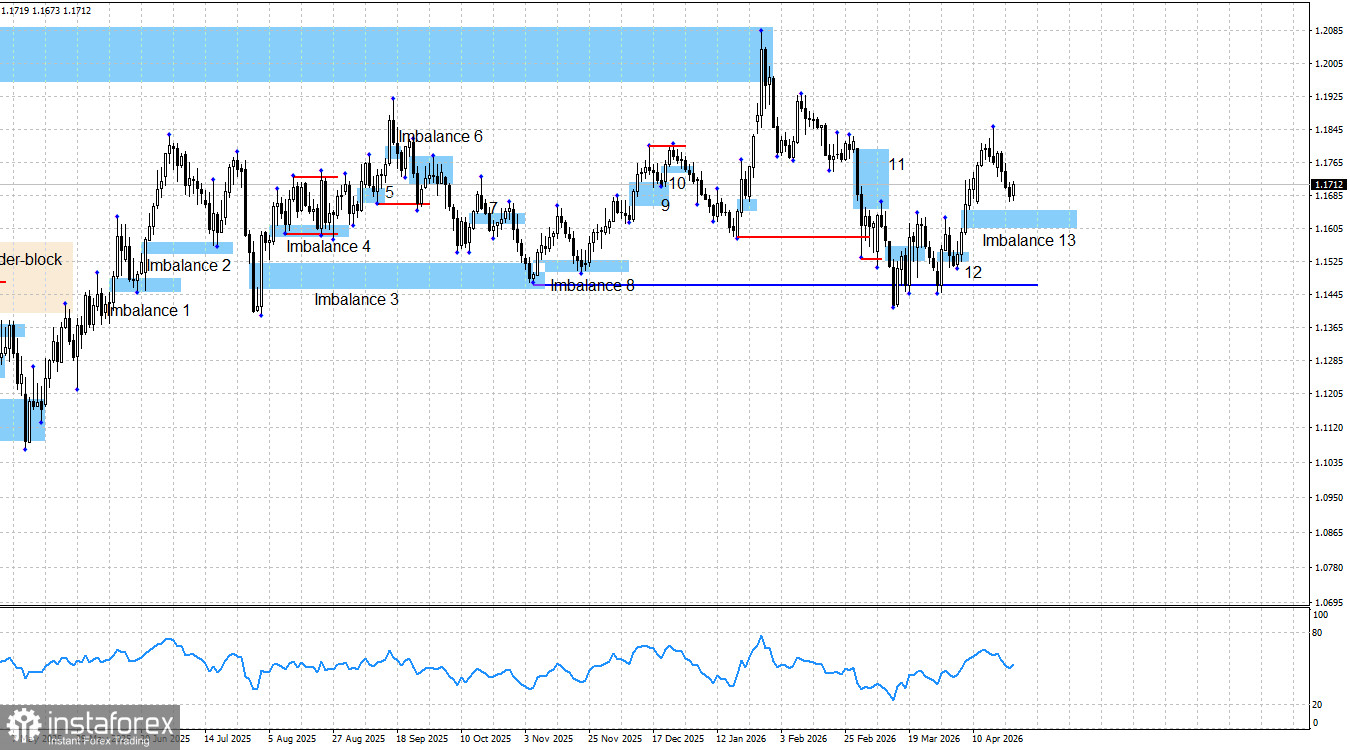
In the current circumstances, traders can only wait for the price to react to imbalance 13. There are no other clear buying zones at the moment, and the trend is still considered "bullish." Therefore, the focus remains primarily on buy signals. The last buy signal from imbalance 12 worked perfectly, with the euro gaining around 270 points. There are currently no bearish patterns, so sell signals are neither expected nor considered.
It is worth noting that all of the U.S. dollar's growth over the past one and a half to two months has been driven solely by geopolitics. As soon as the U.S. and Iran agreed to a two-week ceasefire, bears immediately retreated and bulls rushed in. At present, the ceasefire remains fragile but intact, despite the failed negotiations last Saturday and the cancellation of talks on Monday, Tuesday, and Wednesday. I have repeatedly stated that I do not believe in the end of the bullish trend, despite the break of important trend-forming lows. The price movement over the past two months could evolve into a bearish trend if geopolitics deteriorates further. However, markets often price in the most pessimistic scenario in advance, trying to anticipate the most extreme developments. Therefore, it is possible that traders have already fully priced in the geopolitical conflict in the Middle East.
The overall chart picture is currently clear. First, the price showed no reaction to imbalance 11. Second, it reacted to imbalance 12, forming a bullish signal within a bullish trend. Third, a new bullish imbalance 13 has formed, which represents a zone of interest for future buy trades as well as a support area for the euro.
The news background on Friday was extremely weak, so traders ignored reports from Germany and the United States without hesitation. On Thursday, they also ignored PMI data released across several countries, as well as important reports on unemployment and inflation in the United Kingdom. Thus, even if geopolitics is not the sole driver of the market right now, it still plays a major role.
There are still many reasons for bulls to remain active in 2026, and even the outbreak of conflict in the Middle East has not reduced them. Structurally and globally, Trump's policies—which led to a significant decline in the dollar last year—have not changed. In the near term, the U.S. currency may occasionally strengthen due to risk aversion, but this factor requires ongoing escalation in the Middle East, which is unsustainable. Just two weeks of pause allowed the euro to recover by 60%. There are no other strong supporting factors for the dollar. I still do not believe in a bearish trend. The dollar has received temporary support, but what will sustain bearish momentum in the long term?
Economic Calendar for the U.S. and the Eurozone:
On April 27, the economic calendar contains only one minor event. The impact of the news background on market sentiment on Monday is likely to remain very weak.
EUR/USD Forecast and Trading Tips:
In my view, the pair remains in the stage of forming a bullish trend. The news background shifted sharply two months ago, but the trend itself cannot be considered canceled or completed. Therefore, bulls may well continue their advance in the near term, unless geopolitics suddenly turns toward renewed escalation.
Bulls had the opportunity to open long positions based on the signal from imbalance 12, and the upward movement may continue toward the yearly highs. A new imbalance 13 has also formed, which may soon provide another bullish signal. For uninterrupted euro growth, the Middle East conflict would need to move toward lasting peace, which is not currently the case. However, bears also lack new reasons to attack. In the near term, I would rely primarily on technical analysis.

