
यह भी देखें


 25.09.2026 12:27 PM
The morning session was sluggish: many currency pairs were clearly waiting for direction, and neither the euro nor the pound managed to establish its own trend, remaining largely driven by the broader backdrop surrounding the U.S. dollar rather than by their own domestic news.
The eurozone released a batch of economic data, and the picture was mixed. Germany's GfK consumer climate index for October fell sharply to -30.6 points, compared with expectations of -27.1. This means that German households are considerably more pessimistic than analysts had expected, while the index itself reflects consumers' willingness to spend and make major purchases. Eurozone private-sector lending for August was also weaker than forecast, rising by 3.1% versus the expected 3.2%, while the M3 money supply matched expectations at 3.5%.
There were no data releases from the United Kingdom today, so the pound moved solely in line with the broader market sentiment. Interestingly, the euro reacted very weakly to this entire batch of European data, continuing the trend that has already developed this week. Even the strong morning data on German business activity and business climate previously failed to give the pair sustained directional movement. In my view, the reason for this lack of momentum lies not in the quality of the European indicators themselves, but in the fact that the market is currently focused elsewhere.
Next, all attention will be focused on U.S. Treasury yields, which are holding near their ten-year highs. It is yields, rather than the latest economic data, that are currently determining sentiment toward the U.S. dollar. As long as Treasury yields remain attractive to buyers, the dollar continues to receive support almost automatically, regardless of specific economic releases.
If you are interested in the data, the market will have to digest several developments in the second half of the day. Durable goods orders will be released, showing whether U.S. businesses are willing to invest in equipment and machinery despite high borrowing costs. The University of Michigan Consumer Sentiment Index, along with inflation expectations, will also be released, indicating how concerned ordinary Americans are about rising prices amid high oil prices. John Williams and Beth Hammack will also speak, but I do not expect any surprises here. Given that virtually all Fed officials have already taken a hawkish stance this week, including Tom Barkin and Susan Collins, today's comments themselves are unlikely to become an independent market trigger.
The negotiations between the United States and Iran regarding the Strait of Hormuz will also provide a significant backdrop, potentially affecting oil prices and, consequently, inflation expectations on both sides of the Atlantic. For the euro and the pound, this means that if today's U.S. economic data are strong, they will only confirm the prevailing consensus in favor of further Fed tightening, making it extremely difficult for either pair to find a reason for an independent recovery.
Momentum
For the euro, the key level on the upside is 1.1389. A breakout above it could take the pair toward 1.1414 and then 1.1433. Such a scenario is realistic only if durable goods orders are clearly weak or today's Fed speakers adopt an unexpectedly dovish tone. So far, neither scenario appears likely. I consider a downside breakout below 1.1362 much more likely, with targets at 1.1335 and 1.1312, as both high Treasury yields and the Fed's established hawkish stance continue to weigh on the single currency.
For the pound, the upside level is 1.3252, above which the pair could move toward 1.3282 and then 1.3313. However, the pound simply has no domestic drivers for such a move today, unless the U.S. dollar unexpectedly weakens following the evening data. A downside break below 1.3215, with targets at 1.3180 and 1.3140, looks more logical, especially since the pound has moved passively throughout the day, following the sentiment toward the U.S. dollar.
Mean Reversion
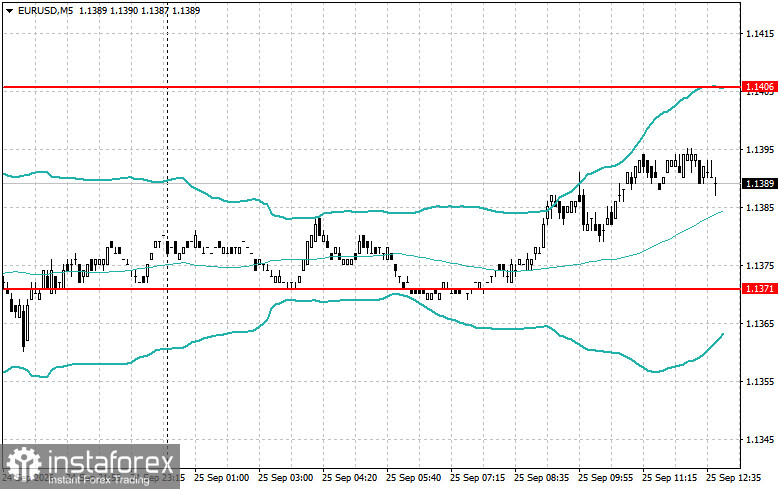
For the euro, I am watching the upper boundary at 1.1406. The idea is simple: the pair attempts to move above this level, but there are not enough buyers to sustain the move, and the price falls back below it, generating a sell signal. Given the euro's current lack of momentum and high U.S. Treasury yields, this scenario appears reasonable. The lower reference level at 1.1371 works according to the opposite logic. However, buying here should be approached with caution, as a sustained rebound will be difficult without a clear deterioration in U.S. economic data, and it would be reasonable to keep the target for such a trade modest.
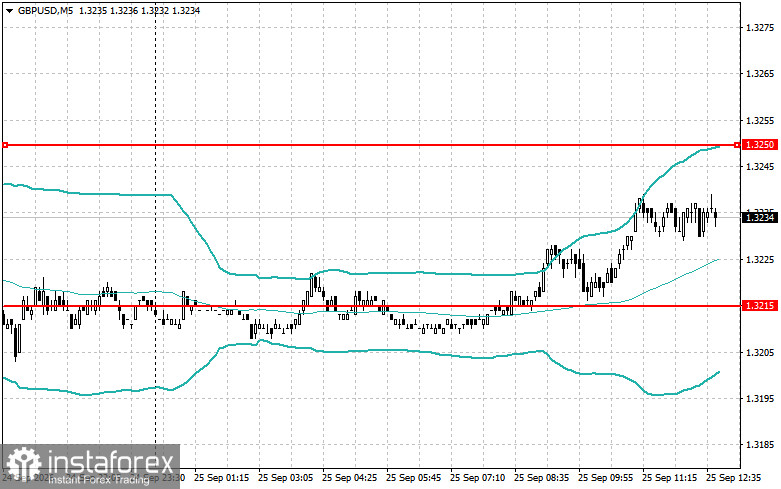
For the pound, the upper boundary is 1.3250. The same reversion setup applies here, and given the complete lack of domestic drivers for the pound today, a false breakout to the upside followed by a quick return inside the range appears to be a plausible scenario. The lower reference level at 1.3215 implies buying on a rebound after a false downside break. However, this level should be approached with caution, as the evening release of U.S. economic data and comments from Fed officials could still significantly change the market situation before the end of the session.

