
Lihat juga


 14.01.2026 07:13 AM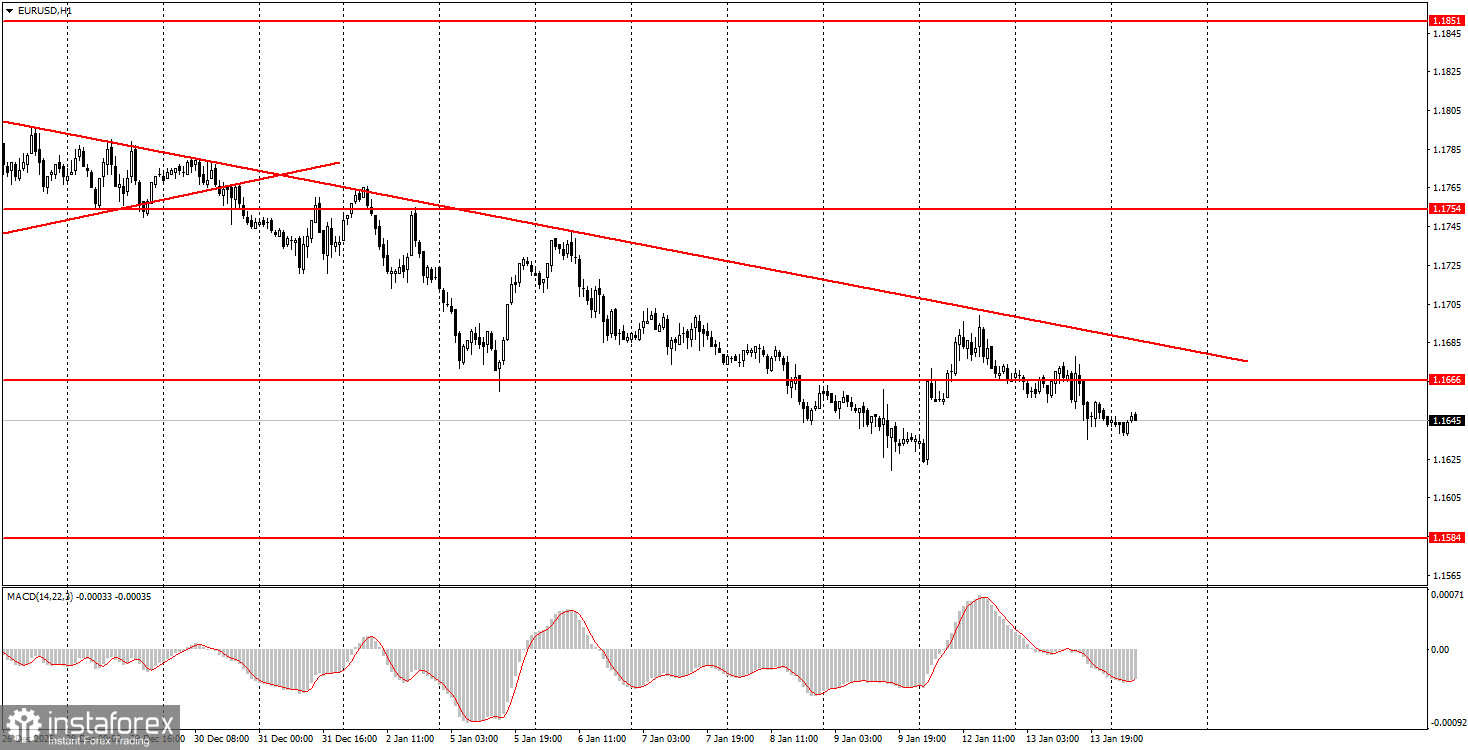
The EUR/USD currency pair remains in a local downtrend. There have already been enough events this week alone for the price to have "flown" up or down by several hundred pips, yet the market continues to rest. For example, yesterday, an important US inflation report for December was published. This report is one of the few that really affects Fed monetary policy. Despite its "bland" value matching forecasts, the market reaction was essentially absent. The total volatility for the day was 43 pips. Thus, we continue to believe that we are observing purely technical weakening of the euro within the sideways channel 1.1400–1.1830 on the daily TF. This channel began forming in June last year. Therefore, the pair has been in a flat for the seventh consecutive month. Hardly any trader believes that the fundamental background is the reason for the pair's sideways movement for 7 months straight.
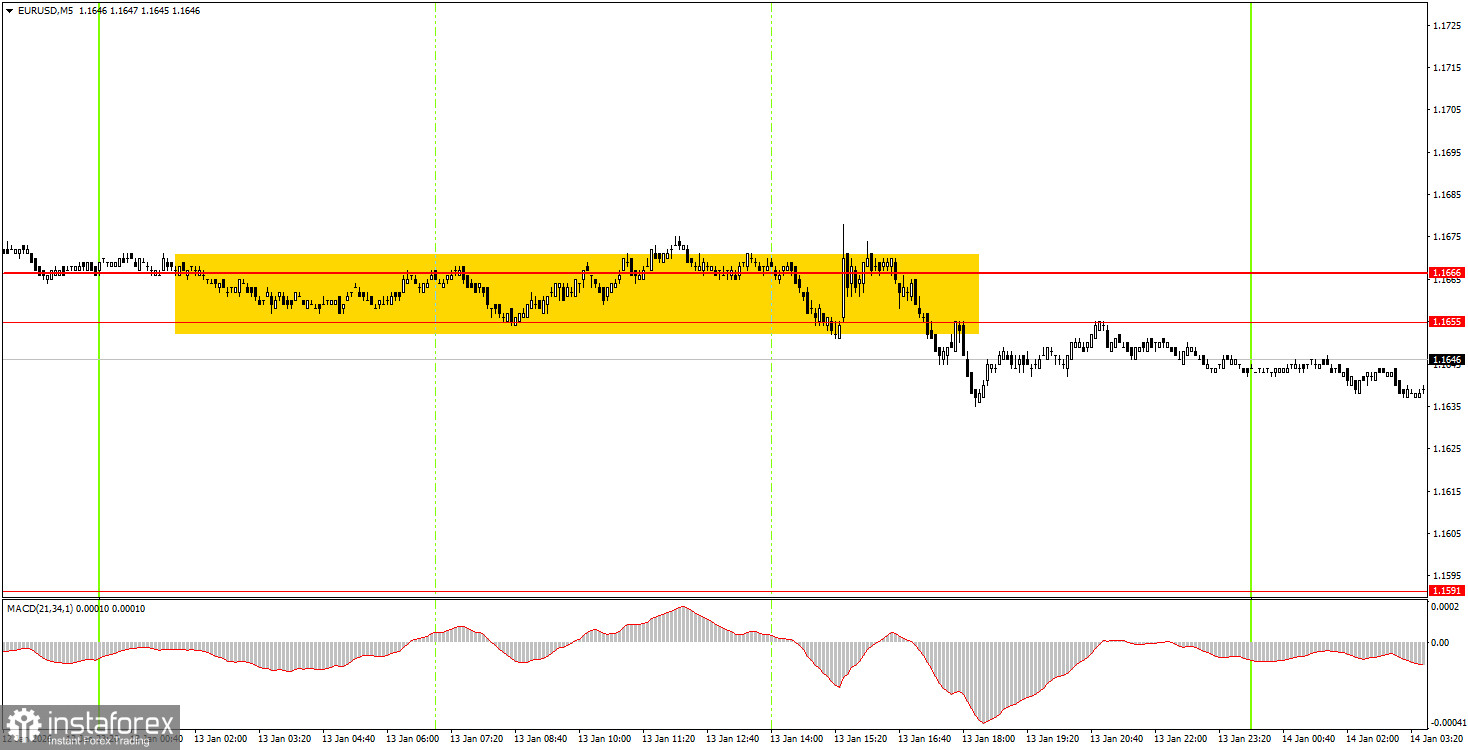
On the 5-minute TF on Tuesday, the pair traded with minimal volatility and moved almost entirely sideways until late in the evening. Only the notorious US inflation report allowed the dollar to strengthen by about 20 pips, triggering a sell signal. However, the decline was short-lived. Novice traders could have earned about 10–15 pips on that signal at best. No other signals were formed.
On the hourly timeframe, the downtrend formation continues, as evidenced by the trendline. It was not possible to overcome the 1.1800–1.1830 area, which is the upper boundary of the daily TF flat, so the technical decline is logical and may continue down to 1.1400. The overall fundamental and macroeconomic background remains very weak for the US dollar, but the daily TF flat plays a priority role, and traders practically ignore the macro background.
On Wednesday, novice traders can again trade from the 1.1655–1.1666 area. A rebound from this area will allow opening short positions with a target of 1.1584–1.1591. A close above this area will make longs relevant with a target of 1.1745–1.1754.
On the 5-minute TF, consider the levels 1.1354–1.1363, 1.1413, 1.1455–1.1474, 1.1527–1.1531, 1.1550, 1.1584–1.1591, 1.1655–1.1666, 1.1745–1.1754, 1.1808, 1.1851, 1.1908, 1.1970–1.1988. Today, no important events or reports are scheduled in the EU, but several secondary US reports will be released, including the Producer Price Index and retail sales. The market continues to trade with minimal volatility, so we do not expect these reports to rouse it.
Support and resistance price levels — levels that serve as targets when opening buys or sells. Take Profit can be placed near them.
Red lines — channels or trendlines that reflect the current tendency and show which direction is preferable to trade now.
MACD indicator (14,22,3) — histogram and signal line — an auxiliary indicator that can also be used as a source of signals.
Important speeches and reports (always listed in the news calendar) can strongly affect a currency pair's movement. Therefore, during their release, trading should be done with maximum caution, or positions should be closed, to avoid a sharp price reversal against the preceding move.
Beginner forex traders should remember that not every trade can be profitable. Developing a clear strategy and effective money management are the keys to long-term trading success.


