
Lihat juga


 03.11.2026 08:58 AM
Yesterday, the euro strengthened against the dollar, and the pound showed similar attempts to rise, but later U.S. data returned some of the lost ground to the dollar. The main impulse for the euro and the pound came in the first half of the day from final manufacturing activity indexes; in the second half that impulse was partially offset by U.S. releases, and today the market's attention shifts from statistics to the midterm elections.

The eurozone manufacturing PMI printed 52.7 versus the forecasts and the preliminary estimate of 52.4, according to S&P Global. The indicator was 52.9 in September, so this looks more like a pleasant surprise relative to expectations than a fresh acceleration. A reading above 50 signals sector expansion, and that was enough to prompt euro buying. The regional picture remains uneven: Germany confirmed 54.2, while France rose from 49.3 to 49.5 and still remains below the 50 threshold. In the U.K. the PMI was 52.8, matching the forecast and the preliminary estimate, compared with 51.9 in September. Note that this resilience in industry supports the scenario priced into ECB expectations. On October 29 the Council kept the deposit rate at 2.50%, though Lagarde signaled that a hike had been discussed. "If nothing big happens, the direction is quite clear for everyone," she said at the press conference. The market expects a final step to 2.75% at the December 17 meeting.
U.S. releases that followed were stronger. The ISM manufacturing index for October came in at 55.5 versus a forecast of 54.5 and a prior value of 54.5. The prices component fell to 75.2 from the previous 77.9 (forecast 77.2) but remains very high, while S&P Global's U.S. manufacturing PMI was weaker than expected at 54.9 versus 56.0. In my view the market favored the ISM headline because production and factory employment continue to support the economy and Fed rate expectations have not shifted materially.
The causal chain is straightforward. Strong manufacturing activity lifts wages and consumer spending, which supports growth and inflation, and all of this pushes the Fed toward tighter policy. Recall that U.S. Q3 GDP rose 3.4% (annualized) versus a forecast of 3.2% and 2.2% in Q2, while core PCE accelerated to 3.6% year-on-year in September. On October 28 the Fed left rates at 3.75–4.00% with a 10–2 vote; two policymakers voted for a hike. The market assessed the probability of a move to 4.00–4.25% on December 9 at roughly 85%. The dollar reacted with a firm gain against the euro and the pound, but market equilibrium held, and, for now, the balance still slightly favors buyers of the euro and the pound.
As for today, there is little point in scanning the economic calendar: no major eurozone releases are expected, and the vacuum will be filled by the U.S. midterms. All 435 House seats are up for election and about one-third of Senate seats. Experts expect Democrats are likely to win the House; Cook Political Report forecasts a Democratic gain of 12–25 seats. The Senate fight is harder: Democrats need to flip four seats, and Republican seats in Alaska, Iowa, Kansas, Ohio and Texas remain under pressure but are not easy to overturn. The backdrop includes Trump's weak economic approval, the September CPI at 3.7% and higher energy prices from the conflict with Iran.
What does this mean for markets? Yields typically move first on elections, then the dollar and gold follow. I will not dwell on gold—it lost about 4% in October and fell toward $4,000—while Brent rose about 12% in the month and was $116.06 on October 30, so a usual defensive reaction to the U.S.–Iran conflict is not evident. The dollar's direction will depend on the reasons behind any rise in yields. If yields climb on hopes for a strong economy, the dollar usually strengthens, as it did in recent autumn weeks. If yields rise on concerns about public finances, I expect the dollar to weaken and the euro and pound to get greater upside potential. Notably, tomorrow the U.S. Treasury will publish its quarterly refunding statement, and U.S. government debt has reached $40 trillion. Trump has pledged to veto bills if Democrats take both the House and the Senate. A separate risk comes from Iran: there was little activity before the vote, but plans for strikes have been discussed for the post-election period, and a fresh outbreak would leave euro and pound demand—as risk assets—weak.
For the pound, a separate catalyst is the Bank of England meeting on November 5. The rate now stands at 3.75%; in September the vote to hold was 6–3, with three members in favour of a 25-bp hike. Many expect a rise to 4.00%; MUFG on October 28 saw such a move as nearly fully priced, and S&P Global's Chris Williamson called a hike almost inevitable after the flash PMI. While that scenario is not yet realized, the pound still has upside potential, although I view the current rate level as a constraint on further gains.
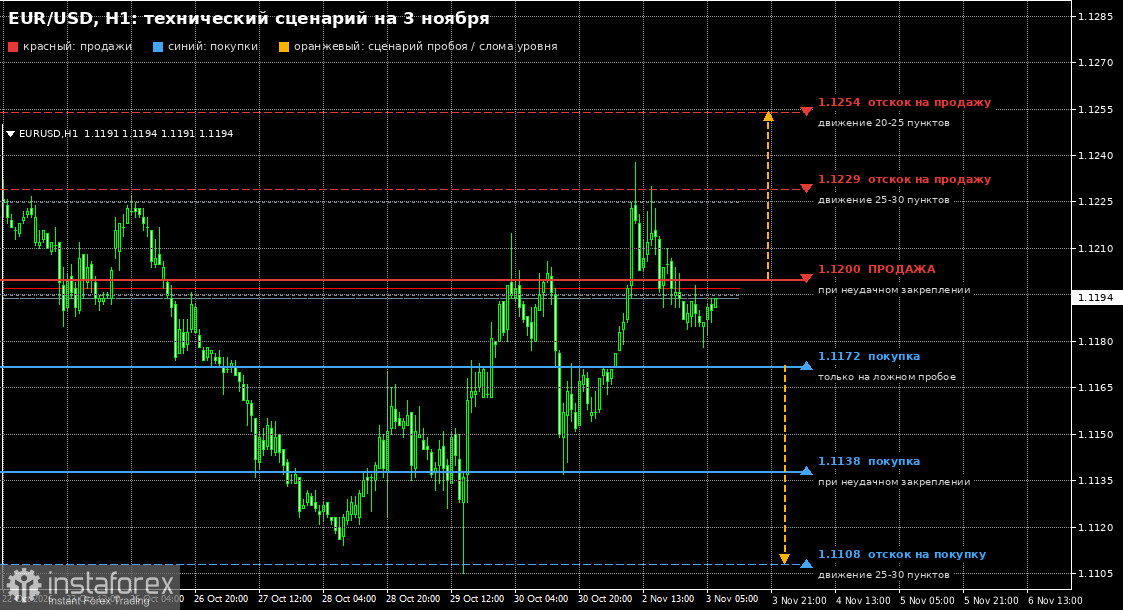
EUR/USD—I consider buys on a drop to 1.1172 on a false break, from 1.1138 on a failed close below, or on a bounce from 1.1108 targeting 25–30 pips. For shorts, bears will show interest at 1.1200 on a failed close and on rallies from 1.1229 targeting the same 25–30 pips. I view short-on-bounce trades from 1.1254 with a 20–25 pip target as viable.
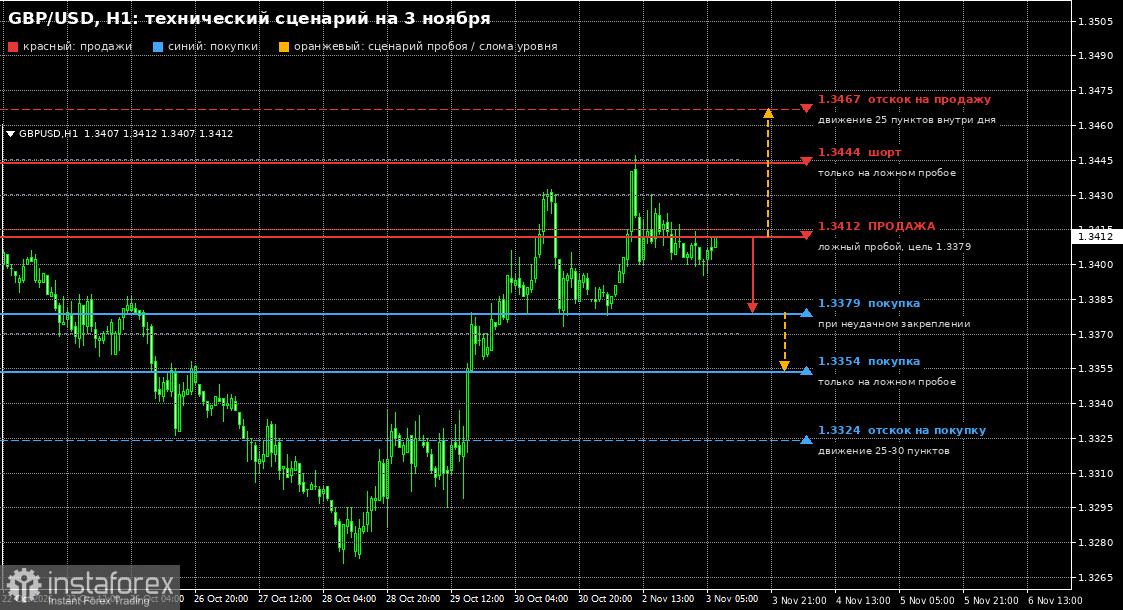
GBP/USD—if bears do not act at 1.3412, a false break of that level would be the signal to open shorts. A break and close above 1.3412 would allow an impulse toward 1.3444, and a move beyond that would open the path to 1.3467, where I will look for short setups on a bounce with a 25-pip intraday move. I permit shorts from 1.3444 and 1.3412 on false breaks, with a bear target at support 1.3379. A failed close there would justify buys in expectation; the range holds until election results; a break below 1.3379 would push the pound to 1.3354, where long positions on a false break or buys on a bounce from 1.3324 targeting 25–30 pips are interesting.
Until initial results arrive, I lean toward the euro and the pound remaining range-bound, and exit from that range will be determined by U.S. Treasury yields. If yields rise on strong economic expectations, the dollar will keep the edge; if they rise on budget worries, I would expect greater upside for euro and pound buyers.


