
Lihat juga


 04.11.2026 04:13 PM
In the first half of the day, the euro and the pound continued to rise against the dollar after the Democrats' victory in the U.S. elections, despite weak business activity readings in the eurozone and the U.K. Recall that Democrats secured control of both chambers of Congress; the new composition will convene in early January. They will be able to block Trump's bills but cannot pass their own without his signature, and a veto override requires two-thirds majorities they do not have. The market read this as a constraint on the administration's domestic agenda. Treasury yields fell across the curve, marking the sharpest decline in two months. As a result, even disappointing European data did not prevent the euro and the pound from rising.
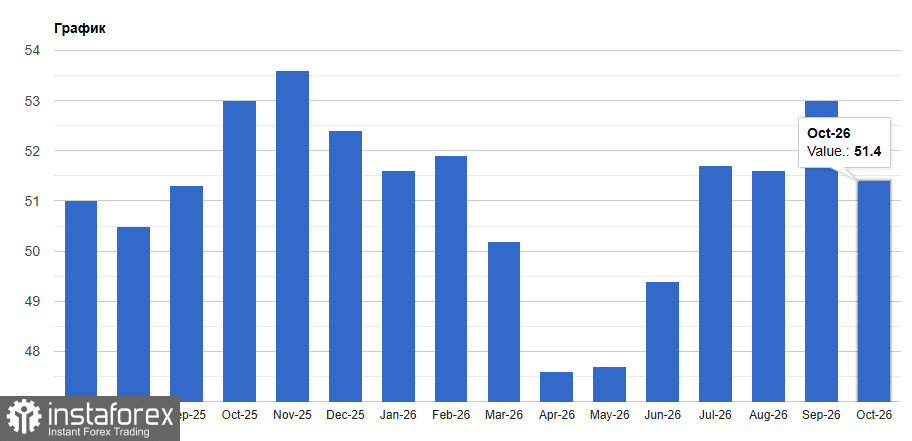
Start with the eurozone. The final composite PMI for October printed 51.7, versus the flash estimate and forecast of 51.9 and 53.1 in September. This is a four-month low and the first monthly fall since May. The services PMI fell to 51.4 versus a 51.7 forecast and 53.0 a month earlier. Expansion has continued for the fourth month running, but it is the weakest pace in that period. France looks worst: activity there contracted again, whereas Germany, Italy, Spain, and Ireland continued to expand, albeit more slowly.
The data structure is worrying. The inflow of new orders nearly stalled after three months of solid growth, services demand eased slightly, and employment fell for the first time since May. Business expectations for the year ahead dropped to a May low and remain below the long-term average. Costs are rising faster than in September because of expensive energy, and cost inflation acceleration reached a five-month high. "The data indicate the eurozone economy is growing at a respectable but not impressive 0.3% pace at the start of Q4, but there are worrying signs of losing momentum," said Chris Williamson, chief business economist at S&P Global Market Intelligence. He cited three pressure factors: inflation, geopolitical uncertainty, and higher borrowing costs.
Inflation in the eurozone accelerated. The consumer price index for October came in at 4.0% versus 3.8% in September, matching forecasts. The rate remains roughly twice the ECB's target, and the rise from 3.2% in August to 3.8% in September was already the strongest since September 2023. That is why the market prices a final deposit rate move to 2.75% in December. The problem is the economy is slowing while prices accelerate. If growth weakens further, the market may question the need for additional tightening. I believe the ECB will have enough arguments to make a move by December, but weakening orders already limit room for a more aggressive path.
In the UK, the picture looks materially stronger, although final readings were slightly softer than the flash estimate. The services PMI for October was 52.8 versus a 53.1 in the flash and 52.1 in September. This is the highest since February; expansion is in its fourth consecutive month, though the index remains below the long-term average of 54.2. New orders rose at the fastest pace since January, driven mainly by domestic demand. Export sales fell slightly, but that was the smallest decline since the downturn began in March.
Labor market news is positive: for the first time in just over two years employment in services rose, albeit modestly. Some firms continue to freeze hiring because of cost pressures, while others are not replacing departing staff due to AI deployment. Business expectations returned to a February high. Costs, however, are rising quickly: the pace of cost inflation reached a five-month high; about 38% of firms reported price rises, and only 1% reported falls, driven mainly by energy, fuel, transport, and wages. For the Bank of England this mix of resilient demand and rising costs argues for tightening.
The rate decision is tomorrow, and a hike from 3.75% to 4.00% is almost fully priced in. Thus the PMI data mostly confirm expectations rather than change them and by themselves do not give the pound a major boost.
All this suggests the euro and pound's recent gains rest not on European data but on dollar weakness and falling yields. The pound looks more resilient: it is supported by a strong services sector and an expected rate hike, while the euro is held back by slowing growth and France's weakness. While the Middle East remains calm, I allow for further gains in both currencies, but any renewed flare-up between the U.S., Iran, and Israel would quickly restore dollar demand and put the euro under the first pressure.
Technical picture for EUR/USD
Buyers should consider how to take 1.1255. Only then would a test of 1.1300 be feasible. From there a move to 1.1335 is possible, but doing so without support from major players will be difficult. On a decline I expect meaningful action from large buyers only around 1.1225. If nobody appears there, it would be prudent to wait for a fresh low at 1.1200 or to open longs from 1.1170.
Technical picture for GBP/USD
Pound buyers need to take the nearest resistance at 1.3490. Only then would a move to 1.3515 be feasible; above that, breaking higher will be difficult. The furthest target is around 1.3535. On a drop, bears will try to seize control at 1.3470. If they succeed, a range break would inflict serious damage on bulls and push GBP/USD to 1.3450 with a prospect of extending to 1.3425.


