
یہ بھی دیکھیں


 24.09.2026 10:32 AM
Bitcoin and Ethereum have made another push higher and are getting closer to a full-fledged bullish trend. We still cannot name the reasons why the new sharp rise in digital assets occurred, although, of course, it all comes down to supply and demand. Demand surged, so the price rose. However, why demand increased is hard to say even after the fact. Recall that the last two major events for the crypto world were negative. Central banks (notably the Federal Reserve) began tightening monetary policy, which raises demand for safe assets like bank deposits and government bonds. The Clarity Act, a bill intended to regulate digital asset investing in the US, again failed to pass through Congress. By logic, the crypto market should have fallen rather than show a new explosive rally. However, as we warned earlier, pumps don't need reasons, and there is no logic to them.
Meanwhile, independent experts note that the last two upward legs for Ethereum and Bitcoin were largely driven by leveraged futures positions. In simple terms, market participants are opening long positions on margin. Such positions are dangerous because they carry a high risk of forced liquidation if the price moves in the opposite direction. Spot trades differ from futures in that you buy the actual asset and have no leverage. So even if you bought Bitcoin at $90,000 and the price fell to $50,000, that would not trigger a margin call for a spot holder. With futures positions, a margin call can arrive very quickly. What happens then? A huge number of leveraged positions would be forcibly closed, which would automatically reduce demand and trigger even larger price declines. That is why the stability and sustainability of any trend is determined by the volume of spot transactions.
Spot demand for Bitcoin and Ethereum remains low, however. Experts note that further growth is possible only if spot interest keeps pace with futures demand and supports it. We have already said that Bitcoin's rise from August 16 to the present looks very much like a pump or manipulation. If most positions on the market are opened on leverage, it is a paradise for big players, since even a small price drop can trigger a wave of forced liquidations. As we have noted before, Bitcoin cannot be considered fully decentralized — its price can be influenced by large funds and players.
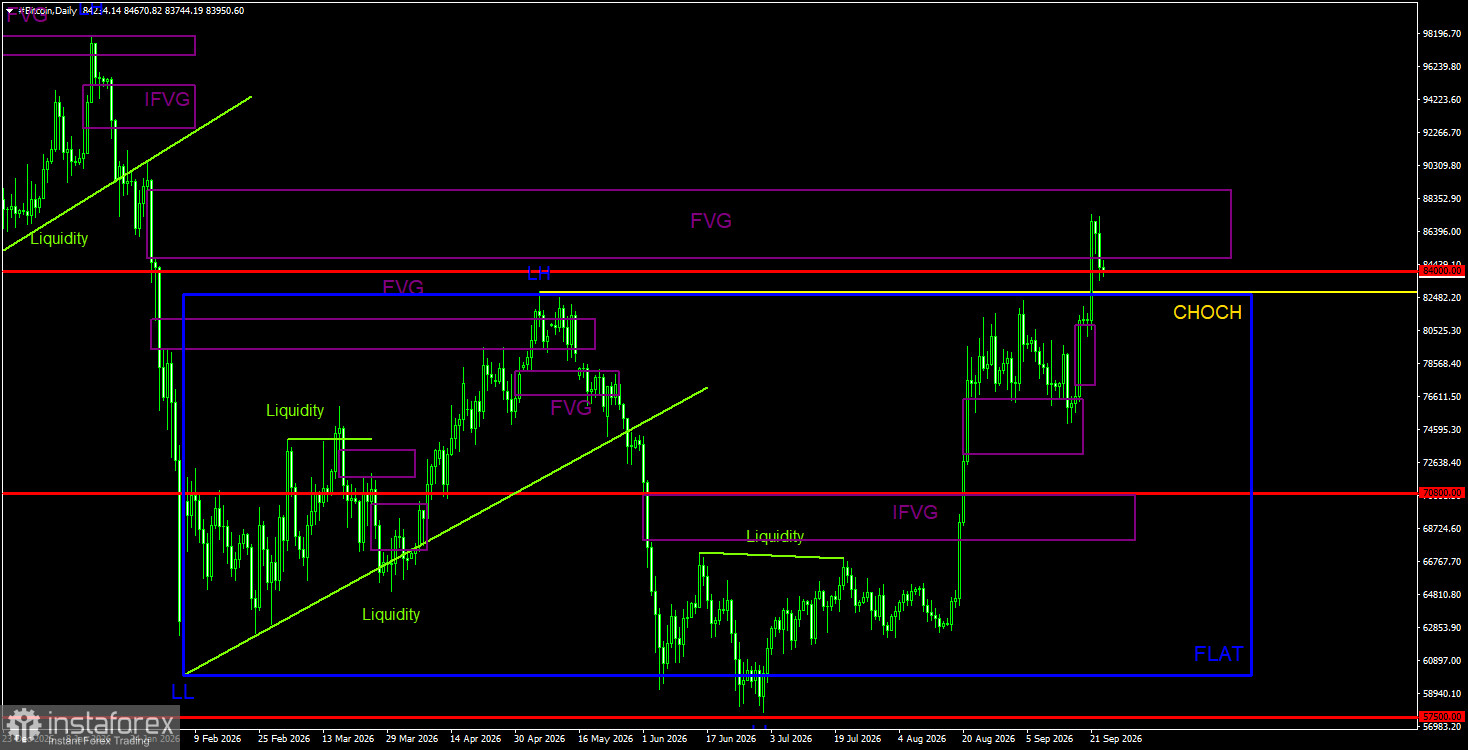
Bitcoin shows all the signs of the start of a new bull trend. This trend begins, as usual, with a pump that has no concrete or clear reasons. The Federal Reserve has not started cutting interest rates, and the Clarity Act was not passed. In the near term on the daily timeframe, Bitcoin may be in decline, as the price has reacted to a bearish FVG. We also note for traders that the current breakout beyond the daily consolidation channel may be a deviation — yes, a deep deviation, but still a deviation. If so, Bitcoin can still fall back to $57,500. On the 4-hour timeframe, long positions can be considered locally from the most recent bullish FVG; however, we currently favor a corrective scenario.
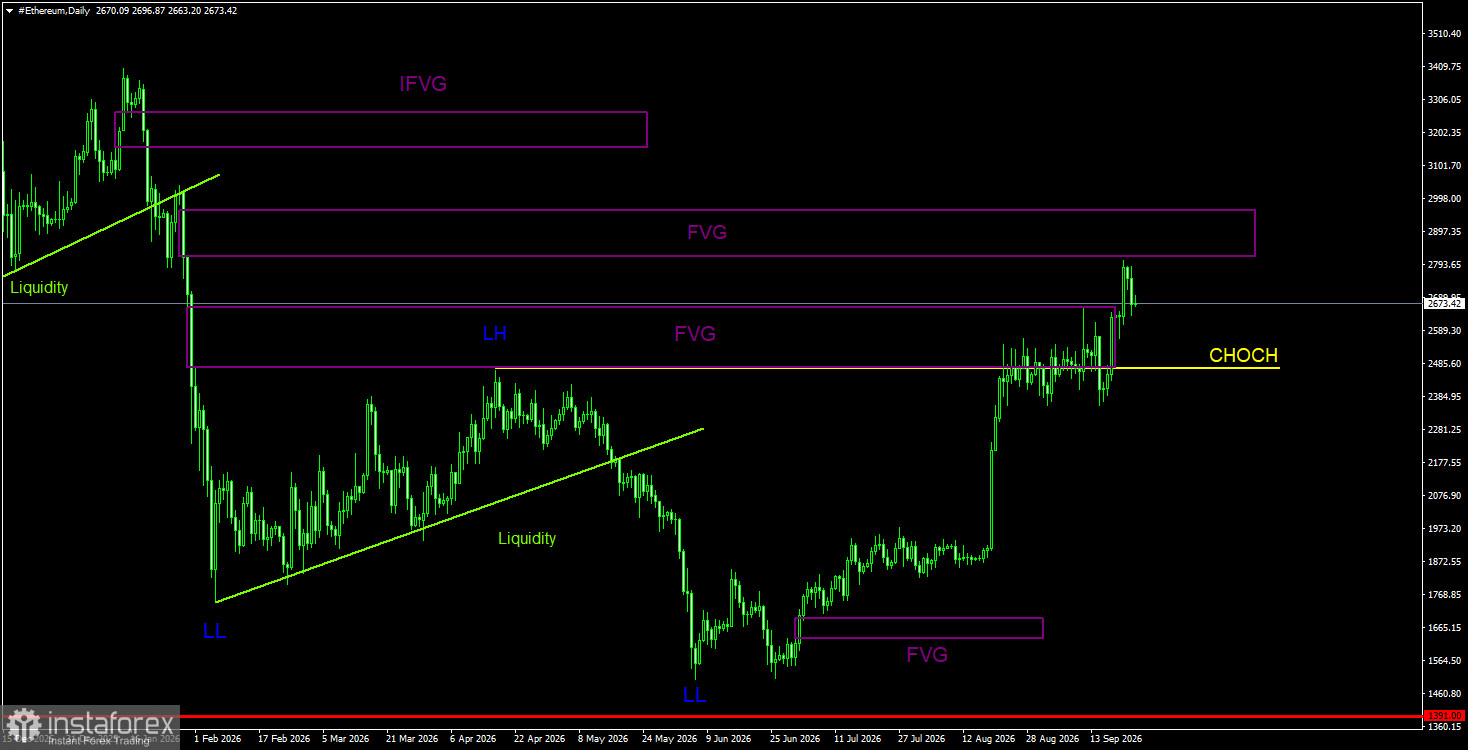
On the daily timeframe, the technical picture for Ethereum changed completely in just a few days. Ethereum is poised to embark on a new uptrend. However, traders should base decisions on the weekly chart, where Ethereum is headed toward $4,800 — the upper band of a five-year sideways channel. On the daily chart, the first bearish FVG did not produce a significant price reaction; the next FVG might. Bitcoin likewise filled the nearest bearish FVG, so both cryptocurrencies may begin a correction in the near term. The recent rise in digital assets has been driven solely by a pump. There are currently more fundamental reasons for a drop in both cryptocurrencies than for further growth.
CHOCH is a change of character / break of the trend structure. Liquidity means traders' Stop-Losses that market makers use to build their positions. FVG stands for a Fair Value Gap (area of price inefficiency). The price often moves quickly through such areas, indicating the absence of one side in the market. Later, the price tends to return and react to these zones. IFVG is an Inverted Fair Value Gap. After a return to such a zone, the price does not react but impulsively breaks through and then tests it from the other side.
OB means an Order Block. A candle on which a market maker opened a position in order to harvest liquidity and then form their own position in the opposite direction.


