
یہ بھی دیکھیں


 10.11.2026 07:32 AM
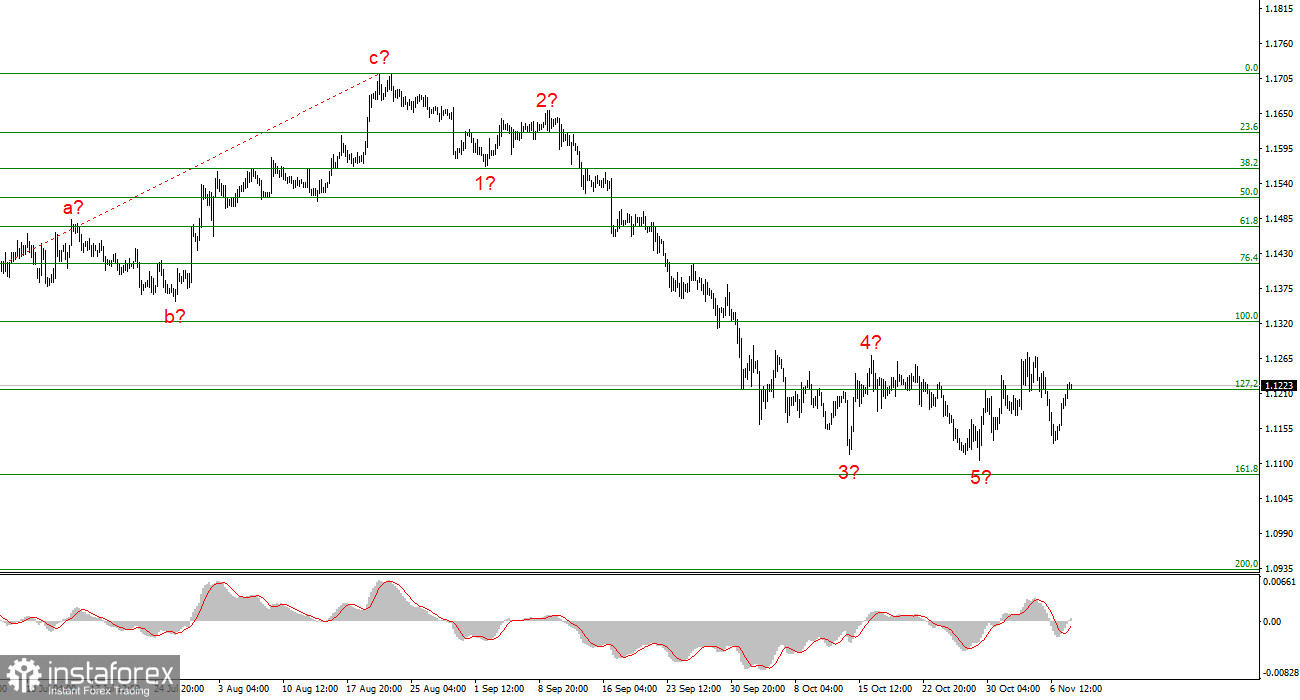
The Elliott Wave count on the 4-hour chart for EUR/USD has become more complex. On the higher timeframe (lower chart), the downward trend segment has taken the form of a five-wave structure, A-B-C-D-E, which could be completed at any time, as it appears to be fully developed. All the waves in this segment are approximately equal in size, so it is considered corrective. If this assumption is correct, once the structure is complete, an impulsive upward trend segment will begin, with targets well above the 20.00 level.
On the lower timeframe (upper chart), an impulsive wave sequence is still developing, which may belong to wave E of the higher timeframe. If this is indeed the case, then no matter how strongly the dollar rises, its strengthening is nearing an end. The expected wave 5 of E is either complete or close to completion. In any case, the current wave structure points to the completion of the downward wave sequence on both charts. News developments and a sharp shift in market sentiment have driven a strong rally in the US dollar, but there are few remaining reasons for further dollar appreciation.
EUR/USD rose by 80 basis points on Tuesday, marking a very strong start to the week for the European currency. The euro did not post such a strong gain even last week, when the EU inflation report showed an increase to 4% and Republicans suffered a decisive defeat in the congressional elections. On Monday, however, there were no major news releases, statements, or reports. The only developments worth noting were several statements from the White House and Iran concerning a possible end to the war. However, virtually all reports from the Middle East remain unconfirmed, while Donald Trump has already promised to end the war "within the next two weeks" around 20 times. Nevertheless, a burst of geopolitical optimism allowed the European currency to gain almost one cent.
Today, the US will release its October inflation report, and market participants expect inflation to accelerate again. This time, the anticipated increase in the annual rate is only 0.1–0.2%, which is unlikely to strengthen market expectations of a more hawkish Federal Reserve monetary policy. Market participants are confident that the FOMC will raise interest rates at its next meeting in December. This decision has therefore already been priced in. Consequently, only a much sharper increase in inflation in October could revive demand for the dollar.
In recent reviews, the weakness of the euro has been highlighted more than once. However, it should also be noted that the dollar has failed to attract traders' attention over the past month. The downward trend segment has paused, while the current wave count continues to signal that it may be nearing completion. The base-case scenario remains not merely the development of an upward wave or wave sequence, but the formation of a fully fledged upward trend segment on both timeframes. The market appears to have exhausted the factors and reasons supporting dollar purchases in 2026.
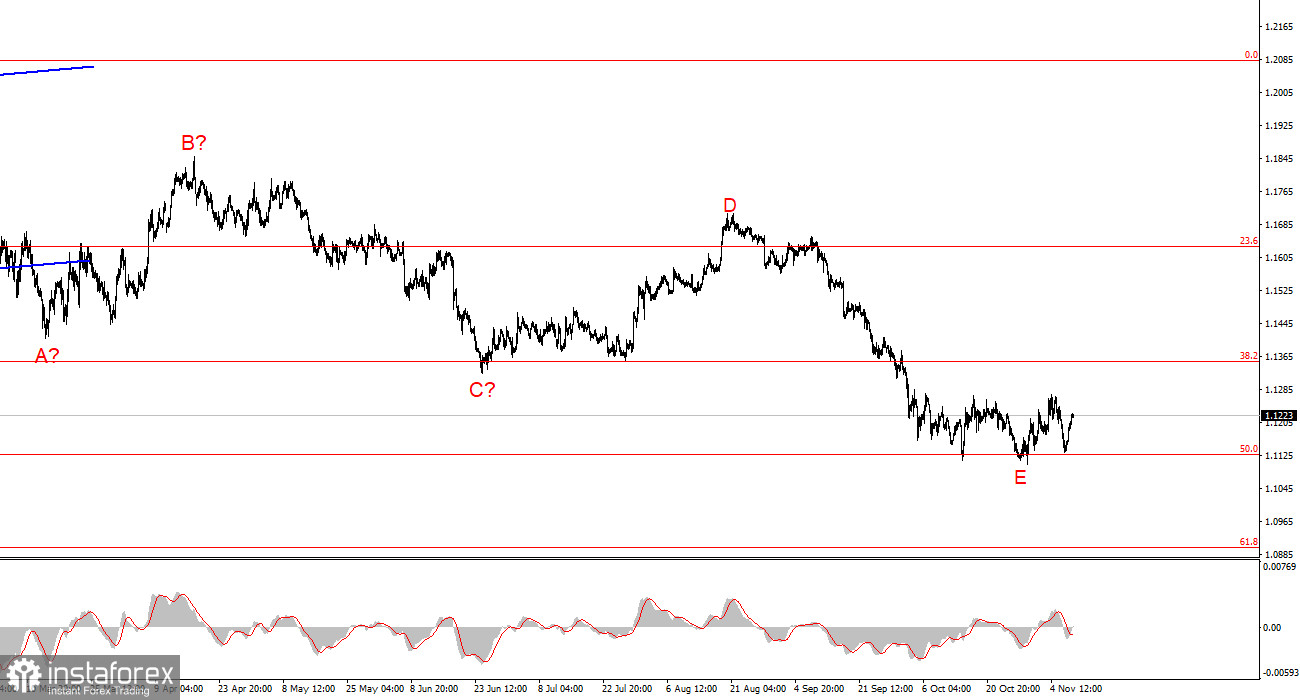
Based on the EUR/USD analysis, the pair remains within the global corrective trend segment A-B-C-D-E. However, this structure appears to be fully developed and may therefore be complete. The current market conditions seem favorable not only for buying the European currency but also for anticipating the formation of a fully fledged upward trend segment. According to the higher timeframe, the pair is expected to rise by at least to the 1.17–1.18 level. The failed attempt to break above 1.1126, which corresponds to the 50.0% Fibonacci retracement level (lower chart, higher timeframe), also indicates that the market may be ready to move higher.
The higher timeframe shows a downward trend segment that has taken the form of an A-B-C-D-E structure. The internal wave structure of wave E has developed into a five-wave impulse, but it may already be complete. If this assumption is correct, a new upward trend segment will now begin to develop.
The main principles of the analysis:
1. Wave structures should be simple and easy to understand. Complex structures are difficult to trade and often involve changes in the expected pattern.
2. If there is no confidence in what is happening in the market, it is better to stay out.
3. There can never be 100% certainty about the direction of price movement. Do not forget to use protective Stop Loss orders.
4. Elliott Wave analysis can be combined with other types of analysis and trading strategies.


