
یہ بھی دیکھیں


 10.11.2026 09:51 AM
Today's macroeconomic calendar includes a US inflation report for October, the last before the Fed meeting on December 9. The consensus expects a noticeable slowdown: headline CPI +0.3% m/m after +0.6% in September (the fastest monthly rise in five months) and core +0.2% after +0.3%. Much of the slowdown is attributed to gasoline, which rose by 9.1% in September and accounted for more than half of the month's increase in prices. Note that oil has only fallen sharply in recent days: WTI dipped to $86.19 on Monday, and Brent is below $92 today, whereas in October, Brent added about 12%, so the full effect of cheaper oil will be felt more in November's report.

Year-over-year numbers will be messier. The Bureau of Labor Statistics does not publish an official year-over-year comparison for October because last year's October data was not collected during the government shutdown, so early headlines will be based on analyst calculations. Unofficial estimates range from 3.7% to 3.9% for headline and from 2.5% to 2.8% for core versus 3.7% and 2.6% in September. Those discrepancies are inevitable and add nervousness into the data release.
The market approaches the print with hawkish expectations. On October 28, the Fed left the policy rate at 3.75–4.00% by a 10–2 vote. Lisa Cook and Beth Hammack dissented in favor of a rate hike, and on November 5, Hammack said that policy should be restrictive. The October jobs report was strong — 165k payrolls vs. a 65k forecast and 0.4% monthly average hourly earnings — and Goolsbee and Barkin spoke on Monday about persistent inflation. The odds of a 25-bp hike in December are roughly 78.8% versus about 85% in late October, and swaps still price in about two hikes by next summer, whereas a month ago, three were fully priced in. So, the December move is largely in the price already, and this release may not change that materially unless it surprises.
Crucially, the bond market is currently siding with the hawks. Treasury yields across the curve fell to September lows after the tech sell-off pushed investors toward safe havens. The 10-year yield has moved back to about 4.88%. However, another hot inflation print would likely erase some of that decline quickly — only a surprise can materially shift priced expectations.
Currency scenarios are as follows. Under a soft print — core inflation of 0.1% or headline inflation of below 0.2% — the probability of a December hike would likely drop, yields would fall, and the dollar would surrender some gains. The euro and the pound would be beneficiaries. If the print is in line with expectations (headline inflation of 0.3% and core inflation of 0.2%), the market reaction is likely to be short-lived. A hot report (core inflation of 0.3% or higher, or headline inflation of 0.4%) would reopen the debate about faster tightening. December odds would jump above 85%, and a March move would become more likely. Yields would move back toward 5%, and the dollar would regain a firmer footing.
Those dynamics would hit the euro, the pound, and the yen most directly since the Fed?ECB rate differential — roughly 1.25–1.50 percentage points — would again argue for dollar strength. The yen would weaken alongside higher US yields. Let me remind you that Japanese consumer spending fell by 6.8% in September, which limits the Bank of Japan's room to tighten, and expectations for a BOJ move on December 18 remain a key constraint. Past interventions also cap USD/JPY upside: this summer, Japan intervened three times for a total of £15.4 trillion.
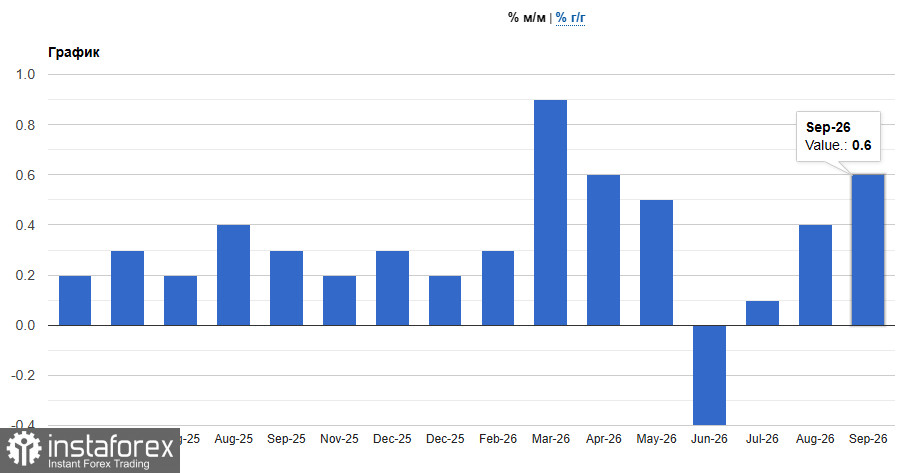
Overall, today's report is more likely to confirm than to alter the Fed's path. My base case is an in-line to slightly softer print, which would elicit a moderate, short-lived currency reaction and leave the dollar slightly softer in the near term. The risk is one-sided: if core inflation prints at 0.3%, I would not rule out a return of the euro and the pound toward Friday's lows because a December hike and further rate rises into spring would cease to be contested.
As for EUR/USD technicals, buyers need to take 1.1245. Only that would open a test of 1.1270. From there, a run to 1.1300 is possible, but achieving it without support from large players will be difficult. On a pullback, I expect increased buying activity only near 1.1215. If that level lacks bids, I would recommend waiting for a dip to a fresh low at 1.1185 or initiating long positions at 1.1165.
Regarding GBP/USD technicals, pound buyers must take the immediate resistance level of 1.3460. That would allow a move toward 1.3481, above which further gains would be challenging. The next upside target is around 1.3501. On a decline, bears will seek control of 1.3430. If they succeed, a range break would deal a serious blow to bulls and push GBP/USD down to 1.3399, with the prospect of extending weakness to 1.3370.


