
Vea también


 05.11.2026 08:49 AM
Yesterday's news: after midterm wins, House and Senate Democrats are preparing their own cryptocurrency regulatory bill to supplant the stalled CLARITY Act — a development that complicates the bill's future in the Senate.

The proposal will be based on amendments that Maxine Waters put forward in 2025 (which Congress did not adopt) and will incorporate elements Democrats already negotiated with Republicans in the Senate, so that work does not have to start from scratch. This is still at the discussion stage; no final text has been released, and the effort is aimed at the next Congress that convenes on January 3, 2027.
The provisions under discussion would shift oversight power toward the SEC and away from the CFTC. That stands in direct contrast to CLARITY, which passed the House on July 17, 2025, by 294–134 and created a softer framework centered on the CFTC. Democrats' draft would strengthen the SEC's role, a clear win for the agency and for Democrats, and it undercuts CLARITY's architects and industry players who had counted on a lighter touch. One controversial element under consideration would restrict crypto activities by Donald Trump and other federal officials.
The timing is deliberate. With Democrats taking control of both the House and Senate on November 3, they will set the agenda rather than acting from opposition. Waters, who previously criticized CLARITY as too favorable to the industry, could return as chair of the House Financial Services Committee. Galaxy Digital cut its view of CLARITY's chance of passage in 2026 from 60% to 10%, and the new congressional makeup only makes that pessimism more plausible.
Republicans have already dismissed the move as a partisan bill designed to advance a Democratic policy agenda rather than deliver a durable regulatory framework. Calculus matters: a bill that reaches the president without bipartisan supermajorities is vulnerable to a veto, and Trump has signaled willingness to use the veto pen. Overriding a veto requires two-thirds support in both chambers, a threshold that Democrats do not have. That means the clause targeting Trump looks more like a bargaining chip than a provision that will survive final passage without concessions.
I do not expect a unified market-structure law in the near term. Instead, I anticipate protracted negotiations between a SEC-centric Democratic draft and a CFTC-centric Republican version. For markets, that translates into another delayed catalyst amid cautious sentiment. Consequently, I expect Bitcoin to remain range-bound roughly between $76,000 and $82,000, while news flow continues to be dominated by ETF outflows and the Binance hack fallout rather than by regulatory clarity.
Technical analysis and recommendations
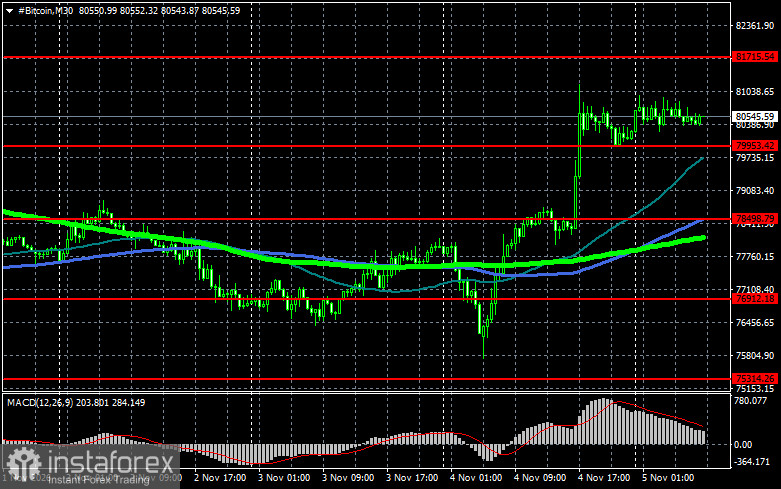
Bitcoin
Buyers are targeting a return to $81,700, which would open a path to $83,000 and then $84,500. A break above $84,500 would indicate attempts to restore the bull market. On the downside, look for buyers near $79,900. A return below that level could quickly push BTC toward $78,500, with a deeper target around $76,900.
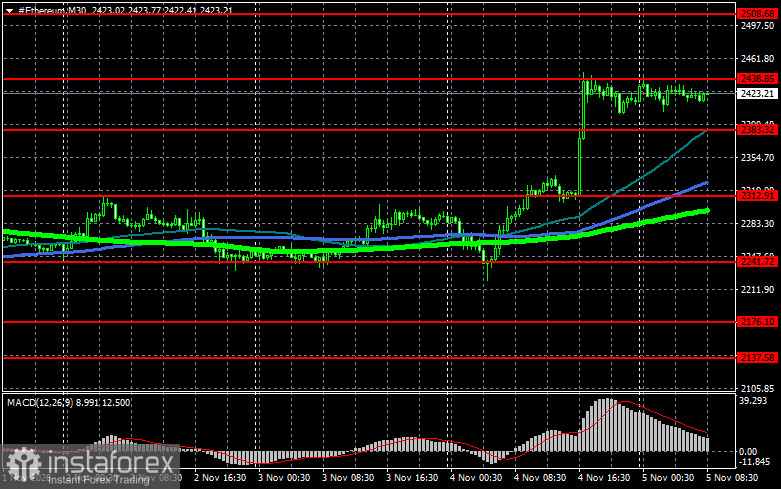
Ethereum
Consolidation above $2,438 would open a path to $2,508, with a further upside target near $2,600. Clearing that level would confirm strengthening bullish sentiment. On the downside, buyers should step in near $2,383. A break below that level could drive ETH toward $2,312, with a deeper target around $2,241.
What's on the chart:
Crosses of — or the price tests of — these moving averages typically either arrest moves or set the next market impulse.


