
See also


 03.07.2026 10:12 AM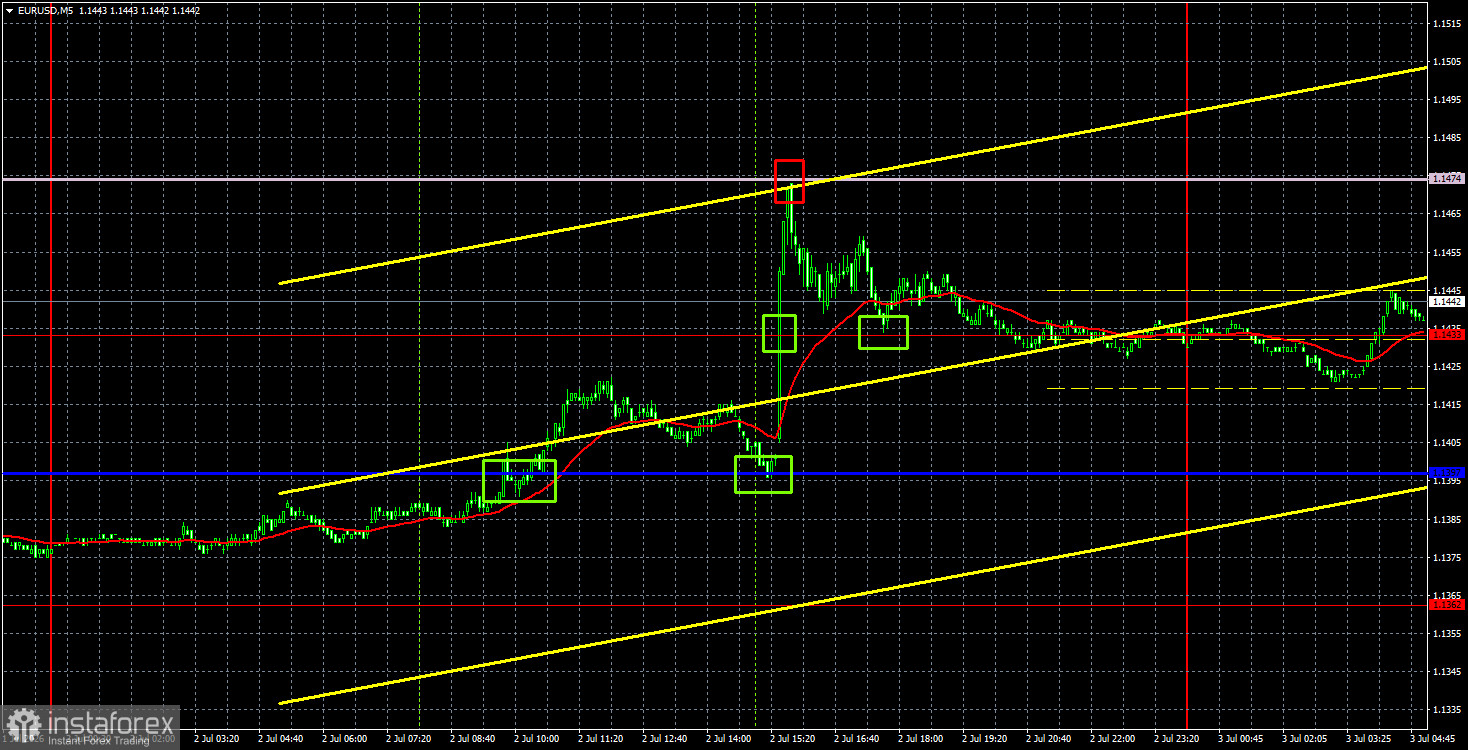
The EUR/USD currency pair posted fairly strong growth on Thursday, which, however, ended very quickly, once again confirming the corrective nature of the movement and the market's lack of strong willingness to sell the dollar. An important Nonfarm Payrolls report was released in the United States yesterday, which triggered the dollar's decline. It turned out that the number of new jobs in the nonfarm sector in June amounted to only 57,000, roughly half of the forecast. Moreover, the May and April figures were also revised downward by fairly substantial amounts. Thus, the U.S. labor market is once again raising concerns, and the dollar fell sharply across the market. However, as we have already noted, this did not last long. At the same time, the unemployment rate declined to 4.2%, but the market did not react particularly positively to this result. The upward trend remains intact, there are no reasons for the dollar to rise, and the market has already priced in all the bullish factors for the U.S. currency. Nevertheless, there is still a feeling that the decline may resume.
From a technical perspective, the upward trend continues, but after eight days of growth, the price still remains below the Senkou Span B line, which best reflects the current strength of the bulls. If the Senkou Span B line is broken, this will provide support to the euro, at least to some extent.
On the 5-minute timeframe, quite a few trading signals were formed on Thursday. First, the pair broke above the Kijun-sen line and then rebounded from it from above. Therefore, traders had two opportunities to open long positions. The movement ended with a test of the Senkou Span B line, near which a sell signal was formed. Thus, the second trade also turned out to be profitable.
The latest COT report is dated June 23. The weekly timeframe illustration clearly shows that the net position of non-commercial traders remains bullish but has declined significantly due to geopolitical events. In recent months, traders have been reducing their holdings of the European currency in favor of the U.S. dollar. Donald Trump's policy has not changed, but for some time the dollar acted as a reserve currency. However, this process may already be over.
We still do not see any fundamental factors supporting the strengthening of the European currency, while there remain plenty of factors favoring a decline in the U.S. dollar. The war in the Middle East temporarily made the dollar extremely attractive, but once this factor loses its effect, everything should return to normal. That may have already happened. In the long term, the euro could fall even to the 1.08 level (the trend line), while the upward trend would still remain relevant. Moreover, in recent months the pair has not moved particularly close to this line.
The position of the red and blue indicator lines points to parity between bulls and bears. During the latest reporting week, the number of long positions held by the Non-commercial group increased by 19,300, while the number of short positions increased by 23,500. As a result, the net position declined by 4,200 over the week.
On the hourly timeframe, a corrective upward trend continues to form within the broader two-month downward trend. The situation in the Middle East remains tense, but we do not believe that further strikes involving Iran and the United States, or uncertainty surrounding negotiations and the prospects of a deal, are sufficient reasons for continued dollar strengthening. The Federal Reserve supported the U.S. currency two weeks ago, yet the market continues to ignore all factors in favor of the euro.
For July 3, we highlight the following trading levels: 1.1234, 1.1274, 1.1362, 1.1433, 1.1536-1.1542, 1.1585, 1.1657-1.1666, 1.1750-1.1760, 1.1786, 1.1830-1.1837, as well as the Senkou Span B line (1.1474) and the Kijun-sen line (1.1417). The Ichimoku indicator lines may shift during the day, which should be taken into account when determining trading signals. Do not forget to move the Stop Loss order to breakeven if the price moves 15 points in the right direction. This will help protect against possible losses if the signal turns out to be false.
On Friday, another speech by ECB President Christine Lagarde will take place in the European Union, while the United States is celebrating Independence Day today. Therefore, volatility may be low, and market movements may be weak and non-trending.
Today, traders may consider short positions targeting 1.1433 and the Kijun-sen line if the price rebounds from the Senkou Span B line for the second time. Long positions may be opened on a rebound from the critical line or after consolidation above the Senkou Span B line.


