
यह भी देखें


 09.11.2026 10:05 AM
Asian markets bounced back today after the largest sell-off in 18 months, producing the strongest one-day gain in three months. The MSCI Asia Pacific index rose by 1.9% after a 3.9% drop on Friday. Taiwan's Taiex jumped by 4.9%, at one point up as much as 6.7%. The Nikkei 225 gained 2.3%. S&P 500 futures added 0.4%, and Nasdaq 100 futures were up 0.1%.
The primary catalyst was action by Taiwanese authorities: the regulator and finance ministry imposed short-selling restrictions from Monday and signaled readiness to deploy a market stabilization fund of TWD 500 billion (roughly $15.2 billion). Support also came from Friday's rebound on Wall Street, when buyers stepped in on weakness, and many analysts expect Democrats to temper the tough rhetoric on AI and data centers that featured in the campaign.
Recall how quickly the market narrative shifted over the week. On Wednesday, November 4, five US tech giants collectively added nearly $1 trillion in market value on bets that regulation would limit spending rather than profits. By Thursday, that thesis reversed: the Nasdaq 100 lost $2.3 trillion in a single day, the S&P 500 recorded its worst week since April 2025, Japanese and Taiwanese markets moved into bear territory, and Samsung and SK Hynix fell by more than 16%. At the same time, capital flowed into China and India, where stocks drew renewed demand amid rotation.
New nervousness came from Nvidia. The board opened an independent investigation after reports that US intelligence agencies suspect a company employee was recruited by Chinese intelligence. CEO Jensen Huang acknowledged a relationship with the employee and said he is fully cooperating. Nasdaq 100 futures lost as much as 1% early in the Asian session but later recovered. The market appears to have treated the news as tangential to the semiconductor sector's long-term trajectory.
Bonds and the dollar moved independently of equities today, as is typical when demand for safe havens eases. Ten-year Treasury yields rose one basis point to 4.87% after a two-point increase on Friday, the second consecutive day of rising yields, although on November 5, the yield dipped to 4.84%, the low since September 10, and on October 28, it was at 5.02%. Note that after Friday's US jobs report, the dollar was at recent highs, so today's pullback looks like a partial pullback rather than a new downtrend.
Oil continued to slide: Brent fell by 1.3% to $97.01/bbl. For context, the close on November 2 was $104.77, and Friday morning was about $99.93. Traders are weighing diplomatic efforts to resolve US–Iran tensions against fresh attacks in the region. Axios reports that the White House has discussed three options: new strikes, continued economic pressure, or a deal involving significant concessions to Tehran.
The main near-term event is ahead: US inflation data due Tuesday. The prior print showed headline CPI at 3.7% y/y and core at 2.6%. Today, Fed officials Goolsbee, Barkin, and Bailey will also speak, but in the absence of key data, the market will likely focus on oil, yields, and AI headlines.
Taken together, the Asian rebound looks so far like a technical response to authorities' measures and to sellers being sidelined, rather than an end to risk-off. I lean toward Asian indices keeping some of the gains in the coming sessions, but volatility should remain elevated until it becomes clearer how far Democrats will go with AI regulation.
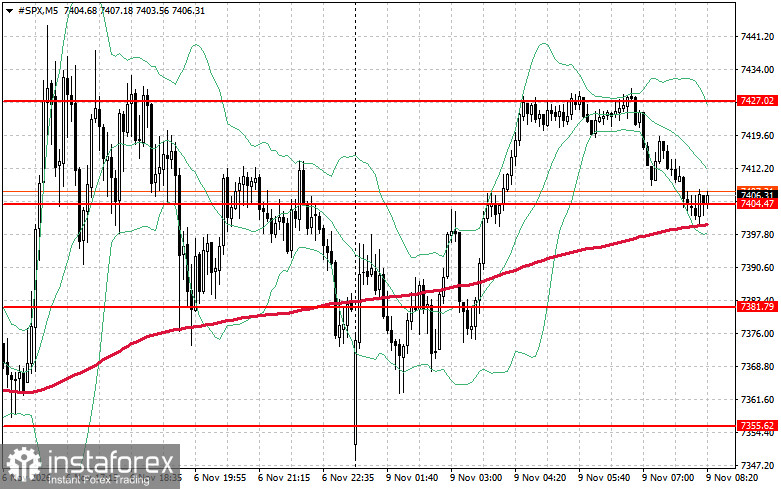
As for the S&P 500 technicals, today's main task for buyers is to overcome the immediate resistance level of $7,427. That would confirm upside momentum and open the way toward the next level at $7,451. Equally important for bulls will be maintaining control above $7,474 to reinforce buying positions. On any pullback amid reduced risk appetite, buyers must defend around $7,404. A break below that level would quickly push the instrument back to $7,381 and open the path to $7,355.

