
یہ بھی دیکھیں


 05.11.2026 09:47 AM
Yesterday, Bitcoin rose 3.5% to $80,500, fully recouping losses from the Binance hack, while Ethereum gained nearly 6% to $2,433. Solana and XRP were more modest, up about 2.5%. The trigger was the US election outcome: Democrats won control of both chambers of Congress, and the market took it calmly. Traders saw the result as clarity rather than a threat to the bullish scenario.

Recent derivatives data point to a reshuffling of positions rather than fresh leverage. Crypto-futures volumes rose 27%, while open interest increased by only about 3%, and Bitcoin's OI rose more slowly than the price. Liquidations totaled roughly $469 million, meaning part of the rally was driven by forced short-covering. The losers were short sellers who bet on further post-hack declines; the winners were those who held longs.
Stocks followed the coins. Strategy and Coinbase both climbed roughly 6%, and Strategy's preferred shares (STRC) reached $100 for the first time since May.
Regarding market reaction to the Binance hack, history shows that in about half of such events, Bitcoin traded higher within the next 30 days compared with pre-hack levels. There are four factors to watch in November. Holding the $76,000–$78,000 area and securing above $80,000–82,000 would be a solid bullish signal. Falling oil and lower Treasury yields would also support risk assets. The return of ETF inflows would be another reason to consider buying crypto. I believe the last point is decisive: until ETFs resume steady inflows, the rebound relies on short covering and tends to fade quickly. If inflows resume, Bitcoin can hold above $80,000 and move toward $81,800; without them, I expect a return to the $78,000–$79,000 range.
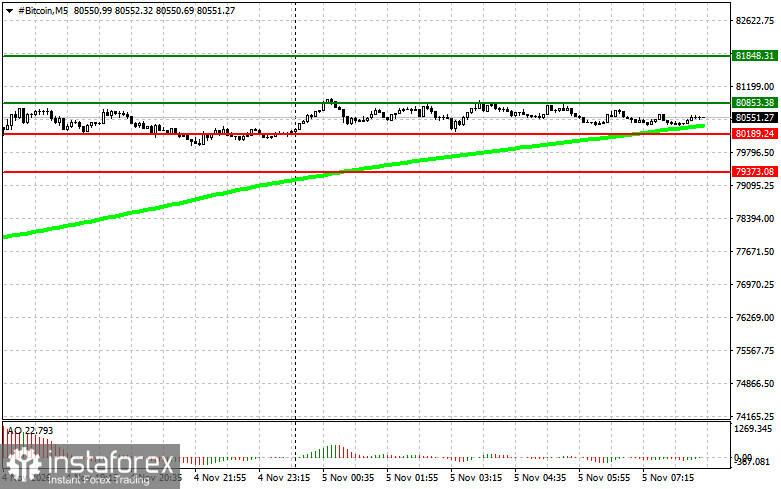
Bitcoin
The market is trading in a narrow range between $80,200 and $80,800, and the plan covers two mirror scenarios with full breakout and rejection setups. A buy is considered on a break above 80,800, provided price stays above the 50-day moving average and the Awesome Oscillator is above zero; the target is $81,800, where profits should be taken and a short on the pullback considered. If a drop below $80,200 proves false and price returns, buy from that level, targeting first $80,800 and then $81,800.
Sell scenarios are symmetrical. A confirmed break below $80,200, with the MA above price and Awesome below zero, opens a short targeting $79,300. If an upside break above $80,800 fails, a short on the rejection targets a return to $80,200 and then lower to $79,300.
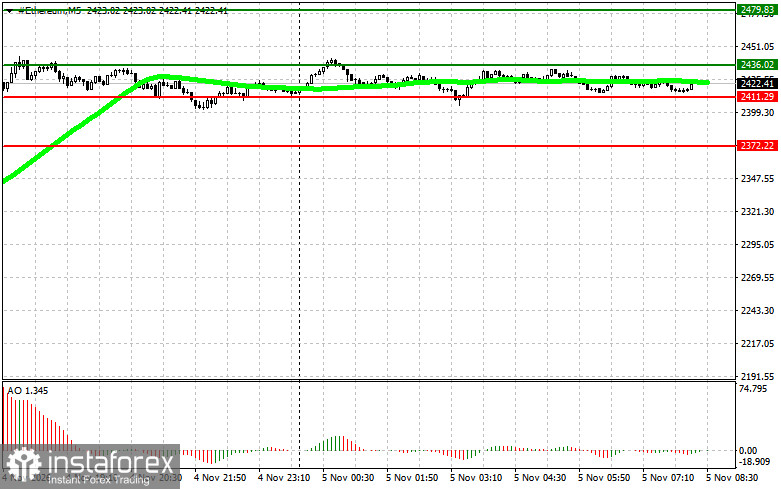
Ethereum
The logic mirrors Bitcoin on its own price scale: the range is set by $2,411 and $2,436, with additional reference points at $2,372 (support) and $2,479 (resistance). Buy on a break above $2,436 while price is above the 50-day MA and Awesome > 0, targeting $2,479 where profit is taken; or buy if a downside false break below $2,411 occurs and price returns first to $2,436 and then to $2,479.
Sell on a confirmed break below $2,411 when the MA is above price and Awesome < 0, targeting $2,372; or go short on a failed attempt to break $2,436 with a return first to $2,411 and then to $2,372.
Both indicators serve as filters to weed out false moves rather than standalone entry signals, and trades are opened only after the price confirms the specified levels.


