
یہ بھی دیکھیں


 09.11.2026 09:06 AM
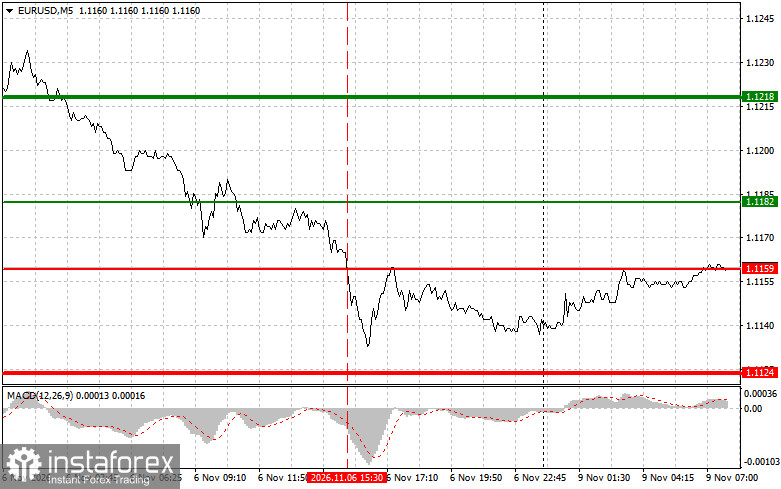
The test of the 1.1159 level occurred when the MACD indicator had already moved significantly below the zero line, limiting the pair's downward potential. For this reason, no short position was opened on the euro.
The new week begins with the market still reacting to the US economic report. The US labor market performed better than expected across all key indicators in October. Employment increased by 165,000, compared with a forecast of 65,000, the unemployment rate fell to 4.1%, and hourly wages rose by 0.4% month over month, exceeding the forecast of 0.3%. The euro weakened in response, as these figures leave the Federal Reserve with little reason to pause its tightening cycle and reinforce expectations of another rate hike in December. Against this backdrop, European retail sales, which fell by 0.7% in September compared with the forecast of a 0.1% decline, look particularly weak.
During the first half of today's session, attention will shift to regional economic data. The Sentix Investor Confidence Index for November is forecast to fall to 1.8 from 2.7, indicating that sentiment is likely to deteriorate further amid weak economic activity, although the eurozone composite PMI has already declined from 53.1 to 51.7. Germany's September trade balance is expected to show a surplus of €18.1 billion, compared with €19.5 billion previously. A further reduction in the surplus would only add to concerns about the strength of German exports. Meanwhile, EU finance ministers and the Eurogroup will hold meetings to discuss the candidates for the position of ECB President. As long as strong US economic data continue to emerge while economic weakness persists in Europe, the euro is likely to remain under pressure.
As for the intraday trading strategy, the focus will be primarily on implementing Scenarios #1 and #2.
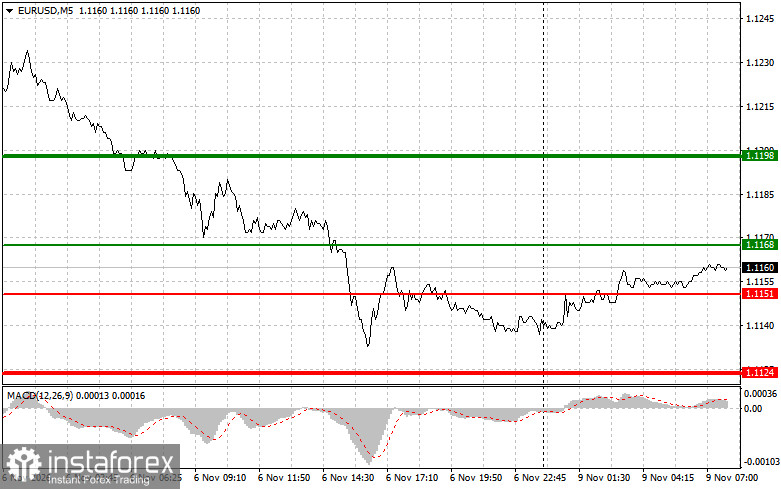
Scenario #1: The euro can be bought today if the price reaches the 1.1168 level (the green line on the chart), with a target of 1.1198. At 1.1198, the position will be closed, and a short position will also be opened in anticipation of a 30–35-point move from the entry point in the opposite direction. A rise in the euro today will only be possible if economic data come in stronger than expected. Important! Before buying, make sure that the MACD indicator is above the zero line and has only just started rising from it.
Scenario #2: The euro can also be bought today if the price tests the 1.1151 level twice consecutively while the MACD indicator is in oversold territory. This would limit the pair's downward potential and trigger an upward market reversal. A rise toward the opposite levels of 1.1168 and 1.1198 can then be expected.
Scenario #1: The euro can be sold after the price reaches the 1.1151 level (the red line on the chart). The target will be 1.1124, where the short position will be closed and a long position opened immediately in the opposite direction, targeting a 20–25-point move upward from that level. Renewed pressure on the pair is likely if economic data come in weaker than expected. Important! Before selling, make sure that the MACD indicator is below the zero line and has only just started declining from it.
Scenario #2: The euro can also be sold today if the price tests the 1.1168 level twice consecutively while the MACD indicator is in overbought territory. This would limit the pair's upward potential and trigger a downward market reversal. A decline toward the opposite levels of 1.1151 and 1.1124 can then be expected.
Important. Beginner Forex traders should be extremely cautious when making trading decisions. Before the release of major fundamental reports, it is generally best to stay out of the market to avoid exposure to sharp exchange rate fluctuations. If trading during news releases, always use stop-loss orders to minimize potential losses. Without stop-loss orders, the entire trading account can be depleted very quickly, especially when money management rules are not followed and large position sizes are used.
It is also important to remember that successful trading requires a clear trading plan, such as the one outlined above. Making spontaneous trading decisions based on current market conditions is fundamentally a losing strategy for an intraday trader.


