
Vea también


 21.08.2026 09:52 AM
At the end of the week, Brent is trading above $93 per barrel, heading for an increase of around 6 percent, while WTI for October delivery is holding at about $86 after five consecutive sessions of growth. Since the beginning of the year, oil has risen more than 50 percent as the U.S.-Iran conflict has plunged the Middle East into chaos, with both sides continuing their struggle for the Strait of Hormuz.
The current rally is driven by Washington's preparations for a campaign of economic isolation against Iran. Treasury Secretary Scott Bessent stated that the administration will present the details of the initiative on Monday after President Trump called this step "economic D-Day." The measures will be aimed at Tehran and could affect countries doing business with it, potentially including China.
The Chinese factor remains the main vulnerability of the entire endeavor. Beijing, being the largest importer of Iranian oil, stated that sanctions and pressure would not work and called for a diplomatic resolution. Bessent noted in his comments that China receives a significant portion of its energy supplies from the region, adding that it would greatly benefit from joining the program.
It is clear that Beijing is counting on Trump needing only a big show of economic pressure, but will not go so far as to actually suffocate Chinese banks. However, the prospect of adding sanctions against Iran to undermine its economy carries a certain degree of risk for the U.S. itself.
It is worth noting that existing measures have proven to be quite effective. Washington has imposed a naval blockade on Iranian ports, aiming to cut off oil exports, and this cordon appears to have worked. But the most painful consequences for consumers have not manifested in the oil itself but in petroleum products. In the U.S., average retail prices for diesel fuel skyrocketed this week to nearly $5.55 per gallon, the highest since late May, while the margin from turning oil into diesel has recently surpassed $100 per barrel, reaching a historical record.
Additionally, further weakening of the U.S. dollar has provided additional support for dollar-denominated commodities. On Friday, the dollar index was heading to its lowest level since May of this year. Thus, oil is rising through three channels, including geopolitical risk, actual shortages of petroleum products, and currency factors. The publication of details regarding the American plan on Monday will show whether Washington will impose secondary sanctions against Chinese buyers, and it is from this that it will depend whether the current rally is the beginning of a new phase or another episode in a protracted standoff.
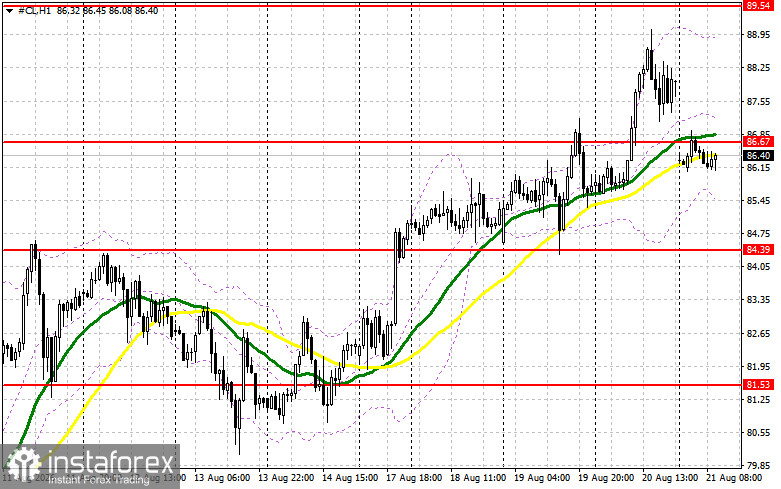
Regarding the current technical picture of oil, buyers need to overcome the nearest resistance at $86.60. This will allow them to target $89.60, above which it will be quite challenging to break through. The most distant target will be around $92.56. In the event of a decline in oil prices, bears will attempt to gain control of $84.40. If successful, a breakout from this range would deal a serious blow to bullish positions and push oil down to a low of $81.50, with a prospect of reaching $78.70.


