
यह भी देखें


 09.11.2026 07:23 AM
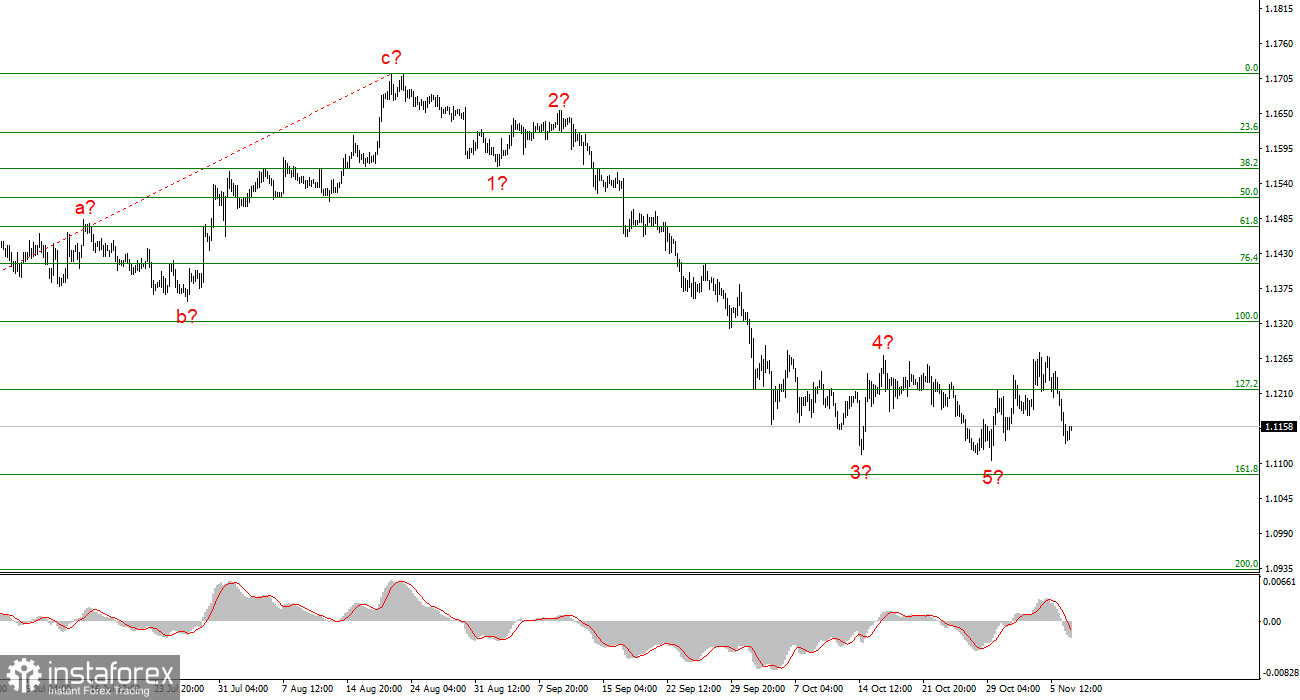
The wave count on the 4-hour EUR/USD chart has become more complex. On the higher timeframe (lower chart), the downward trend segment has taken the form of a five-wave structure, A-B-C-D-E, which may be complete at any moment, as it appears to be fully developed. All the waves in this segment are approximately equal in size, so this structure is considered corrective. If this assumption is correct, the completion of this segment will be followed by the formation of an upward impulse trend segment, with targets well above the 20th level.
On the lower timeframe (upper chart), an impulsive wave sequence is still developing and may belong to wave E of the higher timeframe. If this is indeed the case, the dollar's strengthening is nearing its end, regardless of how strongly it continues to rise. The presumed wave 5 of E is either complete or close to completion. In either case, the current wave structure suggests that the downward wave sequence is nearing completion on both charts. News developments and a sharp shift in market sentiment have driven a strong rally in the US currency, but there are relatively few new reasons for further dollar appreciation.
The EUR/USD exchange rate declined by 77 basis points on Friday, once again casting doubt on the wave count, which has indicated a potential transition to an upward wave sequence for several weeks. The US labor market and unemployment reports delivered an unpleasant surprise, so to speak. More precisely, the surprise was positive, but not for the euro, which has been unable to rebound from its lows and form a convincing corrective wave for several weeks. At present, the euro can hardly aspire to anything more. The market has become so accustomed to selling EUR/USD in recent months that it now seems unable to abandon this pattern, even when there are reasons to do so. The euro's decline has continued despite rising inflation in the eurozone, tighter ECB monetary policy, and the absence of further geopolitical escalation in the Middle East.
Interestingly, the market is paying virtually no attention to inflation in Europe. The Consumer Price Index rose to 4% in October, significantly increasing the likelihood of ECB policy tightening not only in December but also next year. However, market participants have once again ignored a factor that is positive for the euro and shifted their attention to US inflation, which is due to be released tomorrow. What is the prevailing market sentiment on Monday? Almost all traders are convinced that if US inflation accelerates again, the dollar will continue to appreciate. US inflation for October may rise to 3.9%, while core inflation may reach 2.8%. Given the dollar's appreciation on Thursday and Friday, as well as its gains over recent months, it is reasonable to assume that the market has already priced in several rounds of Fed rate hikes. However, inflation figures above forecasts could increase demand for the dollar, as the market would begin anticipating even more hawkish action from the Fed. ECB policy remains largely irrelevant to market sentiment.
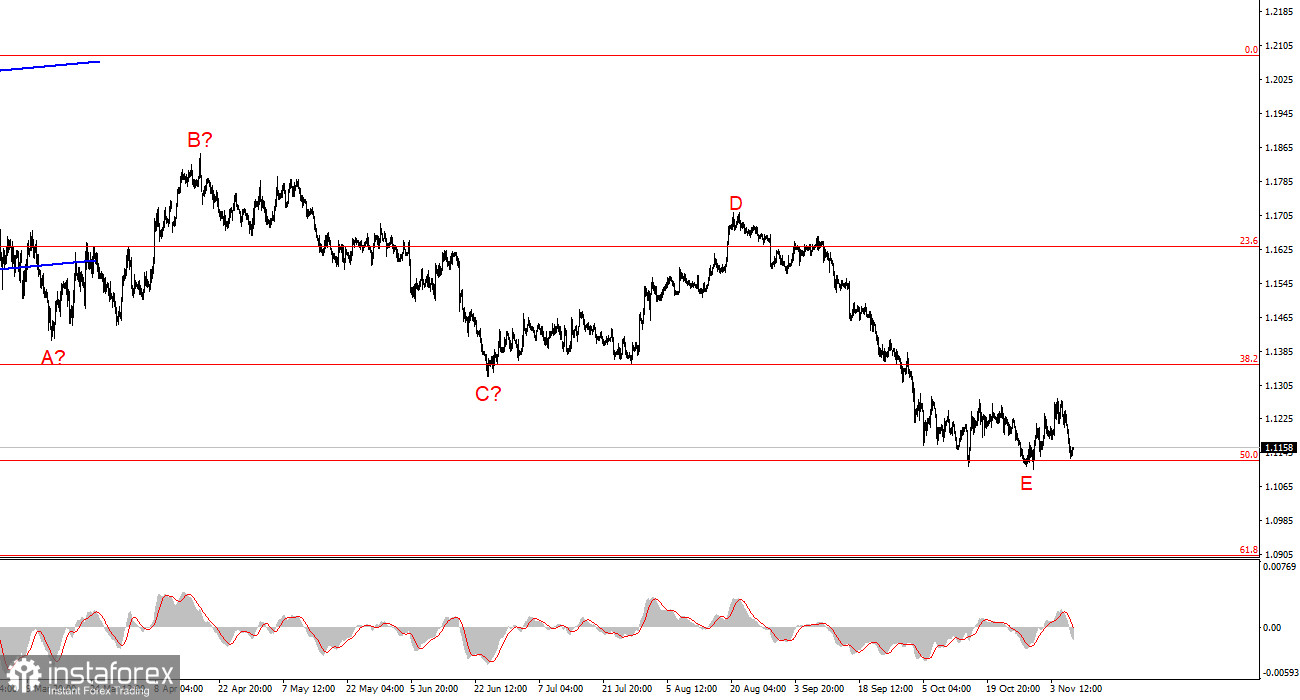
Based on the EUR/USD analysis, the pair remains within the global corrective trend segment A-B-C-D-E. However, this structure appears fully developed and may therefore be complete. The current situation appears favorable not only for buying the euro but also for anticipating the formation of a full-fledged upward trend segment. According to the higher timeframe, the exchange rate could rise to at least the 17th–18th levels. The failed attempt to break above 1.1126, corresponding to the 50.0% Fibonacci level (lower chart, higher timeframe), also indicates that the market may be preparing to move higher.
The higher timeframe shows a downward trend segment that has taken the form of an A-B-C-D-E structure. The internal wave structure of wave E has developed into a five-wave impulse, but this sequence may already be complete. If this assumption is correct, a new upward trend segment will begin to form.

