
Veja também


 09.11.2026 07:40 AM
Bitcoin and Ether continue their downward move, repeatedly fed by fresh negative headlines. Recall that recent developments for the crypto world have been broadly negative. Central banks—notably the Fed—continue to tighten monetary policy, the Clarity Act remains only a bill, Democrats won the U.S. Congressional elections, further reducing the odds that the Clarity Act becomes law, and historically Bitcoin has tended to fall after midterms (which we are seeing now). Two weeks ago the list of headwinds grew with the hack of the world's largest crypto exchange, Binance. That was followed by a stock market collapse and a rout in tech shares, which many experts link closely to Bitcoin's price. Taken together, the fundamentals for further growth in the crypto market remain, to put it mildly, doubtful. We do not deny that the asset can rally in any news environment, but at present there are no technical signals or fundamental reasons to expect a sustained rise.
A new week had hardly begun when Bitcoin plunged again. The latest drop in the leading crypto triggered roughly $1bn of liquidations. Naturally, the bulk of forced closures were long positions. What is happening now is exactly what we warned about a month ago. The most recent demand for "digital gold" was formed on the back of futures positions—that is, leveraged exposure. Such positions cannot form the foundation of a long-term trend because any price decline triggers stop losses, which provoke further falls. Stop Loss levels on leveraged trades are usually placed close to the price, so it is easy for the market to "clear them out."
Spot demand is a much more powerful basis for a trend. Spot trades mean an investor actually bought Bitcoin and placed it in their account or wallet. Of course, they may sell during a downturn, but that decision depends on the investor and their outlook. Futures positions are closed forcibly; spot positions are not. Because spot demand remains low, we still see no grounds for a bullish trend.
We recommend reading other articles by the author:
- EUR/USD review. November 9. Nonfarm payrolls send EUR another knockout
- GBP/USD review. November 9. Bank of England fails to help. Nonfarms are not to blame.
- How US elections affect USD?
- How to trade EUR/USD on November 9? Simple tips and trade breakdowns for beginners
- How to trade GBP/USD on November 9? Simple tips and trade breakdowns for beginners
- What to watch on November 9? Fundamental events explained for beginners
- Interpretation of EUR/USD analysis results on November 9
- Interpretation of GBP/USD analysis results on November 9
Trading recommendations for BTC/USD:
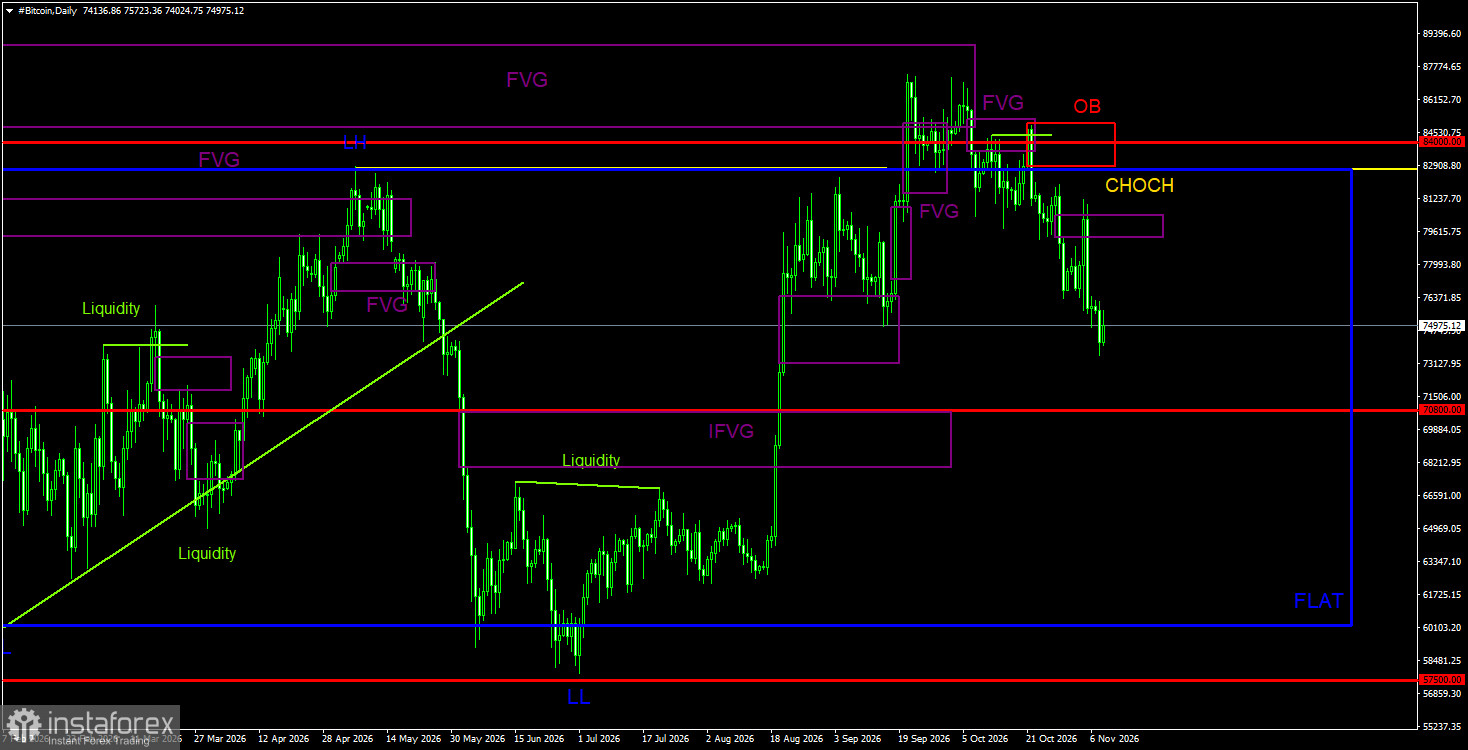
Bitcoin attempted to start a new uptrend, but the fundamental backdrop, spot demand, and recent news are too negative to count on continuation. On the daily timeframe, Bitcoin may remain in decline, as the price has already reacted to three bearish FVGs and formed a bearish order block. A move outside the daily sideways channel is interpreted as a deviation. Thus, Bitcoin generated a reversal signal and set course for $70,800. We do not consider the bearish trend finished. Short positions are more relevant than longs in the near term. Note the active bearish FVG on the daily chart, around which a sell signal was formed. On the 4-hour timeframe a new bearish FVG formed; a reaction to it would provide traders with an opportunity to open new short positions.
Trading recommendations for ETH/USD:
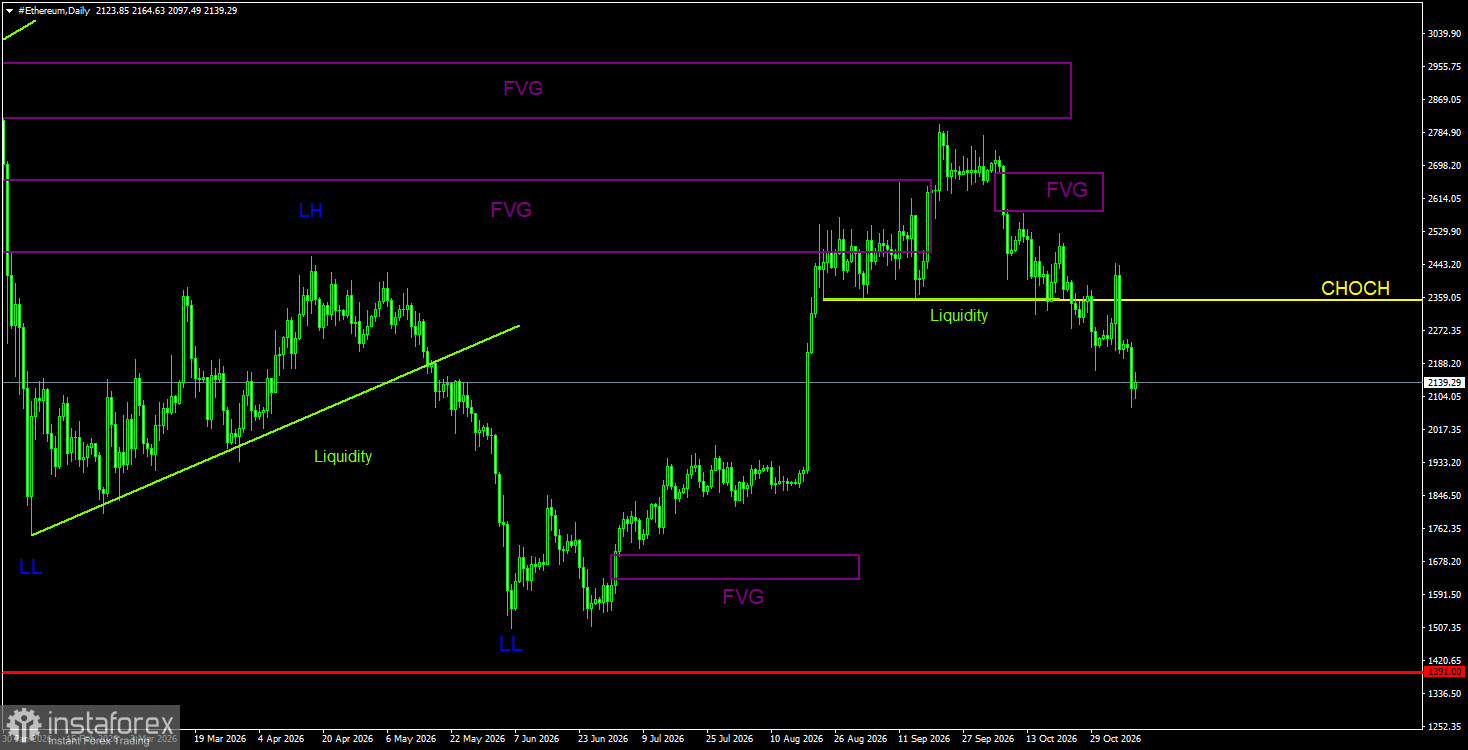
The daily technical picture for Ether has changed. Ether made a substantial upward impulse in June–September 2026 that could mark the start of a new long-term trend. However, at the same time, there is no confidence that Bitcoin's bear market has ended. If Bitcoin remains in a downtrend or even a flat, do not expect Ether to rise. Bitcoin has generated enough sell signals and bearish patterns on the daily chart to continue its decline. Therefore, we also expect Ether to fall, with targets near $1,850 and $1,391. On the 4-hour timeframe a new bearish FVG formed that coincides with a similar pattern on Bitcoin.
Explanations for illustrations:
- CHOCH—change of trend structure.
- Liquidity—liquidity, stop losses, and pending orders that market makers use to build positions.
- FVG—fair-value gap. A price inefficiency area that price traverses quickly, indicating the absence of one side of the market; subsequently, price tends to return and react to such areas in continuation of the main trend.
- IFVG — inverted fair-value gap. After returning to such an area, the price often does not react but impulsively breaks through and then tests from the other side.
- OB—order block. The candle where a market maker opened a position aiming to take liquidity to form a position in the opposite direction.


