
Vea también


 09.11.2026 07:23 AM
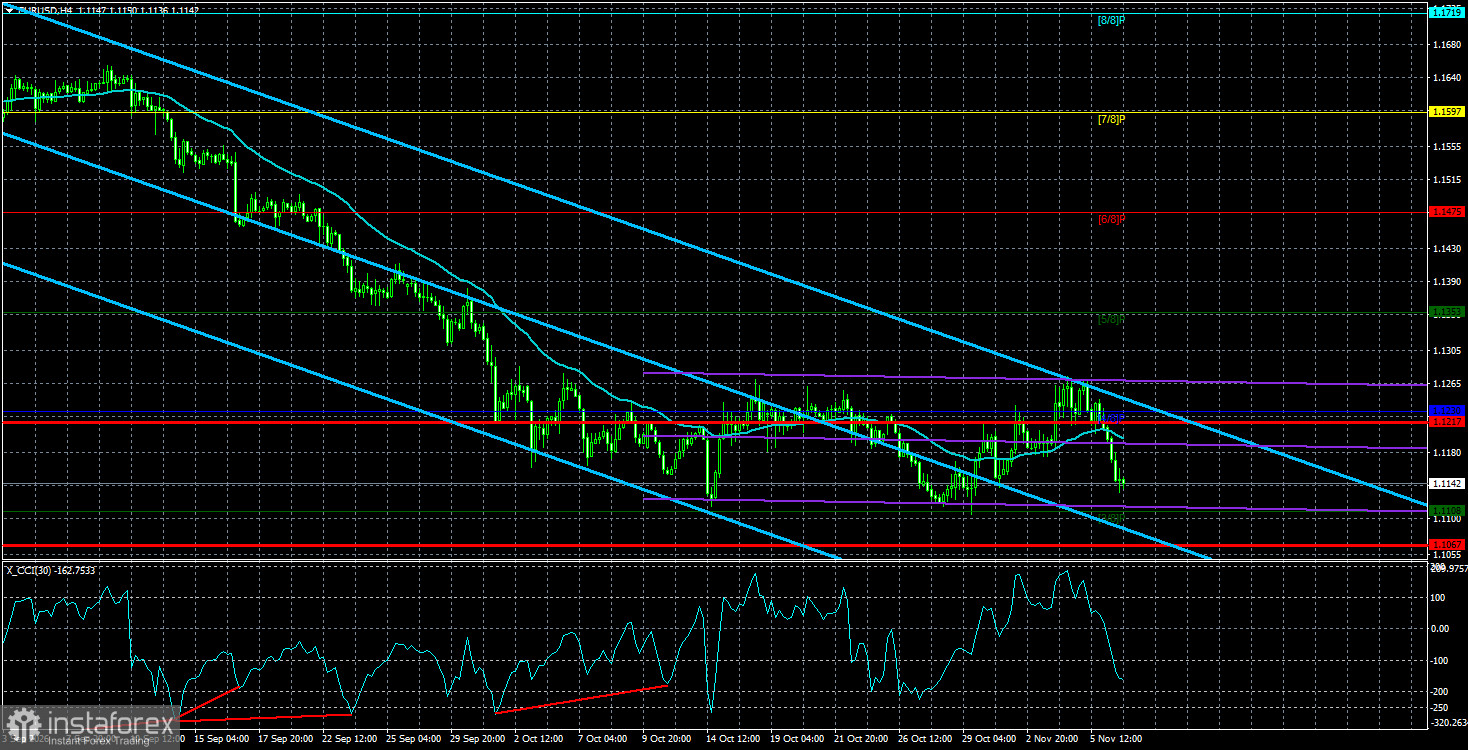
The EUR/USD currency pair fell sharply on Friday. This time, it would be difficult to argue that the decline was unjustified or unexpected. A closer examination of Friday's price movements (for example, on the 5-minute timeframe) clearly shows that the US dollar began to appreciate overnight, and this movement was not triggered specifically by the US labor market and unemployment data. To be more precise, the dollar had already started rising on Thursday, when there were no major events or economic releases in either the United States or the European Union. So, what caused this movement: a natural market reaction to Nonfarm Payrolls and the unemployment rate, or would the dollar have appreciated even without these reports?
The second explanation seems more likely. It should be remembered that the euro has either remained broadly unchanged or, at worst, declined for almost three months. Therefore, it would be difficult to argue that strong US economic data is the main reason for the dollar's strength. The European economy is not demonstrating strong growth, but its weakness has been evident for 10 years. In other words, it is no surprise to the market that the US economy is growing faster and more strongly than the European economy. Over the past month, EUR/USD had been trading within the 1.1111–1.1268 sideways channel. What happened on Thursday? The price once again rose toward the upper boundary of this channel but failed to break through it. This triggered another decline toward the lower boundary of the channel. That is why the pair's decline began on Thursday and continued overnight into Friday, before the release of the key US labor market reports.
As we can see, Nonfarm Payrolls and the unemployment rate had nothing to do with the dollar's latest appreciation. Of course, these reports give the Federal Reserve considerably more room to maneuver, allowing it to raise the key interest rate with greater confidence. However, what exactly did the labor market reports change? The Federal Reserve will tighten monetary policy in December regardless. Strong labor market data did not increase the likelihood of this outcome because it was already close to 100%. As for next year, the Fed is also expected to tighten policy at least once more, since two rate hikes will clearly not be enough to put the economy back on a disinflationary path.
Moreover, Donald Trump intends to bring the conflict between Ukraine and Russia to an end in the near future. At the same time, it remains unclear whether he plans to resume military action in the Middle East or reach an agreement with Iran. If both conflicts move toward peaceful resolutions, another increase in energy prices should not be expected. Consequently, inflation may begin to slow or at least stop accelerating. The point is that it is too early to make predictions about next year. On January 3, the newly elected US Congress will officially take office. Therefore, it is impossible to know in advance whether Democrats will be able to block a war with Iran, as they are currently promising to do. It should be remembered that the US president has extensive powers. Trump can veto any bill passed by Congress.
Near the lower boundary of the sideways channel, a rebound or a deviation followed by another upward movement within the range would be expected. If the price moves outside the sideways range, the dollar may continue its unjustified and speculative appreciation.
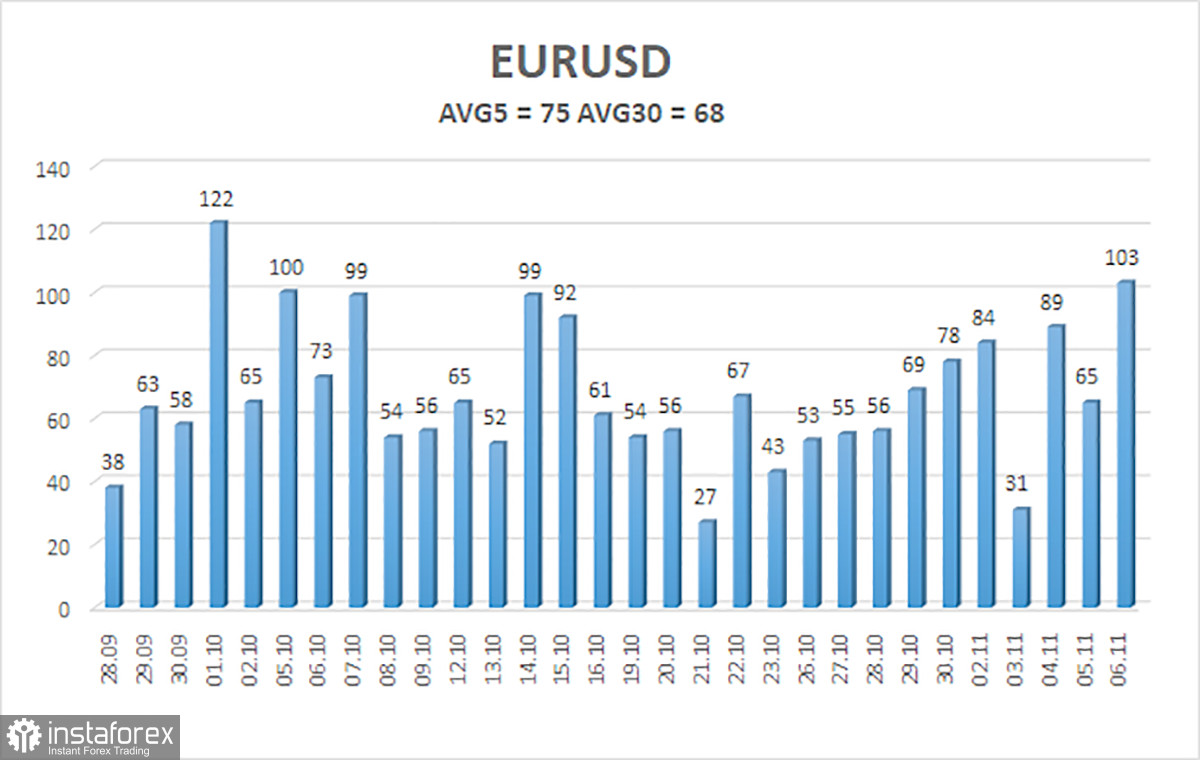
The average volatility of the EUR/USD currency pair over the last five trading days, as of November 9, stands at 75 points and is classified as "medium." The pair is expected to trade between 1.1067 and 1.1217 on Monday. The upper linear regression channel is pointing downward, indicating a downward trend. The CCI indicator has entered the oversold area five times and formed four bullish divergences, but traders have ignored all these signals. The irrational downward trend remains in place.
Nearest support levels:
S1 – 1.1108
S2 – 1.0986
S3 – 1.0864
Nearest resistance levels:
R1 – 1.1230
R2 – 1.1353
R3 – 1.1475
The EUR/USD pair remains in a downward trend, although there are insufficient fundamental, macroeconomic, and geopolitical factors to justify its continuation. The global fundamental outlook for the US dollar remains negative. However, in 2026, geopolitical developments initially provided strong support for the US currency, followed by the Federal Reserve's hawkish stance. If the price remains below the moving average, short positions
can be considered with targets at 1.1108 and 1.1067. Above the moving average, long positions remain relevant, with targets at 1.1353 and 1.1475. However, the pair first needs to move out of the 1.1114–1.1265 sideways channel.
Explanations for the illustrations:
The linear regression channels help identify the current trend. If both channels point in the same direction, the trend is currently strong.
The moving average (settings: 20.0, smoothed) identifies the short-term trend and the direction in which trading should currently be conducted.
Murray levels are target levels for price movements and corrections.
Volatility levels (red lines) indicate the likely price channel within which the pair may trade over the next 24 hours, based on current volatility readings.
The CCI indicator: a move into the oversold area (below -250) or the overbought area (above +250) indicates that a trend reversal in the opposite direction may be approaching.


