
यह भी देखें


 10.11.2026 01:10 PM
The euro received a wave of buying today despite no notable eurozone releases. The EUR/USD pair rose above 1.1250, marking a weekly high, but couldn't hold it. Traders began taking profits, and the price has now returned to 1.1223.
The rise without data looks fragile, and all attention now shifts to the US. Today the consumer price index for October will be published. For those new to the topic, this index shows how much goods and services have become more expensive. The headline monthly figure is expected at 0.3% after 0.6% in September, and the core measure, which excludes food and energy, at 0.2% after 0.3%. Core is needed to understand whether inflation is running hot within the economy itself rather than because of fuel. Year-on-year headline inflation is expected at 3.9% versus 3.7%, and core at 2.8% versus 2.6%. September's spike was largely driven by gasoline, which rose 9.1% and contributed more than half of the monthly increase. Therefore, the forecast implies half the monthly gain, and the dollar will be helped specifically by figures above these expectations. Additionally, Federal Reserve officials Christopher Waller and Michelle Bowman will speak. Waller in early September said he was ready to support holding the rate if inflation continued to decline, while Austan Goolsbee and Tom Barkin this week signaled a possible hawkish response. Tone in the committee is changing quickly, and their words after the data can easily amplify the move.
The backdrop remains a rate gap. The Fed funds rate is 3.75–4.00%, noticeably above the European Central Bank's 2.50%. The market prices in almost an 80% chance of a hike at the December 9 meeting, while the ECB is expected to raise rates only on December 17. Added to this is large-speculator positioning. As of November 3, their net short position on the euro rose to 157,791 contracts from 143,894 a week earlier. In short, bets on a falling euro are increasing, and the number of such contracts is higher than in mid-October, when it reached a decade high of about 138,000.
In my view, part of today's rise was linked to players closing those short positions rather than genuine renewed interest in the euro. If the monthly index prints above 0.3%, core above 0.2%, and Waller and Bowman back a hawkish line, euro buyers will have almost no arguments.
Price is now at 1.1223, just five pips above the range's lower boundary. A move out of the range is called a breakout, but one touch of the level is not enough — confirmation is needed, meaning several consecutive five-minute candles must close beyond it. Otherwise, you can easily get caught by a false breakout, after which price returns.
From above 1.1247 is active. A close above opens the way to 1.1272 and then to 1.1298. Today has already shown how hard it is to follow that path. The pair rose above this level but failed to hold and fell back, so buyers need a fresh reason. That reason can only be soft US inflation, which would weaken the dollar. I believe in that scenario less than in the opposite.
Below the reference is 1.1218. A close below it leads to 1.1187 and then to 1.1164. I consider this direction primary. Price is already near the level, and the rise without data has lost strength, so high inflation and a hawkish tone from Waller and Bowman will quickly restore dollar demand. Use caution here because five pips can be covered in a couple of minutes, and reactions to the report are often sharp in both directions. It's better to wait for candles to close beyond the level and only then consider entry.
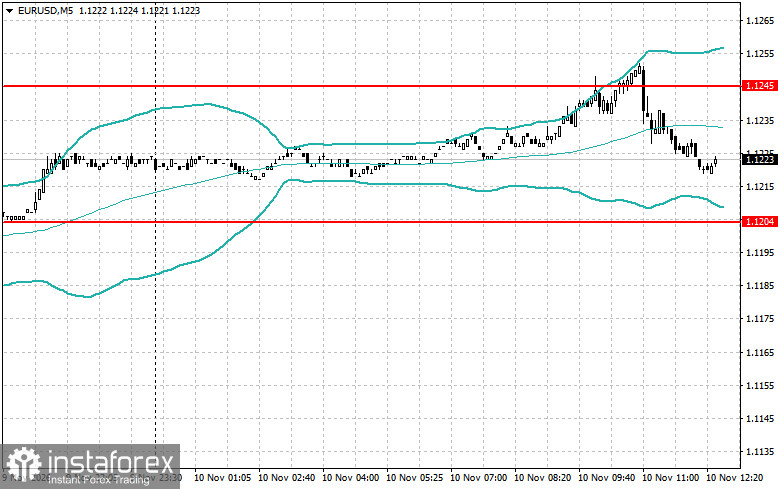
Two levels appear here: 1.1245 and 1.1204, positioned differently. The upper reference 1.1245 lies only two pips below the breakout point 1.1247, and novices need particular care here. Such proximity means one touch cannot determine the move's character. If price reaches 1.1245, pokes 1.1247, and quickly returns below, the reversion works, and I consider selling with a stop above 1.1247 with a small buffer. If it confidently closes above, that is a breakout, and selling isn't allowed there. The difference between these scenarios can take several minutes, so it's better to skip the first reaction in this zone. The morning rally to the high essentially played out this way, and if the market repeats it after the data, this level will be in focus again.
The lower reference 1.1204 sits fourteen pips below the breakout point 1.1218, so there is more room for error. The scheme is mirrored. Price first breaks 1.1218, falls to 1.1204, finds no continuation, returns above, and then I look to buy with a stop below 1.1204 with a margin. This picture is most likely if US inflation prints close to expectations and the market retraces after the initial reaction. If the price closes below 1.1204, the reversion is canceled, and the downward breakout plays, with the 1.1187 target already very close.

