
یہ بھی دیکھیں


 09.11.2026 10:09 AM
The dollar strengthened on Friday versus the euro, the pound, the yen, and a number of other currencies. EUR/USD is trading near 1.1161 early Monday, well below Thursday's morning high at 1.1270. GBP/USD is holding around 1.3378 after trading at 1.3500 on Thursday. That was broadly expected: the US equity outlook remains challenging and was reinforced by strong US economic data — above all, the labor market report.
What the October data shows: nonfarm payrolls rose by 165,000 versus a 65,000 consensus and 60,000 in September — roughly two-and-a-half times expectations — after a year-earlier drop of 140,000 in October. Revisions matter: August and September together were revised up by 84,000 jobs, lifting the three-month average to 137,000 from 79,000. The unemployment rate fell to 4.1% from 4.2%, and private payrolls added 159,000 jobs versus a 64,000 forecast. The US labor market is in very good shape. The dollar is the main beneficiary, while the euro and the pound are the losers.
Average hourly earnings jumped sharply as well, a direct boost to inflation: monthly wages rose by 0.4% versus a 0.3% forecast, and annual wages were up 3.1% versus a 2.9% estimate. Also, the University of Michigan consumer sentiment index rose to 51.0 in November versus a 48.0 forecast, while inflation expectations fell to 4.3% from 4.7%. All this points to further Fed tightening. The policy rate now stands at 3.75–4.00%. The market is pricing in nearly an 80% chance of a December hike, and traders do not rule out additional rate hikes next year, potentially into March. Recall that the October 28 decision was taken by a 10–2 vote, and Fed governor Beth Hammack, who favored a rate increase, reiterated on November 5 the need for restrictive policy, so the Fed's rhetoric has not softened. The ECB's deposit rate is 2.50%, and even an expected lift to 2.75% on December 17 would not close the gap. That policy divergence has supported recent dollar strength.
However, the picture remains mixed. The Nasdaq decline driven by AI-sector worries is still fresh in investors' minds, and today, Taiwan introduced short-selling restrictions and is prepared to deploy a stabilization fund of TWD 500 billion. Ten-year Treasury yields are 4.87%, versus a low of 4.84% on November 5 (the lowest since September 10) and 5.02% at the end of October. Why did the dollar dip this morning even though it was the strongest G10 currency after the jobs report? In my view, some participants are taking profits and waiting for US inflation data on Tuesday.
Much will depend on developments in the Middle East, which remain ambiguous. On the one hand, Democrats have promised a quick end to the war, and Senate Majority Leader Chuck Schumer said they will bring it to a close. On the other hand, they have limited influence over foreign policy compared with Donald Trump, and the new Congress does not convene until January. Trump has said he will negotiate and described new strikes as highly unlikely if talks make significant progress, but Secretary of State Marco Rubio said over the weekend that the terms Iran has put forward for a ceasefire and agreement are unacceptable. Brent has dropped by more than 16% since the middle of last week and is trading around $97 versus roughly $105 on November 2, but the equilibrium is fragile. Over the weekend, a tanker was struck by an unknown projectile leaving the Strait of Hormuz, and the Houthis damaged Aramco offices in Riyadh. What does this mean for the euro and the pound? Any escalation would reverse the oil move higher, and rising oil prices would intensify inflationary pressure and force the Fed into a tougher stance — a scenario that would favor the dollar and leave the euro and pound among the underperformers. The pound also has a domestic channel: after the Bank of England raised interest rates to 4.00% in a 9–0–0 vote, Andrew Bailey said a second hike is more likely than not if energy prices return to previous levels.
Regarding today's data, let's go straight to the economic calendar. In the first half of the day, Germany's trade balance for September is due: the consensus is €18.1 billion versus €19.5 billion in August and €21.3 billion in July, the third consecutive decline. The print is not especially eye-catching, but for an export-oriented economy, a shrinking surplus is negative. Next, Sentix investor confidence for the eurozone for November will be released. It is expected to fall to 1.8 from 2.7. In the short term, the euro could react to a disappointing print, particularly after Friday's retail sales surprise, which dropped by 0.7% month-on-month versus a -0.1% forecast. From the US calendar, we'll see wholesale inventories for September (consensus +0.6%). That series typically attracts little market attention.
Today also brings a meeting of EU finance ministers and the Eurogroup, where candidates to succeed Christine Lagarde as ECB president (she leaves on February 7) are being discussed. The nomination window closed on November 6: the Netherlands nominated Klaas Knot, and Spain put forward Pablo Hernandez de Cos. The main debate is scheduled for November 26–27, and today's talks are preliminary, but they can still move the euro intraday. Knot is viewed as a hawk, and on November 4, he said the ECB would have to respond to new inflation shocks with a fairly hawkish policy, while Hernandez de Cos is perceived as relatively more dovish. Signals favoring Knot would likely support the euro, while signals favoring his rival would weigh on it.
More market attention will fall on speeches by Fed governors Austan Goolsbee and Thomas Barkin and BOE governor Andrew Bailey. Bailey already spoke last week after the rate hike — his stance is clear, and I don't expect anything new. Goolsbee and Barkin are worth listening to: on November 5, Barkin confirmed support for a gradual pace of hikes but did not indicate how high rates might go, and their comments on the labor market could strengthen the dollar as early as the afternoon. I lean toward continued downside pressure on EUR/USD and GBP/USD ahead of the US inflation release, though the prior CPI reading of 3.7% y/y (core 2.6%) leaves room for surprises in either direction. Absent further escalation in the Middle East, I expect the dollar to keep the upper hand.
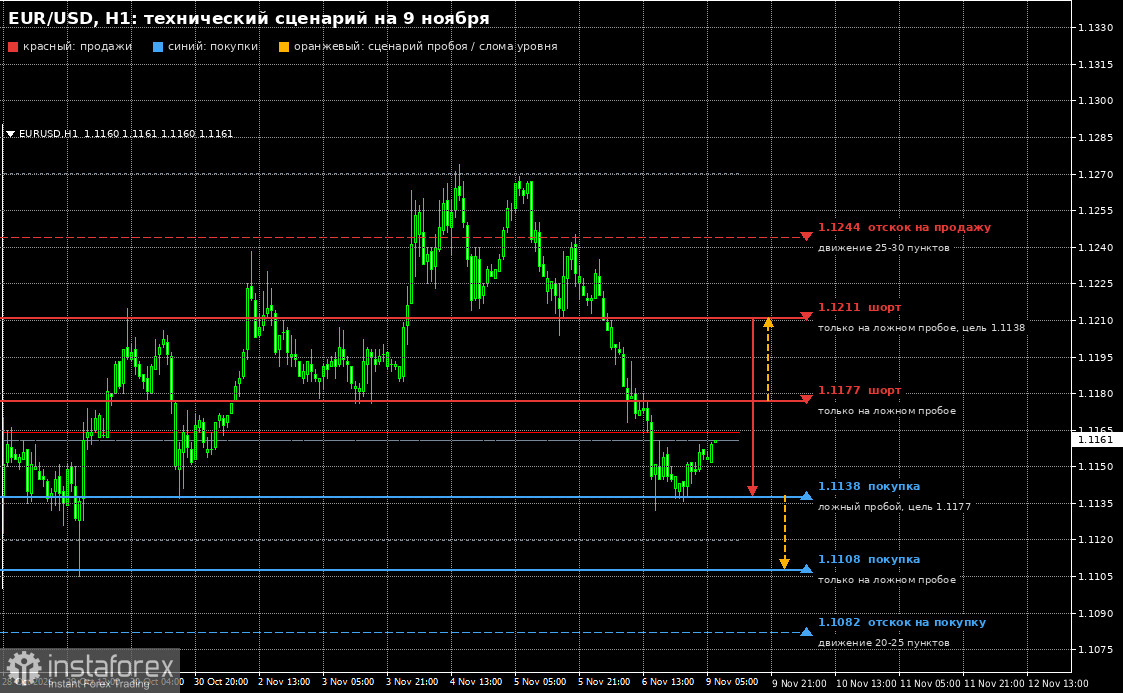
As for EUR/USD technicals on the 1-hour chart, for buyers, there is a support level at 1.1138. A false break there would create a reason for a move up to 1.1177. A break and consolidation above that area, followed by a successful retest from above, would justify adding long positions targeting 1.1211, with a further target at 1.1244. At that level, I would consider selling on a rebound, aiming for a 25–30 pip move. Short entries at 1.1177 or 1.1211 would be prudent only after a false breakout. Bears' immediate target would be 1.1138. A break and hold below that support would drop the euro toward 1.1108 and 1.1082, where I'd look to buy on a rebound for a 20–25 pip move. Long positions at 1.1108 or 1.1138 are acceptable in the event of false breakouts.
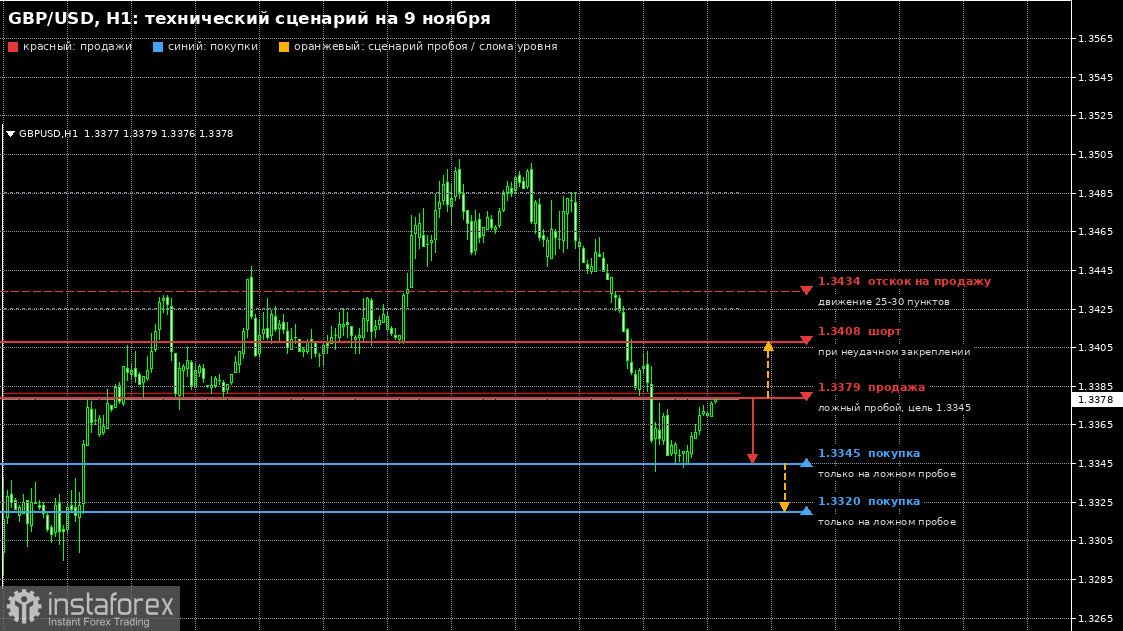
As for the GBP/USD pair, I expect the battleground to be around 1.3379. Given the lack of major UK fundamental releases, a false breakout and return below that level would be a sell signal with a potential pullback to at least 1.3345. If selling pressure at 1.3379 is weak and the move continues higher, I would look for short opportunities on a false breakout at 1.3408 or on a rebound at 1.3434, targeting a 25–30 pip move. On the downside, I'd look to go long on false breakouts at 1.3345 and 1.3320, given the current bearish market structure, and look for long entries on a rebound from 1.3218, aiming for 15–20 pips.


